Remembering Tanglewood

I’d heard that our little public golf course in western Forsyth County had once hosted a major tournament, but until reading Ed Hardin’s column I didn’t know anything about the 1974 PGA. It’s an interesting read:

Tanglewood comes to life at this time of year, a reminder of golf’s fleeting seasons and cyclical nature. The 1974 PGA Championship played here 40 years ago this week was one of the best tournaments in golf history.

And almost no one knows it.

That’s probably in part because it was a PGA, the least of the four majors in stature and style, a tournament seemingly locked in the ’70s with a great little storyline that gets lost in the strangest of ways…

Yet somehow, the 1974 PGA produced a classic finish. It’s doubtful that you have any idea how good a tournament it was. Almost no one does.

Lee Trevino won by one shot over Jack Nicklaus. Sam Snead, at age 62, finished third. Let that sink in for a second.

Trevino, using a putter found in the attic of a home he was renting that week, held off Nicklaus, who had hired a local heating and air conditioning salesman to be his caddie. Snead, 10 years after becoming the oldest player to win a tour event at the 1965 Greater Greensboro Open at Sedgefield, shot a 68 on Sunday to finish in a four-way tie for third, one stroke ahead of Player.

Here’s the kicker: you can play that same course today for as little as $29 a round. Since I’m not a golfer I don’t take advantage of it, but every time I drive by on my way to the tennis courts (Tanglewood has a very nice public tennis facility) I think about how envious my golfing buddies back in DC would be if they knew I lived 10 minutes from a course that good…and inexpensive.
Dealing With Surprising Social Media Fame

Update 8/2/14 – NPR has a story about this and in it mention that they are checking with the Justice Department to see if the restaurant’s policy is a violation of the prohibition against public businesses like restaurant’s discrimating based on religion. It would seem not since the discount is supposedly at the discretion of each server, but then again stuff like this is often not obvious or all that logical. I wouldn’t blame the restaurant for discontinuing the policy just to play it safe.

Mary’s Gourmet Diner on Trade Street in Winston-Salem just found out what it’s like to have something go viral. From a story on HLNTV:

The tab belonged to Jordan Smith, who had traveled to Winston-Salem for a business trip and stopped for breakfast at Mary’s with two colleagues Wednesday morning.

She tells HLN the group “prayed over our meal and the waitress came over at the end of the meal and said, ‘Just so you know, we gave you a 15% discount for praying,’ which I’d never seen before.”

Impressed, Smith shared a photo of the receipt on her Facebook page. A mutual friend then posted the pic on the page of Orlando Christian radio station Z88.3 and it’s taken off from there, being shared more than 1,700 times as of Thursday afternoon.

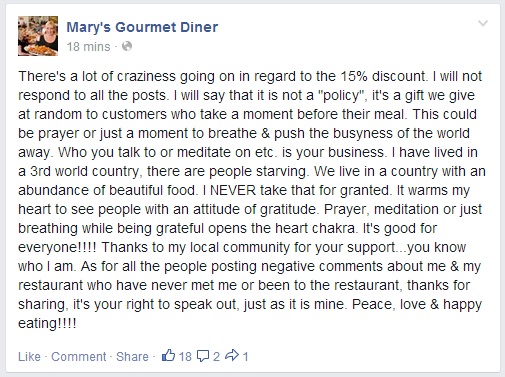
Well, apparently things heated up on Facebook thanks to all the attention, causing Mary to post the following on her business’ Facebook page:

MarysFB

Here’s the text in case that’s hard to read:

There’s a lot of craziness going on in regard to the 15% discount. I will not respond to all the posts. I will say that it is not a “policy”, it’s a gift we give at random to customers who take a moment before their meal. This could be prayer or just a moment to breathe & push the busyness of the world away. Who you talk to or meditate on etc. is your business. I have lived in a 3rd world country, there are people starving. We live in a country with an abundance of beautiful food. I NEVER take that for granted. It warms my heart to see people with an attitude of gratitude. Prayer, meditation or just breathing while being grateful opens the heart chakra. It’s good for everyone!!!! Thanks to my local community for your support…you know who I am. As for all the people posting negative comments about me & my restaurant who have never met me or been to the restaurant, thanks for sharing, it’s your right to speak out, just as it is mine. Peace, love & happy eating!!!!

It’s a sign of our times that doing almost anything positive can be turned into a negative. Sheesh.

We were talking about this at work and we all had the same thought before Mary posted on Facebook: if we know they’re giving 15% off just for praying we’d bow our heads in a heartbeat. Of course that kind of defeats the purpose, but I wonder how many people around Winston were thinking the same thing?

Where is the Internet?

BoingBoing has an excerpt from the book “I Work at a Public Library” that is a prime example of far too many conversations I’ve had with people I won’t name (because I’m nice that way):

A man keeps wandering up to the desk to ask computer-related questions:

Man: How do I make the computer like a typewriter?

Man: There are squiggly red lines on everything I type. What do you suppose that means?

Man: The computer keeps asking me to save my work to a disk and I’m not interested.

Man: Now, eventually I want to make a website. Do I just get the framework up and going using the typewriter function? And do I just save it to a floppy to get it up on the website? And can I do any of this on one of your computers, or do I just take the disk home and do it there? Where is the Internet?

Man: Maybe you could help me make a website. How long do you think it would take? I have about an hour.

Friends and family, you know who you are.

Oh This Cynical World

Someone left porcelain dolls outside of eight homes in California and because the dolls resembled little girls who lived in them it creeped out some of their parents. They called the police and of course the police investigated:

Orange County Lt. Jeff Hallock told KTLA that the pattern was “creepy or very unusual” so they began collecting the dolls and interviewing the affected families…

“Following conversation and questioning of several parents, information was learned that focused on a female adult who lived in the local community and attended church with many of the impacted families,” according to a release from the police department…

“Investigators have concluded that her motivation was out of goodwill and that she intended it as a kind gesture,” police said.

This truly says something about our society these days. You can’t blame the parents for being a little spooked by it, or the police for doing their jobs, but it’s hard to believe that a generation ago the first thought wouldn’t have been “I wonder who’s leaving these gifts around?” instead of, “Holy crap some creep’s stalking our daughter.” Again, not blaming the parents, just pointing out that it’s just one more way our society has changed. After all, who lets their 10 year old play outside all day unless they have some sort of GPS enabled locator in his pocket?

Insights from Ira Glass, Host of This American Life

This interview on Lifehacker with Ira Glass about how he does his work ends with a great piece of advice:

I’d just say to aspiring journalists or writers—who I meet a lot of—do it now. Don’t wait for permission to make something that’s interesting or amusing to you. Just do it now. Don’t wait. Find a story idea, start making it, give yourself a deadline, show it to people who’ll give you notes to make it better. Don’t wait till you’re older, or in some better job than you have now. Don’t wait for anything. Don’t wait till some magical story idea drops into your lap. That’s not where ideas come from. Go looking for an idea and it’ll show up. Begin now. Be a fucking soldier about it and be tough.

With some slight editing this could work for almost any line of work.

Airing of Grievances Coming to a Commission Meeting Near You

A front page article in the July 15, 2014 Wall Street Journal makes the point that the recent SCOTUS ruling allowing prayers before public meetings is an opportunity for atheists too:

The former president of the Freethinkers of Upstate New York, Mr. Courtney says he plans to give a four-minute speech highlighting the notion that the country was founded on the authority of the people, and the importance of ensuring Americans of all types are heard.

He will be the first atheist to address the Greece town board. Before the Supreme Court ruling, the town board allowed a Wiccan priestess to deliver an invocation.

While Mr. Courtney disagrees with the Supreme Court’s ruling, he takes some comfort in his view that it weakened what he calls Christianity’s “de facto monopoly on invocations.”

“In a sense, it has opened the door for a bit of a free-for-all,” he says.

The article also mentions the Pastafarians who are planning to offer their own prayers. Personally I’d like to see observers of the Festivus holiday take their turn at the podium to air their grievances. Not familiar with Festivus? Check out the video clip below and you’ll get it.

Our own Forsyth County Commission’s case is mentioned in the article of course. That case has irked me long enough that I can’t stomach giving it another minute of my life to think about, but I will say this: the true test will be when the commission is faced with having to entertain an invocation from a hard core satanist. It’s one thing to listen to a non-believer offer up generic messages of inclusion and cooperation, but it’s an entirely different ballgame to listen to someone ask them to accept guidance from the devil. I wonder if they’ll take their own advice offered to the non-believers who’ve complained about the invocations in the first place – just step out of the room if you don’t like it?

Our Rapidly Changing Culture

Making the social media rounds recently was this observation shared on Craigslist by the management of a New York City restaurant who were trying to figure out why service was so much slower in 2014 than in 2004 despite a simplified menu and increased staff size. They found security footage from 2004 and compared it to current footage. Some results they shared in their post:

Before even opening the menu they take their phones out, some are taking photos while others are simply doing something else on their phone (sorry we have no clue what they are doing and do not monitor customer WIFI activity).

26 out of 45 customers spend an average of 3 minutes taking photos of the food.

14 out of 45 customers take pictures of each other with the food in front of them or as they are eating the food. This takes on average another 4 minutes as they must review and sometimes retake the photo.

9 out of 45 customers sent their food back to reheat. Obviously if they didn’t pause to do whatever on their phone the food wouldn’t have gotten cold.

27 out of 45 customers asked their waiter to take a group photo. 14 of those requested the waiter retake the photo as they were not pleased with the first photo. On average this entire process between the chit chatting and reviewing the photo taken added another 5 minutes and obviously caused the waiter not to be able to take care of other tables he/she was serving.

Given in most cases the customers are constantly busy on their phones it took an average of 20 minutes more from when they were done eating until they requested a check. Furthermore once the check was delivered it took 15 minutes longer than 10 years ago for them to pay and leave.

8 out of 45 customers bumped into other customers or in one case a waiter (texting while walking) as they were either walking in or out of the Restaurant. 

They studied 45 customers in both cases and found that, on average, the time spent in the restaurant went from 1:05 in 2004 to 1:55 in 2014. It’s fairly safe to assume that other service businesses are experiencing similar behavioral changes in their customers, and it’s stunning to think about how quickly it’s happened.

BTW, I’m a notorious food-porner, but I can’t imagine taking more than 10 or 15 seconds to snap a pic of my snapper. I like my food way too much to waste more time than necessary before I dig in.

Hype vs Hyperbole

A few weeks back the folks at the Greensboro Coliseum started hinting to the press that they would have a “historic” announcement. What was this historic announcement? That Paul McCartney would play a concert there as part of his US tour this fall. Sure McCartney’s a big act – a huge act to many folks – but is one concert date on one tour really historic?

Compare that with yesterday’s announcement that downtown Greensboro will be getting an 850-seat venue affiliated with House of Blues. Much less hype for something that will have much more impact on Greensboro in the long run.

Some local folks got their panties in a twist when other folks got a little snarky about the McCartney announcement. They took it as a slam on McCartney when really it was an indictment of the over-the-top PR push by the Coliseum folks. There’s a reason people don’t trust marketers/advertisers and the Coliseum folks provided us with a perfect example when the crossed the line from hype to hyperbole.

Measuring Success

There are many ways to measure success and/or failure, and it’s important to keep that in mind when you assess hot-button issues. For instance, this article in the Greensboro News & Record about Obamacare’s affect on insurance coverage in North Carolina:

In North Carolina, 16.7 percent of residents are now uninsured, compared with 19.6 percent before the onset of the ACA, according to a study conducted by the social network WalletHub.


North Carolina ranked 33 among states for its number of uninsured residents.

The Tar Heel state also ranked fourth among states with the most net new private insurance enrollees per capita.

WalletHub used data from the Kaiser Family Foundation, the Centers for Medicare & Medicaid Services, the U.S. Department of Health and Human Services and the Census Bureau to make its projections.

Those who supported Obamacare will likely tout this statistic as proof that Obamacare is working. On the other hand, those opposed to Obamacare can ask the question, “But at what cost?” That’s the crux of the issue: we can all probably agree that more people having health insurance is a good thing, but we’d probably have lots of heated debate over how much to pay for it, how to pay for it and how to structure the program. Does the phrase “socialized health care” ring any bells.

Quite frankly I think it’s far too early in the process to declare Obamacare a success or failure, but I’d say these numbers show a positive trend towards getting more people health insurance coverage. Long term who knows whether or not Obamacare will be a net success, but at a minimum we’ve seen thousands of North Carolinians moved off the roles of the uninsured and that’s a step in the right direction.


Basic Income Guarantee

Until stumbling across a post referencing it at Fred Wilson’s AVC I’d never heard of “basic income guarantee.” So what is it exactly? From Wikipedia:

An unconditional basic income (also called basic incomebasic income guaranteeuniversal basic incomeuniversal demogrant,[1] or citizen’s income) is a proposed system[2] of social security in which all citizens or residents of a country regularly receive an unconditional sum of money, either from a government or some other public institution, in addition to any income received from elsewhere.

A basic income is typically intended to be only enough for a person to survive on, so as to encourage people to engage in economic activity. A basic income of any amount less than the social minimum is sometimes referred to as a ‘partial basic income’. On the other hand, it should be high enough so as to facilitate any socially useful activity someone could not afford to engage in if dependent on working for money to earn a living.

Interesting concept, but this quote from Wilson’s post echoes my initial reaction:

I don’t have a formed opinion on this idea. I know that welfare didn’t work out too well in the last century. So I’m nervous about any system that encourages or incents people not to work. But if we really are headed into a world where there aren’t any low skilled jobs, then I guess we need to be talking about ideas like this.

One of Wilson’s colleagues has been writing about the concept and has a couple of posts that explore how this all might work. You can read them here, but this excerpt highlights why this might be a concept worth exploring:

A higher minimum wage, as vigorously argued for in an interesting recent piece on Politico, can inject some short term liquidity into the economy and I am sympathetic to that but it is also a very blunt instrument and still doesn’t help with the many unpriced activities. The same goes for government mandated shorter working hours or longer vacations (although I am pretty sure that Google’s founders did not have a government mandate in mind)…

This brings me once again to the idea of a guaranteed basic income. This is a potentially attractive alternative for a number of reasons:

First, it sets human creativity free to work on whatever comes to mind. For many people that could be making music or learning something new or doing research.

Second, it does not suppress the market mechanism. Innovative new products and services can continue to emerge. Much of that can be artisanal products or high touch services (not just new technology). 

Third, it will allow crowdfunding to expand massively in scale and simultaneously permit much smaller federal, state and local government (they still have a role — I am not a libertarian and believe that market failures are real and some regulation and enforcement are needed, eg sewage, police).

Fourth, it will force us to more rapidly automate dangerous and unpleasant jobs. Many of these are currently held by people who would much rather engage in one of the activities from above.

Fifth, in a world of technological deflation, a basic income could be deflationary instead of inflationary. How? Because it could increase the amount of time that is volunteered.

Very interesting.