Doubt I could get my better half to do this hotel stay with me, but it can’t hurt to ask. Skip to 2:30 in the video if you want to see what I’m talking about.
Doubt I could get my better half to do this hotel stay with me, but it can’t hurt to ask. Skip to 2:30 in the video if you want to see what I’m talking about.
The Atlantic Monthly has a fascinating look at how the jobs picture has changed in America since 1977. Why that date? Because that’s the last time our labor-participation rates were as low as they are today. From the article:
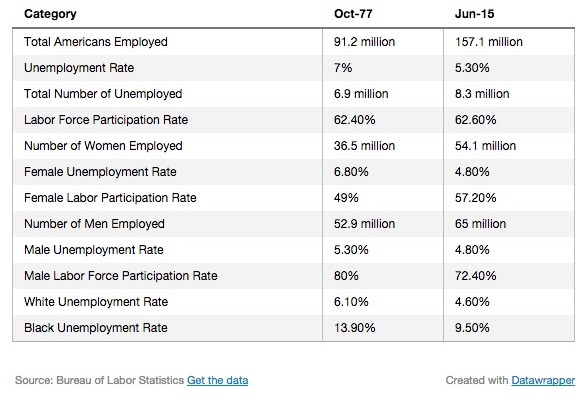
A couple things jump out here: Even though the labor-participation rate is almost as low now as it was then, the workforce has grown faster than the population (which was 220 million then and is around 319 million now). The big jump is in the number of women employed—from 36.5 million in October 1977 to 54.1 now. Male employment has also climbed, but not as much. So as the female labor-force participation rate has climbed, the male rate has dropped, from eight in 10 to barely seven in 10 men working full time. And whereas the male unemployment rate was much lower in 1977, now there’s gender parity.
Even as the gender balance has shifted, it’s noticeable that the racial balance hasn’t. Now, as in 1977, the black unemployment rate is much higher than the national rate, and lags far behind white unemployment.
This isn’t all just evidence of a bad economy—much of the decline comes from Baby Boomers reaching retirement age and checking out, though some of it comes from would-be workers who simply can’t find work, and millions more Americans are underemployed. That isn’t without challenges: An aging population could draw more in benefits than the government collects in social-security taxes. Massive spending on health care for older Americans could be a drag, too.
There’s more to read at the site, in particular what Americans were doing for work back then versus today, but I find the role of women in the workforce to be most interesting. With more women now graduating college than men how many households of the future will see a reverse of the traditional roles of breadwinner (men) versus secondary income/homemaker (women)? We’ve already seen a huge shift in household composition away from the traditional roles – more dual income homes, single parent homes, women as primary breadwinners, etc. – but it seems clear that the shift will continue over the next generation. What will the impact be on our society?
We’ve already lived through a generation of women struggling to balance work and home life, to face the never-ending tension of career versus kids, but we’re about to be confronted with men having to confront a similar situation over the next generation. The reality that men’s traditional role as primary breadwinners or “heads of household”, at least according to our societal norms, is beginning to dawn on America. Over the next generation the big question is going to be how men will handle being the secondary earner and likely primary caregiver to their children? How will society, especially other men, react to them and treat them when they do? I suspect they will go through many tumultuous days trying to find the right balance, just as many women have for years, and it’s often going to be ugly. Can they do it? You bet, but it’s going to be a painful process as they learn to do it.
*Update*
This Planet Money post also highlights what’s going on:
The share of marriages where women work full time but men don’t is highest for low-income families.
The story here has as much to do with the decline of working men as it does the progress of women in the economy. In just the 10 years between 2000 and 2010, the manufacturing sector lost an astounding 5 million jobs. Since manufacturing jobs historically have been held predominantly by men, this left lots of men out of work. Women, on the other hand, have benefited from the employment boom in the service sector, which employs more women than men.
High-income families are much more likely than average to have both spouses working full time. The message is pretty clear: It’s pretty hard to be rich with only one income.
From a long New York Times piece on photographer Robert Frank:
Frank retains the spontaneous enthusiasm of a much younger man. In his tenth decade, he is still a free-form outsider seeking untried situations, fresh leaps — and nothing pleases him more than picking up on the scent of something exceptional. Last year, after receiving intriguing letters postmarked North Carolina from an itinerant laborer named Gustavo, Frank set off to find him. He discovered Gustavo in Winston-Salem painting a house, he says, but ‘‘I was disappointed in him. He was ordinary. He seemed not to be possessed by anything. He just drifts.’’
That’s truly unfortunate. There are soooo many people here in Camel City that I’m sure Frank would have found extraordinary.
Speaking, or writing, about race in America is almost always an exercise fraught with risk and anxiety. Because we each bring our own racial identity to the table, our own experiences and perspectives, our own preconceptions and expectations of other races, we almost always struggle with overcoming our own obstacles to express our views. Maybe we’re afraid of offending so we salt our statements with ample disclaimers. Maybe we’re enraged so we salt our statements with hyperbolic adjectives. Maybe we’re confused and salt our statements with conflicting viewpoints. Maybe we’re so wrapped up in our own experience that we close our ears to the stories of those we’re trying to talk to. Likely we’re a combination of some or all of these things and as a result our attempts at talking about anything race-related are uncomfortable at best. The result? We do as much as we can to not talk about race in anything but the most generic terms.
Then we have something happen like the Charleston shootings of this week, or the events in Ferguson and Baltimore in the last few months, and race catapults to the top of our minds and the tip of our tongues. We can’t avoid addressing it and that’s when a great divide appears between us. That’s when we most need for people who can articulate the issues in a way that helps us better understand them. but unfortunately that’s when opportunists, the self-appointed leaders of their constituencies, appear on camera claiming they represent the whole of their race and instantly closing the ears of just about everyone. (How long do you think it will be before Al Sharpton shows up in Charleston?) That’s also when those who would like anything but reconciliation, the haters, step up with a megaphone and barf their venomous propaganda all over the rest of us.
Then there’s the matter of talking about guns in our country. The reaction to mass shootings like those in Charleston (and Connecticut, Virginia, Colorado, etc.) is depressingly predictable and divisive. It is near impossible to have a conversation about guns without it spiraling into a heated, virulent argument in which no one seems to think there’s some point between absolute freedom to own ANY weapon or a total ban on weapons.
In its own way gun control as a topic is as divisive as race and when you combine the two topics, as you most definitely are when you start to address the shootings in Charleston, you have the recipe for a witches brew of misunderstanding and divisive rhetoric.That’s why it’s so important that we DO have people who can say what’s needed in a way that we can all hear and understand. Once again the comedian shows us the way:
And then there’s this from David Remnick on President Obama’s reaction to the events in Charleston:
Obama is a flawed President, but his sense of historical perspective is well developed. He gives every sign of believing that his most important role in the American history of race was his election in November, 2008, and, nearly as important, his reëlection, four years later. For millions of Americans, that election was an inspiration. But, for some untold number of others, it remains a source of tremendous resentment, a kind of threat that is capable, in some, of arousing the basest prejudices.
Obama hates to talk about this. He allows himself so little latitude. Maybe that will change when he is an ex-President focussed on his memoirs. As a very young man he wrote a book about becoming, about identity, about finding community in a black church, about finding a sense of home—in his case, on the South Side of Chicago, with a young lawyer named Michelle Robinson. It will be beyond interesting to see what he’s willing to tell us—tell us with real freedom—about being the focus of so much hope, but also the subject of so much ambient and organized racial anger: the birther movement, the death threats, the voter-suppression attempts, the articles, books, and films that portray him as everything from an unreconstructed, drug-addled campus radical to a Kenyan post-colonial socialist. This has been the Age of Obama, but we have learned over and over that this has hardly meant the end of racism in America. Not remotely. Dylann Roof, tragically, seems to be yet another terrible reminder of that.
Nearly all of South Carolina was in mourning Thursday. Flags were at half-mast. Except the Confederate flag, of course, which flew high outside the building where Tillman still stands and the laws of the state are written.
I’m with Jon Stewart in feeling confident that nothing will change as a result of Charleston, or the dozens of similar events that have preceded it, or the dozens of similar events that are sure to follow. Why? Because change comes only when enough of us want it, and right now there just aren’t enough people who want it. Too many people benefit from the racial divide, from scaring the crap out of people – “They’ll take your guns, rape your women, steal your jobs… – and playing both sides to the middle for any real change to happen. The odds of that changing in my lifetime are minuscule and shrinking by the day, but my hope is that my children and their children can fix what the rest of us have so royally screwed up.
Our three kids – currently 22, 21 and 19 respectively – have been on our family auto policy for years so we’re accustomed to the added cost, but for those whose kids are just entering the world of driving the added insurance expense can come as a shock. The bad news is that in North Carolina the average increase is 60 percent, but the good news is that it’s not that bad when compared to other states:
North Carolina has the fourth lowest increase rate, following Hawaii at 17 percent, New York at 53 percent and Michigan at 57 percent.
By comparison, the national average is 80 percent, compared with 85 percent in 2013. The most expensive is New Hampshire at 115 percent.
Other bad news for parents of 16 year olds is that the average increase that first year of driving is 96 percent and it’s only at age 19 that it drops to 60 percent.
This is a cross-post of something I wrote for the work blog:
From the 6/8/15 Wall Street Journal:
The U.S. homeownership rate is below where it stood 20 years ago when President Bill Clinton launched a national campaign to encourage Americans to buy homes. Conventional wisdom says the rate, at 63.7%, is leveling off to where it was for decades before the housing-market peak.
But this is probably wrong, according to research from the Urban Institute, which predicts homeownership will continue to slip for at least 15 years.
Demographics tell the story.
Urban Institute researchers predict that more than 3 in 4 new households this decade, and 7 of 8 in the next, will be formed by minorities. These new households—nearly half of which will be Hispanic—have lower incomes, less wealth and lower homeownership rates than the U.S. average.
The upshot is that fewer than half of new households formed this decade and the next will own homes. By contrast, almost three-quarters of new households in the 1990s became homeowners.
The downtrend would push homeownership below 62% in 2020, and it would hold the rate near 61% in 2030, below the lowest level since records began in 1965.
It’s no secret that today many more people in our economy are freelancers than in the past, but would you believe that the number is about 53 million people?
I was on the phone last night with Stephen DeWitt, the CEO of our portfolio company Work Market. He was talking about a specific community of people and I asked him how many of them were likely to be freelancers. He said “well the statistics say that 3 to 4 out of every ten people these days are freelancers.”
I thought that sounded high but after reading Mary Meeker’s Internet Trends Report, in which she says that “34 percent of the work force in the United States, 53 million people, now consider themselves independent contractors, short-term hires or other kinds of freelancers”, I think Stephen has it exactly right.
Look around you on the subway, the baseball park, the movie theater, 3 to 4 out of every ten people are freelancers. That’s a big number. And its growing pretty rapidly. Younger people are more inclined to be freelancers. Older people turn to freelancing for flexibility or economic necessity. And employers are more inclined to hire freelancers as technology makes the management and compliance requirements around freelancers easier to handle.
This has me wondering about the implications for things like benefits. I’m not sure about this, but I don’t think that freelancers qualify for unemployment benefits since they are typically tied to the company you worked for. If you don’t work for anyone how would you qualify for benefits? It also feels like we’ve already seen the impact on health insurance – it’s a safe bet that a good chunk of the uninsured are freelancers who don’t have companies to provide insurance. Even if the ACA is pushing many of them to buy their own insurance, they were an available market precisely because they didn’t have company-provided health insurance.
The excerpt above came from Fred Wilson’s blog and I agree with his last paragraph from that post:
It’s a new era we are living in and the nature of work is changing and changing fast. There are tons of opportunities in and around this trend and we are invested in some of them. It’s one of the big megatrends of this century.
The next time you read, see or hear a news story related to dietary or health study claims you might want to keep remember story titled “I Fooled Millions Into Thinking Chocolate Helps Weight Loss. Here’s How”
“Slim by Chocolate!” the headlines blared. A team of German researchers had found that people on a low-carb diet lost weight 10 percent faster if they ate a chocolate bar every day. It made the front page of Bild, Europe’s largest daily newspaper, just beneath their update about the Germanwings crash. From there, it ricocheted around the internet and beyond, making news in more than 20 countries and half a dozen languages. It was discussed on television news shows. It appeared in glossy print, most recently in the June issue of Shape magazine (“Why You Must Eat Chocolate Daily,” page 128). Not only does chocolate accelerate weight loss, the study found, but it leads to healthier cholesterol levels and overall increased well-being. The Bild story quotes the study’s lead author, Johannes Bohannon, Ph.D., research director of the Institute of Diet and Health: “The best part is you can buy chocolate everywhere.”
I am Johannes Bohannon, Ph.D. Well, actually my name is John, and I’m a journalist. I do have a Ph.D., but it’s in the molecular biology of bacteria, not humans. The Institute of Diet and Health? That’s nothing more than a website.
Other than those fibs, the study was 100 percent authentic. My colleagues and I recruited actual human subjects in Germany. We ran an actual clinical trial, with subjects randomly assigned to different diet regimes. And the statistically significant benefits of chocolate that we reported are based on the actual data. It was, in fact, a fairly typical study for the field of diet research. Which is to say: It was terrible science. The results are meaningless, and the health claims that the media blasted out to millions of people around the world are utterly unfounded.
Here’s how we did it.
You really should read the whole thing to see exactly how easy it is to game the science journalism field. And if you want to be happy you should also embrace the strategy of believing the studies that purport to show the health benefits of eating/drinking whatever you want and ignoring those that claim those same habits are unhealthy.
Works for me.
I truly enjoy listening to a married couple talk about their journey together which is why I’m really digging SoulPancake’s series of videos called The Marriage Project. Here’s the latest:
*This is a cross post of something I wrote for the day job.
It’s no secret that there’s a dearth of younger home buyers these days, but why are young adults still slow to move from renting to buying even though the economy is finally growing? Shane Squires of MPF Research wrote about some of the challenges faced by millennials:
For starters, income levels for those between 25 and 34 are down. Median household income for that demographic has declined between roughly 5% and 15% in real terms from 2000 to 2012 for every education level of the head of household, according to the National Center for Education Statistics. And in 2013, the real median net worth of households under 35 years old was just $10,400. That was approximately 32% below the level estimated in 2001, according to the Federal Reserve Survey of Consumer Finances…

He then cites some data showing that the combination of an increasing population and anemic job growth coming out of the past two recessions led to a highly competitive job market that prompted many students to continue on to grad school. That demand allowed universities to jack up tuition which led to more debt:
That brings us to the most commonly cited economic constraint for Gen Y – student debt. Over the decade from 2002-2003 to 2012-2013, the number of full-time undergraduate students rose from 9.1 million to 11.6 million people, according to College Board. That increased demand enabled higher education institutions to raise tuition prices 51% past the rate of inflation in the past 10 years,…
Add to that the increase in health care costs, which he cites as being 31% greater than the reported rate of inflation, and the increase in cost of staples and you can see that young adults face some serious obstacles to home ownership. Even the accelerated job growth of 2014 is recognized with a caveat:
Given that job growth has accelerated notably in 2014, with a much higher share being created in higher-paying sectors, these trends in income and net worth are bound to start improving to some degree. Though, considering that the appreciation of median home prices has vastly outpaced wage growth over the past decade, many in the Millennial generation will likely continue to find it more difficult to qualify for a mortgage than Generation X did 10 years ago.
It would be easy to point to the Great Recession as the primary cause for the struggle young adults will have in moving from renting to buying, but some of the contributing factors are the result of societal shifts that began a generation ago. For instance, the decoupling of income from worker productivity:
The “decoupling” is the divergence between labor productivity and employment/wages that happened in the US in the 1980s and has become quite pronounced over the past thirty years. During the great postwar boom, productivity and wages grew in lockstep in the US. Of course, we don’t see any data from the 19th century and the first half of the 20th century so it’s not clear that labor and wages have always grown in lockstep. But something certainly changed in the 1980s and the result has not been good for median family income which has been stagnant in the US for almost thirty years now.

This is the kind of shift that does not happen overnight, and if that trend is to reverse it will not happen in a matter of years but in decades. What that means for rental housing providers in particular is that the falling rate of home ownership could be the new normal for a generation to come, which is good news for their businesses. On the other hand, if real median household income continues to decline then the demand for market rate units could stall and the demand for affordable housing units could skyrocket.
Obviously some policy changes could change this outlook. For instance if lending standards are relaxed again and if more affordable single family homes are constructed, then rental demand would obviously be impacted. Considering the lessons we learned when the housing bubble popped that first if is pretty big, and given the persistent problem of slow income growth any growth in home construction we do see probably won’t come close to what we saw in the late 90s through mid 00s.
Long story short – rental housing should continue to grow for the foreseeable future.
 Befuddled