Lies, Damned Lies and …

Mark Twain popularized the phrase, “There are three kinds of lies: lies, damned lies, and statistics” and it stuck because 125% of humans who have ever lived have been misled using statistics. (See what I did there?) If you think this is a problem unique to politics or baseball, think again:

Reinhart is a physicist turned statistician who has set out to write a book whose aim is to improve the quality of statistical education and understanding that researchers need to have. Statistics Done Wrong is not a textbook. It is a highly informed discussion of the frequent inadequacy of published statistical results and confronts the sacred cow: the p value. Here is what he has to say on page 2.

“Since the 1980s, researchers have described numerous statistical fallacies and misconceptions in the popular peer-reviewed scientific literature and have found that many scientific papers — perhaps more than half — fall prey to these errors. Inadequate statistical power renders many studies incapable of finding what they’re looking for, multiple comparisons and misinterpreted p values cause numerous false positives, flexible data analysis makes it easy to find a correlation where none exists, and inappropriate model choices bias important results. Most errors go undetected by peer reviewers and editors, who often have no specific statistical training, because few journals employ statisticians to review submissions and few papers give sufficient statistical detail to be accurately evaluated.”

Astonishing to my eyes was his conclusion that

“The methodological complexity of modern research means that scientists without extensive statistical training may not be able to understand most published research in their fields.”

The excerpt above is from a post on Boing Boing about a book that Alex Reinhart has written (Statistics Done Wrong) to try and address the issue of statistical malpractice and I’m thinking it could be a useful reference for all of us who need to parse statistics as part of our daily lives, which based on my extensive research would be all 125% of us.

Long-term Recovery

Friend Kim Williams has written an important opinion piece for the Winston-Salem Journal and I highly recommend you check it out. Here’s just a snippet:

Being an addict means so much that is negative in our lives. Lies, stealing, distrust – we wrap addicts in all of these things. However, I would like to believe that that is only part of the truth.

One of the major obstacles to recovery is public stigma. The stigma comes, in part, from the way we talk and think about recovery. Addict. Junkie. Druggie. These terms carry with them the Hollywood scenes and dramatic memories of the underbelly of alcoholism and addiction. These words cause us to ignore the people like myself who are living in recovery. These words and prejudices cause us to objectify the addict and the alcoholic. We can then easily place them in the box with the “town drunk” as too often incurable. As a result, when I sought help, the help that was available to me existed only in church basements, amid bad coffee, smoke-veiled doorways and broken stories of destruction and carnage…

According to the 2012 National Survey on Drug Use and Health, 23.1 million people ages 12 and older needed treatment for an illicit drug or alcohol use problem last year, but only 2.5 million received treatment at a specialty facility. About one-quarter of those who need treatment but do not receive it lacked insurance, according to the article…

There are an estimated 23 million people in the United States who are living in long-term recovery. I am an addict, but I’d prefer to say something different. I am a person in long-term recovery. What that means to me is that I haven’t had alcohol or other drugs since July 10, 1999. This has allowed me to become a better person, a loving father, grandfather and husband. I have established myself as a productive member of my community and a successful business leader.

Kim’s focus here is on the price that individuals pay for their addiction and the lack of resources many of them find when they look for help, but we should also keep in mind the impact that the lack of resources have on the rest of us. Our prisons are full of people put there for drug crimes, we have foster homes filled with children who are a product of homes broken by addiction and we have friends and families who suffer the agony of watching their loved ones kill themselves slowly and abuse those around them in the process. In one way or another addiction takes a tremendous toll on everyone, not just the addicted, and we long ago passed the point where we need to change how we address the issue.

You should also check out Kim’s blog and his ebook Wishful Preaching.

The Helpful Dad Bod Flowchart

The Wonkblog has posted a very helpful dad bod flowchart, and as a well-worn dad it should surprise no one that I fall squarely in the dad bod strike zone:

Wondering what this whole dad bod thing is? Well, apparently it’s just another tool of the patriarchy.

Personally I think it’s the first positive pop-culture related thing to come along for middle aged men since, well, anything.

Code of Conduct

Until reading Anil Dash’s blog post about it I’d never heard of ConfCodeofConduct.com. What is it? In a nutshell it’s a “rules of the road” for conferences, trade shows, etc. Here’s their short version:

Our conference is dedicated to providing a harassment-free conference experience for everyone, regardless of gender, gender identity and expression, age, sexual orientation, disability, physical appearance, body size, race, or religion (or lack thereof). We do not tolerate harassment of conference participants in any form. Sexual language and imagery is not appropriate for any conference venue, including talks, workshops, parties, Twitter and other online media. Conference participants violating these rules may be sanctioned or expelled from the conference without a refund at the discretion of the conference organisers.

Thankfully I’ve never had to work an event that would have had to invoke this code, with perhaps the exception of some costumes worn by folks at one or two trade shows. (There are some things I really wish I could un-see). Still, I’ve heard tales of conferences where this code would have been necessary and I’m glad I wasn’t there to see it.

I’d say this is a pretty good code for any gathering of 2+ humans, not just conferences.

Very Big Development for Downtown Winston-Salem

Wrote this for the blog at the day job today. Exciting news for Camel City:

A few years ago the mayor of Winston-Salem took a bit of a political hit for leading a public bailout of the development that would eventually become the BB&T Ballpark just off of Business 40 in downtown Winston-Salem. Really the mayor and the rest of the city’s leaders didn’t have a choice – if they didn’t come up with the financing to finish the construction the private developer had started, then the city would have a giant red clay mud pit on a site that was envisioned as a vital part for the redevelopment of downtown – and because of the recession that was in full swing at the time there really weren’t any private sector options. Since they took the political hit and came up with the dough the city now has one of the nicest minor league ballparks in the country, the baseball team regularly sets tremendous attendance numbers and thousands of people are regularly drawn downtown from spring through the early fall. Oh, and they were able to restructure the debt so that it would be payable over 25 years and could eventually net the city some money.

So why the brief history lesson? Because today we’ve learned that a private developer is planning a very large multi-use project that will help the city realize the vision it had for that part of downtown those many years ago. From the Triad Business Journal:

An Atlanta-based real estate investment group has announced plans for more than 1 million square feet of retail, office, hotel and residential property adjacent to Winston-Salem’s downtown ballpark.

The proposed development by Brand Properties, called the Brookstown District at BB&T Ballpark, would include 300,000 square feet of retail, 300,000 square feet of office space, 250 hotel rooms and 580 luxury residential flats.

If this comes to fruition then the overall downtown plan that’s been promoted by the city’s leaders for years, with the Innovation Quarter to the east as one bookend and the ballpark/Brookstown area to the west as the other, will take a HUGE step towards being realized.

The Genesis of Lewisville’s Cycling Culture

In the region in which I live the small town I live in, Lewisville, NC, is a bit of a mecca for road cyclists. Several times a week you will see large groups of cyclists meet in downtown Lewisville and depart for long rides in several different directions. The good townspeople of Lewisville are split on their feelings about the cyclists – some welcome their presence and wonder how the town can make hay out of Lewisville’s reputation within the cycling community, while others find them a nuisance as they wait for an opportunity to pass the riders on Lewisville’s two-lane country roads – but they’ve been a presence for many years and in the ten years I’ve lived here I’ve always wondered how Lewisville came to be known as a cycling hot spot. Scott Sexton’s recent column in the Winston-Salem Journal reveals how it all got started:

(Gene) Gillam was born in Iowa and grew up in Greensboro before heading to The Citadel. He became a pilot with the U.S. Army Air Force and flew B-26 bombers.

Sixty-one times he flew missions over Normandy, northern France, the Rhineland and the Ardennes. He was shot down several times, and was rescued by French families and the French Resistance — the sorts of things that awe us today but were almost routine to men of his generation…

It was through his hobbies that a lot of people got to know Gillam. He was an avid runner and, later on, became something of a pioneer within the local cycling community. That’s where Ken Putnam, the owner of Ken’s Bike Shop, first met and got to know Gillam.

“He used to live out in Lewisville, on Grapevine (Road),” Putnam said. “A group of us would meet out at his house and just go ride. That’s why all the rides now start in Lewisville, because we’d leave from Gene’s house.”

Again, that might not seem like much more than a couple of guys out indulging a hobby — until you consider what has transpired since a handful of oddballs started heading west from Gillam’s house in Lewisville each weekend in the early 1970s.

The routes plotted out by that little group eventually got written down, named and taught turn-by-turn to new groups of riders as they discovered the sport. That small group grew by twos and threes, and turned into other groups of differing interests and abilities.

These days, hundreds of riders leave from Lewisville in any given week throughout the spring, summer and fall.

#Dadbod

Suddenly me and my ilk – middle aged guys with semi-maintained middle aged bodies – are trendy, at least according to this item from The Atlantic:

Is “dadbod” a hashtag joke or a social-sexual movement? A bit of both, probably. A month ago at The Odyssey, Clemson sophomore Mackenzie Pearson explained that this “new trend” had “fraternity boys everywhere” rejoicing. “In case you haven’t noticed lately, girls are all about that dad bod,” she wrote. “The dad bod is a nice balance between a beer gut and working out. The dad bod says, ‘I go to the gym occasionally, but I also drink heavily on the weekends and enjoy eating eight slices of pizza at a time.’” In the time since, #dadbod has gone viral on social media, to the cheers of Jason Segel lookalikes everywhere.

It ain’t much, but I’ll take it. #Dadbod owners of the world unite and rejoice!

If You’re a Poor Kid in Forsyth County Then You’re Screwed

According to a recently released report Forsyth County, NC is the second worst county in the United States when it comes to income mobility for poor children. From the report in the New York Times:

Forsyth County is extremely bad for income mobility for children in poor families. It is among the worst counties in the U.S.

Location matters – enormously. If you’re poor and live in the Winston-Salem area, it’s better to be in Davie County than in Yadkin County or Forsyth County. Not only that, the younger you are when you move to Davie, the better you will do on average.

Every year a poor child spends in Davie County adds about $40 to his or her annual household income at age 26, compared with a childhood spent in the average American county. Over the course of a full childhood, which is up to age 20 for the purposes of this analysis, the difference adds up to about $800, or 3 percent, more in average income as a young adult…

It’s  among the worst counties in the U.S. in helping poor children up the income ladder. It ranks 2nd out of 2,478 counties, better than almost no county in the nation.

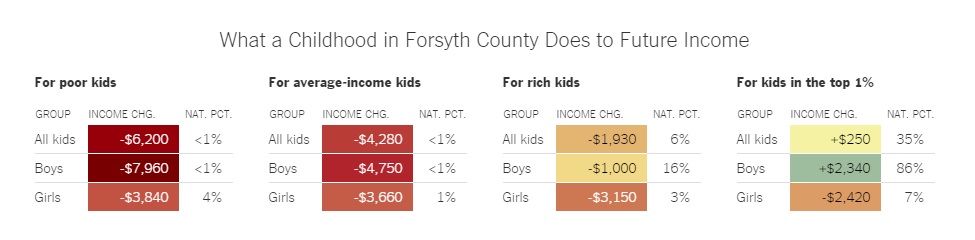
Take a look at this graphic and you can see that there’s a huge disparity between the prospects for poor kids and rich kids in the county:

Source NYtimes.com

Source NYtimes.com

Forsyth’s neighbor to the east, Guilford County, isn’t much better off:

It’s among the worst counties in the U.S. in helping poor children up the income ladder. It ranks 37th out of 2,478 counties, better than only about 1 percent of counties.

While it would be easy to say, “This should be a wake up call to the leaders of our community” I think that would be a cop out. This is the kind of thing that should concern us all because what do we think will eventually happen if we continue to allow a huge segment of our community to live in circumstances in which they perceive little chance of improving their lot in life? What do we think these young people will do when they lose hope?

So yeah, our elected leaders should view this as an early warning that they need to address these underlying causes of this disparity in opportunity, but this is bigger than them. All of us need to get engaged, through our schools, churches, civic groups, businesses and neighborhoods, in order to begin to make any progress in improving the prospects for our kids’ futures. The underlying issues are systemic – broken family structures, poor educational attainment, too many low wage jobs, etc. – and only a concerted effort by the entire community will be able to address them. If we don’t we will have much larger problems on our hands in years to come.

Winston-Salem and Forsyth County have made a great deal of progress in addressing the major economic challenges that were wrought by the declines of the local manufacturing industries, highlighted by the resurgence of downtown Winston-Salem, but now we need to make sure that the tide rises for everyone, not just those lucky enough to be born into well off families.

Questions from Every Q&A You’ve Ever Suffered Through

Like many of you I’ve had to sit through an astounding number of presentations followed by Q&a sessions. That’s why I find this list of the questions asked at every Q&A ever to be so funny, and kind of depressing. Here’s a nice selection you should all recognize:

1. “I’d like you to know that I’m particularly smart. Here are some subjects I consider myself to be very smart about. There is no question.”

2. “Can you explain why I didn’t understand this presentation?”

10. “I used to like your work, but I don’t now. Have you considered doing the things I like again?”

14. “Someone else already asked my question. Make them give it back.”

18. “I drifted in and out during the middle of whatever it was you were talking about. Could you please revisit that entire topic? I will not be more specific, thank you for your time.”