Video Power

My better half and I are trying to sell the house we lived in for our first 12 years in North Carolina, and let’s just say the process is different than our past house sales have been in the past. Probably the biggest change has been that there are far more things we, as owners, can do to help market the house. Among them is cultivating our house’s Zillow listing.

Our realtor set up the listing, but once it was set up we ended up writing a lot of the copy and adding some of the unique selling points for the house and neighborhood. When we bought the house the online tool all the realtors were using was Listingbook, which was pretty cool for that time, but we were completely dependent on the realtor to make any changes we felt were needed. With Zillow we’re able to do it ourselves, which is great because we’re the party with the greatest interest in getting everything right.

Unfortunately, there haven’t been any takers on the house, but this last weekend we learned exactly how powerful video can be. Zillow allows you to post a video on your listing and we had a video we’d shot a while back, but you have to use Zillow’s app to actually record the video so we didn’t have a video on our listing for quite a while. This past Saturday we were at the house and I took a few minutes to walk around the house shooting the two minutes of video that Zillow’s app allows, and then uploaded it while we were still there. The result? Views and saves of our house listing spiked big time.

The result? Views and saves of our house listing spiked big time.  Here’s a graphic showing the daily numbers going back a month:

170425 Zillowstats30Day

The traffic on our listing is represented by the green bars, the average traffic for houses like ours is represented by the blue line chart behind the green bars. The second highest day is the fourth bar from the right, which was last Saturday when I uploaded the video in the afternoon. The highest day was the next day, Sunday, which is also one of the very few days our listing exceeded the average.

We’ve had some small traffic increases in the past when we logged in to edit some text, but as a rule we were getting between 6-12 views a day with one or two saves a week – a save is when someone saves the listing in the Zillow app so they can come back later or get alerts when a listing changes – and nothing really moved the needle much until we posted the video. As you can see from this graph showing the last week the video made a massive difference, and keep in mind that the video was shot using my phone in about 15 minutes with no editing.

170425 ZillowStats

Now, if only we could convert that traffic into buyers!
Can Poverty Change You Genetically?

This is a fascinating article, written by a former investment manager and current Truman National Security Fellow, who escaped abject poverty in Appalachia, that looks at the early (as of now) research showing the potential link between poverty and genetics. Basically, the stress of poverty might change your body in a way that can be passed to your children and grandchildren.

Even at this stage, then, we can take a few things away from the science. First, that the stresses of being poor have a biological effect that can last a lifetime. Second, that there is evidence suggesting that these effects may be inheritable, whether it is through impact on the fetus, epigenetic effects, cell subtype effects, or something else.

This science challenges us to re-evaluate a cornerstone of American mythology, and of our social policies for the poor: the bootstrap. The story of the self-made, inspirational individual transcending his or her circumstances by sweat and hard work. A pillar of the framework of meritocracy, where rewards are supposedly justly distributed to those who deserve them most.

What kind of a bootstrap or merit-based game can we be left with if poverty cripples the contestants? Especially if it has intergenerational effects? The uglier converse of the bootstrap hypothesis—that those who fail to transcend their circumstances deserve them—makes even less sense in the face of poverty epigenetics. When the firing gun goes off, the poor are well behind the start line. Despite my success, I certainly was…

Why do so few make it out of poverty? I can tell you from experience it is not because some have more merit than others. It is because being poor is a high-risk gamble. The asymmetry of outcomes for the poor is so enormous because it is so expensive to be poor. Imagine losing a job because your phone was cut off, or blowing off an exam because you spent the day in the ER dealing with something that preventative care would have avoided completely. Something as simple as that can spark a spiral of adversity almost impossible to recover from. The reality is that when you’re poor, if you make one mistake, you’re done. Everything becomes a sudden-death gamble.

Now imagine that, on top of that, your brain is wired to multiply the subjective experience of stress by 10. The result is a profound focus on short-term thinking. To those outsiders who, by fortune of birth, have never known the calculus of poverty, the poor seem to make sub-optimal decisions time and time again. But the choices made by the poor are supremely rational choices under the circumstances. Pondering optimal, long-term decisions is a liability when you have 48 hours of food left. Stress takes on a whole new meaning—and try as you might, it’s hard to shake.

As the author points out, this research calls into question the whole concept of poverty as choice, or poverty as the result of laziness, and asks us to reconsider how we address poverty. One thing’s certain: whether or not you agree that poverty has a biological impact, you have to acknowledge that the programs we’ve depended on to fight poverty until now have not worked. Whether it’s because the programs are misguided, or there was a lack of political will to follow through on those programs that exhibited promising results, or some combination of those factors and more, we’ve failed to pull a huge chunk of our population out of poverty and if we want to change that then we’re going to have to make substantial changes. Soon.

Google PhotoScan and Google Books

One of the mobile apps I’ve had the most fun with lately is Google’s PhotoScan. Basically, it lets you use your phone’s camera to scan printed pictures rather than take a picture of a picture. Here’s how it’s described on the app page:

Don’t just take a picture of a picture. Create enhanced digital scans, wherever your photos are.

– Get glare-free scans with an easy step-by-step capture flow

– Automatic cropping based on edge detection

– Straight, rectangular scans with perspective correction

– Smart rotation, so your photos stay right-side-up no matter which way you scan them

Scan in seconds

Capture your favorite printed photos quickly and easily, so you can spend less time editing and more time looking at your bad childhood haircut.

The way it works is you fire up the app, make sure the picture you’re scanning is in the “frame” you see on your screen, and then when you tap the shutter button four dots appear on the picture and the app instructs you to move a circle from dot to dot in a certain order. I wondered why the app requires this action, but not enough to acturally research it, but I think I might have stumbled on the answer in this article about Google’s massive book scanning project:

The stations—which didn’t so much scan as photograph books—had been custom-built by Google from the sheet metal up. Each one could digitize books at a rate of 1,000 pages per hour. The book would lie in a specially designed motorized cradle that would adjust to the spine, locking it in place. Above, there was an array of lights and at least $1,000 worth of optics, including four cameras, two pointed at each half of the book, and a range-finding LIDAR that overlaid a three-dimensional laser grid on the book’s surface to capture the curvature of the paper. The human operator would turn pages by hand—no machine could be as quick and gentle—and fire the cameras by pressing a foot pedal, as though playing at a strange piano.

What made the system so efficient is that it left so much of the work to software. Rather than make sure that each page was aligned perfectly, and flattened, before taking a photo, which was a major source of delays in traditional book-scanning systems, cruder images of curved pages were fed to de-warping algorithms, which used the LIDAR data along with some clever mathematics to artificially bend the text back into straight lines.

I don’t know for sure, but it sure sounds like the technology developed for the book scanning project translated nicely to an app that could be used by average people armed with smartphones to scan gazillions of old photos into the great Googleshpere in the sky. Amazing.

Oh, and you should read that article on the book scanning project. It’s a fascinating exploration of a copyright conflict that has resulted in Google having a database of 25 million scanned books that no one is allowed to read.

Eugeology #13 – Masters of Reality

What rock was I living under that kept me from discovering this album before now?  There’s much to like, not the least of which is that there’s a healthy strain of blues laced throughout. That said, it’s not the kind of blues influence that has me thinking, “Okay, that riff was cool the first twelve times but enough’s enough.” Rather it’s the kind of blues influence that injects a bit of lightness to balance out the “rockier” cuts.

The band’s Wikipedia page describes them thusly:

Masters of Reality is a hard rock group formed in 1981 by guitarist and singer Chris Goss and Tim Harrington in Syracuse, New York.[1] The band is sometimes associated with the “Palm Desert Scene“, which includes bands like Kyuss, Queens of the Stone Age and many other stoner rock or (as they prefer to call it) “desert rock” bands. The band is named after the album Master of Reality by Black Sabbath.

I was nodding my head when I read this because one of my first thoughts, when I started listening, was, “These guys remind me a lot of Queens of the Stone Age” and that’s a good thing because Queens is one of my favorite bands from that era.

Honestly, I loved this album. The variety from track to track, Chris Goss’s vocals, the backing vocals, Tim Harrington’s lead guitar…I just loved all of it. Now, if you’re one of those folks who just can’t stand the blues in any way, you’ll probably disagree with me wholeheartedly.

I’m REAL interested in Tim’s take on this one because I just don’t know how he’s gonna react. He’s not a fan of southern rock, and any blues-influenced rock will have a taste of that, but this is truly bluesy so I suspect it grew on him as he listened. As always I’m interested in Eugene’s backstory for this one and I’m pretty sure this one is a true favorite of his.

Links & Notes

The Masters of Reality (Album) Wikipedia Page

The Masters of Reality Wikipedia page

Eugene’s Take at Wheeler’s Dog

Tim’s Take at Useless Things Need Love Too

Eugeology #12 – Twisted Sister’s Love is For Suckers

With Eugene’s last selection, I basically trashed Sammy Hagar. Not that I think Hagar is a bad singer, but I’m just not a fan and his style distracts me enough that I have a hard time enjoying whatever song I’m listening to. This week’s selection features a singer, Dee Snider, that most people would think more likely to be annoying/distracting. He’s gimmicky and over the top, almost a parody of the 80s hair rock singer he was. Weirdly, though, I’ve always liked him.

Maybe it’s because I always loved how over the top Snider and the rest of Twisted Sister was. It was an unapologetic approach, a total schtick, and you almost had to remind yourself they were actually a pretty good band.


I was not real familiar with this particular album, but like everyone else alive in the mid-80s I’d heard their third album – Stay Hungry – a LOT. Hell, We’re Not Gonna Take It was essentially the anthem of my graduating class.

But this review is about Love is for Suckers and I’ll say it’s a solid effort. On my kindergarten grading sale it’s a low √+, with more √s than +s, but still enjoyable. It’s less “showy” than Stay Hungry was but it also seems a little more consistent. Simply put it’s just kinda fun.

I’m interested in Tim’s take on this one because it seems like the kind of thing he’d dig. I already know Eugene likes it, so I’m interested in his backstory for this one (those are my favorite parts of all his reviews).

Links & Notes

Love is for Suckers Wikipedia Page

Twisted Sister Wikipedia Page

Eugene’s Take at Wheeler’s Dog

Tim’s Take at Useless Things Need Love Too

Eugeology #11 – Montrose

Gotta say this up front for this album: I’ve never been a Sammy Hagar fan. Wasn’t a big fan of his solo stuff, and didn’t like his stint with Van Halen either. I can’t explain why, but I just never liked his approach to singing.

So, that being said listening to this album was kind of hard. Basically, I got tired of Hagar about halfway through the second song so I just tried to concentrate on the rest of the band as I listened.

Using my kindergarten grading system that I introduced with the last album I ended up giving this one a straight √. It might have been a √+ if anyone but Hagar had been singing, but since the lead singer is obviously a HUGE part of the band it’s awful hard to overcome that.

For instance, I really liked the start of I Don’t Want It but as soon as Hagar got into the action I just kinda had an, “ugh” reaction. Still, when Ronnie Montrose’s guitar was front and center I was really liking it. Honest to goodness that was true with almost every track of this album, so let’s just say that if you could eliminate the vocals this would be a + album.

As with UFO (Eugene’s last selection), I really enjoyed the long, 70s-style jams. If you’re a fan of that and don’t have the same problem with Hagar that I do, then you’ll like this one.

I’ve intentionally avoided reading Eugene & Tim’s reviews so that they don’t skew mine, but if I had to guess I’d say they don’t feel the same way about Hagar that I do. Wish I could explain why he has that effect on me, but it is what it is, so I’m prepared for Eugene to give me his flabbergasted look.

Links & Notes

Montrose Wikipedia Page

Eugene’s Take at Wheeler’s Dog

Tim’s Take at Useless Things Need Love Too

Eugeology #10 – UFO’s Strangers in the Night

Thank God for Wikipedia. Without it, I would have had no idea this pick of Eugene’s is considered by many aficionados to be one of the best live albums. Until he sent the link to me and Eugene I’d never heard of UFO’s Strangers in the Night, but thanks to the wonders of the internet I can pretend to have known that Slash stated this is his favorite live album.

As I stated on the last post, I’m way behind in my Eugeology listening so I’ve come up with a system to expedite my listening and reviewing: until I get caught up I’m simply keeping a playlist of the songs on the album and scoring the songs thusly: If I like the song it gets a “+”, if I think it’s passable I give it a “√” and if I don’t like it I give it a “-“. You might recognize this as the same scoring kindergarten teachers use.

So, using my system the album gets a very solid “√+”, without a single track getting a “-” and more getting “+s” than “√s.” I was going to list my favorites here, but as I listened that list got pretty damn long so suffice it to say I really like the majority of them.

What I loved about the band: lead guitar. Dude really brought it, and to my untrained ear it didn’t sound like he missed a thing. Since guitarist Michael Schenker played with the Scorpions, who I loved back in the day, I’m pretty sure I’m biased.  I also thought drums and bass were strong, but I’m no expert. Vocals were pretty good too, but as with every live album I’ve ever heard the vocals are overtaken by the instruments. In the end I really think Schenker carried the day.

What I loved about the album: solid, classic 70s-style concert jamming, which is why I really liked Love to Love (8 minutes) and Rock Bottom (11 minutes and the guitar solos are truly “Holy hell!” worthy).

Going to have to thank Eugene for turning me on to this one.

Links & Notes

Strangers in the Night Wikipedia Page

UFO Wikipedia Page

Eugene’s Take at Wheeler’s Dog

Tim’s Take at Useless Things Need Love Too

Eugeology #9 – The Cult’s Electric

I am WAAAAY behind on my Eugeology posts, but that’s the price I pay for, well, living. You see my (much) better half and I recently celebrated our 25th anniversary and all the related planning, traveling and other such really put a dent in my free time. So, I’m going to be listening to a bunch of bands and posting my vapid and uninformed thoughts about them over the next few days.

This week’s band is one of my favorites from the late 80s and early 90s, The Cult and the album is Electric. The first time I heard them was also the first time I saw them; it was a performance on a late show (I don’t remember which one) and I was entranced by singer Ian Astbury. The combination of his stage presence and his incredibly distinctive voice was something to behold, and I thought it definitely set them apart from the rest of the crowd at the time.

I’m much more familiar Sonic Temple, which was the album they produced after Electric, but there were a few tracks on this I recognized. Love Removal Machine is probably the song the average schmo like me would have heard, but I’d also heard Wild Flower and their cover of Born to Be Wild (not a great cover BTW).

What I’ve always loved about The Cult is that you always know it when you hear them. As I’ve already said Astbury is one of the most distinctive singers around, but I’d also say that Billy Duffy on guitar has a pretty recognizable style, although some of his solos fall prey to the <insert solo here> arrangement. In other words they feel a little gratuitous.

This is a solid album, but if I had to pick I’d go for Sonic Temple as their better album. If you’re looking for a little harder edge, old school rockin’ then this is definitely worth your time, but if your time is limited then go with the later album.

Links & Notes

Electric Wikipedia Page

The Cult Wikipedia Page

Eugene’s Take at Wheeler’s Dog

Tim’s Take at Useless Things Need Love Too

25

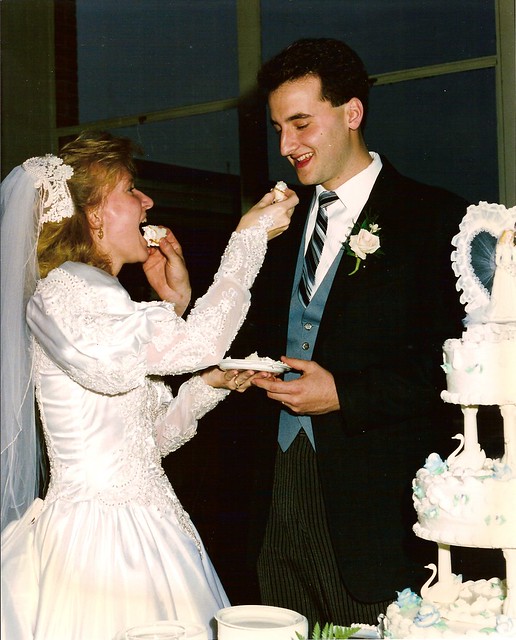
Normally I’m not at a loss for words, but as I write this I truly can’t come up with anything that would come close to adequately describe how I feel today about the woman who joined me in saying “I do” 25 years ago today. What I can say is that I’m amazed that 25 years can seem to pass so quickly and yet every one of those years feel like they pack a lifetime of memories. None of those years were easy; all held days, weeks and months of ecstasy; some held weeks or months of challenges and pain; most held a dose of all of that. The result is that we stand together here on the other side of those 25 years and I love her more than I could ever imagine back when we were so young and untested.

Most people spend their lives wondering if they’ll ever experience a miracle. I wake up every morning and look into the eyes of mine. I’m truly a man who’s been blessed beyond measure.

Jon and Celeste's Wedding

I Don’t Wanna Be Anyone’s Wrapping Paper

This piece from Quillette Magazine hit home with me in so many ways, but more than anything it articulated why I’ve never registered with any political party: I simply don’t want to identified by the labels attached to the parties. Here are some excerpts that will, hopefully, outline what I mean:

Labels suck.

Conservative, liberal, progressive, libertarian, green. These words have come to mean nothing about the folk that embody them. In our era of career politicians, it would be like saying a quarterback drafted by the Oakland Raiders is irresistibly  —  unequivocally  —  a “Raider” in his style of play. He’s not; he’s just a guy throwing a ball whilst wearing their black jersey…

As a corollary, political labels seem not just irrelevant but also treacherous. The wrapping paper of your Christmas gift may delight you… it still doesn’t tell you what’s inside the box. And that, matter-of-factly, is the gift with which you’re bequeathed; the wrapping paper soon squeezed and discarded. To think, and vote, using labels grants us a false sense of security and prohibits the unmasking of (most) politicians for what they are: virtue-signalers to their base, peddling false and reductive narratives  —  often devoid of context and policy. It’s a cunning sleight of hand, abetted by the mainstream media, that leaves a great number of us agreeing with people with whom we would otherwise disagree. And the principal reason why this occurs is because of labels.

It’s not only the politicians  —  as a system  —  that are to blame for this upside-down world. It’s us all, callous bearers of that almost archaic duty: citizenship. Too often we favour the collective over the individual, group think over free thought, headlines over trends. We reflexively embrace our fellow [insert your label] without examining how we ever wound up ascribing to their “ideology” or “party.” In the practice of political faith, no matter the denomination, we are either fundamentalists or atheists. We subscribe to all the commandments or none at all. When is the last time you met a Democrat in favor of the Second Amendment or a Republican supporting abortion? Religion was once described by Christopher Hitchens as “a surrender of the mind.” Increasingly, so is political partisanship. Truth and sense, historical perspective and systemic thinking, matter less than jersey colour. We relish the chance to define and affirm our sense of self in proclaiming, say, our liberal credentials or conservative pedigree. Politics shifts from a practice (“what”) to an identity (“who”).

You don’t have to work hard to test this theory. Simply post a hot-button political story on your Facebook timeline and watch your friends react exactly as you’d expect them to based on their labels, i.e. their party affiliations. It’s truly remarkable.

kellyanne-conway-accused-of-disrespecting-the-oval-office-1

Picture linked from Piximus.net. Attributed to Brendan Smailowski/AFP

A silly non-consequential example that appeared on Facebook this week was related to the picture of Kellyanne Conway sitting on a couch in the Oval Office (see above) in what some people thought was an inappropriate way. Of course many “liberal” friends jumped all over it and then many “conservative” friends accused them of overreacting, and in the midst of that came this comment from a “conservative” that to me defined irony: “Why? Because liberals believe every photo/meme that they see on facebook is the gospel truth. That’s why.” This from a member of a group of people that spent eight years gleefully sharing every idiotic anti-Obama (including Michelle) meme you can imagine.

Here’s the thing: I have no idea if that particular “conservative” friend ever shared one of those anti-Obama memes, but she has identified herself as a member of that tribe so by default I’m assuming she did. That’s what happens when you identify yourself closely with a political party – you give people permission to assume that you believe whatever line that party is spouting. You can claim you’re an independent thinker all day long, but by raising your hand and saying “I’m a Republican” or “I’m a Democrat” you’re giving the world permission to assume that you believe everything that party espouses until you can prove otherwise. That’s why you’ll never see me join a party; I’m certain I’ll disagree with at least 25-50% of the policy positions that any party takes so I’m just not going to have my name associated with it.

As for the argument that people turn off their brains and just toe the party line, I’m pretty sure that if you asked anyone whether that’s true they would say, “Absolutely it’s true, especially with members of <insert opposite party name here>. Of course some members of <insert good guy party name here> do that too, but mostly the hard core nutjobs. Me and my friends aren’t like that.” Then they’ll fire up Facebook and start sharing idiotic memes as soon as your conversation is over.