Category Archives: Government

Mind the Gap

It will be interesting to see if the Republicans in the states that decided not to expand Medicaid as part of ACA will pay a political price for the outcome. From the Wall Street Journal:

Some GOP-led states are revisiting their decision as complaints pile up over the coverage gap—and its consequences for businesses—in such states as Utah and Florida. The state senate in New Hampshire last week reached a tentative deal to expand Medicaid. In Virginia, newly elected Democratic Gov. Terry McAuliffe hopes to get legislators to reverse his Republican predecessor's stance against expansion.

Lawmakers are also getting a push to boost Medicaid rolls from hospitals that expected a vast new pool of paying customers under the health-care law. Instead, the failure to expand Medicaid coverage by some states not only adds fewer insured patients, it also eliminates the payments hospitals had long received to cover the cost of uninsured people they treat free…

Eugene Steuerle, an Urban Institute economist and former Treasury Department official who served under presidents in both parties, said he couldn't recall a social program that excluded beneficiaries because they earn too little…

Governors in some states that refused to expand Medicaid now say the coverage gap is hard to ignore. "I am not a fan of the Affordable Care Act," Utah Gov. Gary Herbert said in an interview. But, he said, he is working with state legislators on a plan to expand Medicaid after advisers calculated that about 60,000 of his constituents would fall through the gap.

"That is not fair," Mr. Herbert said. "When I say doing nothing is not an option, I'm talking about the 60,000 people in Utah who live below the poverty line and don't have access to health care."

Easy Money in Camel City

Earlier this week the Winston-Salem City Council approved a $100,000 loan for the Winston-Salem Chronicle newspaper. The loan raises all kinds of ethical questions for the newspaper and it also calls attention to a small business loan program administered by the city and is likely not well-known to most people.  That makes for an interesting item on Yes! Weekly's blog:

The city has approved $6.1 million to 142 businesses over the past 28 years, according to information provided by Assistant City Manager Derwick Paige. Of those, 21 businesses withdrew, two are under legal action and two are pending. Alarming perhaps, only 48 remain open, while 69 are closed. The city estimates that about 491 jobs were created through the loans, which equates to about $12,398 per job…

Camino Bakery, owned by Cary Clifford, received a $24,845 loan in FY 2011-2012 and currently owes $24,384.

The city loaned Ziggy's (partially owned by YES! Weekly publisher Charles Womack) $50,000 in FY 2010-2011. The borrower currently owes $49,923.

What this piece doesn't reflect is how much interest has been paid on the loans mentioned, but if the terms are similar to the terms the Chronicle received - the newspaper would not have to begin making repayments for the first 36 months after receiving the loan. At the end of the deferment period, the Chronicle would have to make monthly payments with a 2 percent interest rate (source Winston-Salem Journal) – then it can't be much and you have to look at these and think, "Man, what a SWEET deal!"

Seriously, Ziggy's got $50,000 in 2010-11 and still owes $49,923 which means they've repaid $77 in four years. Let's hope they got the same deal as the Chronicle and have just now started to make payments and not that they're stiffing the city because they're struggling financially. Either way though, the real point here is that these loan terms appear to be amazingly generous and it's going to be interesting to see if the publicity this story has generated will prompt a flood of loan requests. 

Anyone want to partner with me on my dream coffee shop-book shop-beer garden business somewhere downtown? I hear there's money to be had! 

News Flash: Lewisville Residents Already Have Recycling

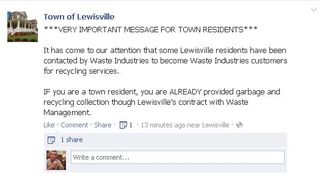
The Town of Lewisville recently posted the following on its Facebook page:

***VERY IMPORTANT MESSAGE FOR TOWN RESIDENTS***

It has come to our attention that some Lewisville residents have been contacted by Waste Industries to become Waste Industries customers for recycling services.

IF you are a town resident, you are ALREADY provided garbage and recycling collection though Lewisville's contract with Waste Management.


LewisvilleRecycle

Credit Where Credit is Due

Walmart catches a lot of heat,  much of it probably justified, for its treatment of employees, low wages, sourcing practices, etc. but it rarely seems to get credit when it does something right. That's why I found this story from Louisiana so interesting.

Two Walmart stores in Louisiana will be stuck with most of the bill after food stamp recipients went on a huge shopping spree after a power outage temporarily lifted their spending limits, resulting in cleared store shelves and mass chaos…

According to a Louisiana Department of Children and Family Services’ spokesman, retailers who chose not to use the emergency procedures that limit sales up to $50 per cardholder during an emergency would be responsible for any additional amount spent during the power outage…

The shopping frenzy was triggered after the Electronics Benefits Transfer system went down because a back-up generator failed at 11 a.m. EST on Saturday…

Around 9 p.m. CT on Saturday, a Walmart employee made an announcement that the computer system had been restored and all card limits had returned. At that time, many customers left shopping carts full of food inside the store.

The focus of the story is on the food stamp recipients taking advantage of a computer glitch to go on a shopping spree, but what caught my attention was the fact that the Walmart stores continued to allow the customers to use their EBT cards even though they knew there was an issue. They could just as easily have said they wouldn't process the cards until the system came back online, but the store managers chose to continue processing. Maybe they thought they'd eventually get their money, or maybe they were compelled to by law – I have no idea – but the fact of the matter is they did a generous thing by not denying the EBT payments.

And those folks who took advantage of the situation? That's a perfect example of why the backlash against government aid programs is gaining traction.

C-SPAN Sports

If you're into Robert's Rules of Order and all things parliamentary procedure-y you'll get a kick out of this. The Republican bloc in the House performed some parliamentary gymnastics to make sure they controlled how/if the Senate's continuing resolution made it to the floor and Maryland's Rep. Van Hollen (D) decided to call them on it. Confused? Welcome to the club, but it's crap like this that convinces the vast majority of Americans that Congress is totally screwed up.

The Red State ACA Donut Holes

North Carolina, like many states controlled by Republicans, opted out of the Medicaid-expansion component of the Affordable Care Act. A New York Times article explores the practical effect it's having on those states' citizens:

A sweeping national effort to extend health coverage to millions of Americans will leave out two-thirds of the poor blacks and single mothers and more than half of the low-wage workers who do not have insurance, the very kinds of people that the program was intended to help, according to an analysis of census data by The New York Times.

Because they live in states largely controlled by Republicans that have declined to participate in a vast expansion of Medicaid, the medical insurance program for the poor, they are among the eight million Americans who are impoverished, uninsured and ineligible for help. The federal government will pay for the expansion through 2016 and no less than 90 percent of costs in later years.

Those excluded will be stranded without insurance, stuck between people with slightly higher incomes who will qualify for federal subsidies on the new health exchanges that went live this week, and those who are poor enough to qualify for Medicaid in its current form, which has income ceilings as low as $11 a day in some states…

The 26 states that have rejected the Medicaid expansion are home to about half of the country’s population, but about 68 percent of poor, uninsured blacks and single mothers. About 60 percent of the country’s uninsured working poor are in those states. Among those excluded are about 435,000 cashiers, 341,000 cooks and 253,000 nurses’ aides.

“The irony is that these states that are rejecting Medicaid expansion — many of them Southern — are the very places where the concentration of poverty and lack of health insurance are the most acute,” said Dr. H. Jack Geiger, a founder of the community health center model. “It is their populations that have the highest burden of illness and costs to the entire health care system.”

We're going to be hearing a LOT about the ACA, aka Obamacare, rollout over the next few months. The program opened for enrollment on Tuesday (Oct 1) with a start date set for January and the traffic to the website was heavy enough that it slowed to a crawl.  Like any new program, especially one of this scale, there will be issues but it will be interesting to see if the overall benefits outweigh the problems enough that people will eventually say "Keep the government's hands off my ACA!"

If that does happen it will be with folks like the self-employed who couldn't get on a regular insurance plan that was anywhere near affordable, the employees working for small employers who stopped offering health insurance long ago because they couldn't afford to provide coverage and weren't legally required to, and the folks with preexisting conditions who couldn't get any coverage no matter how much they were willing to spend. Sadly it seems that a huge chunk of the working poor will fall in the "not poor enough" donut hole created by states' refusal to expand Medicaid and won't have access to a program that was most definitely intended for them.

As you can likely tell I'm one of those who is truly hoping that ACA is a step in the right direction for our country. I don't believe it's a silver bullet or that it truly fixes anything, but I'm hoping that it's a step in the direction of a comprehensive, effective reform of our health care system. It's still way too early to see what the end result of ACA is going to be, but quite frankly it would be hard to go backwards from where we've been in the recent past so I'm pretty confident it will be a net benefit for society. On the other hand I seriously doubt it's enough on its own and I hope we continue to look for ways to make sure the neediest have some form of health coverage without bankrupting the rest of us in the process.
Living in the Land of the Suicide Caucus

The 80 Republican representatives who signed the letter sent to House Speaker John Boehner urging the course of action that has led to the government shutdown were dubbed The Suicide Caucus by none other than conservative columnist Charles Krauthammer. Who are they and where are they from? Let's see:

On August 21st, Congressman Mark Meadows sent a letter to John Boehner. Meadows is a former restaurant owner and Sunday-school Bible teacher from North Carolina…

Meadows was not pleased with how Boehner and his fellow Republican leaders in the House were approaching the September fight over spending. The annual appropriations to fund the government were scheduled to run out on October 1st, and much of it would stop operating unless Congress passed a new law. Meadows wanted Boehner to use the threat of a government shutdown to defund Obamacare, a course Boehner had publicly ruled out…

Before Meadows sent off his letter to Boehner, he circulated it among his colleagues, and with the help of the conservative group FreedomWorks, as well as some heavy campaigning by Senators Ted Cruz, Marco Rubio, and Mike Lee, seventy-nine like-minded House Republicans from districts very similar to Meadows’s added their signatures.

Here's a map showing the 80 districts. I live smack dab in the middle of the heaviest concentration:

SuicidePactDistricts

But are they really suicidal? Actually they're acting rationally if you look at where they're coming from:

In one sense, these eighty members are acting rationally. They seem to be pushing policies that are representative of what their constituents back home want. But even within the broader Republican Party, they represent a minority view, at least at the level of tactics (almost all Republicans want to defund Obamacare, even if they disagree about using the issue to threaten a government shutdown).

Most folks here in the land of the Suicide Caucus despise "libruls" and distrust the government intensely. What would be interesting to see is how they would react if their reps got their way and shrank government programs drastically. Most folks don't realize all the programs the government is behind – "Keep the government's hands off my Medicare! – so would they put two and two together and blame their representative for their lost money/service? Probably not. 

What’s In a Name

This is easily the most unsurprising video you'll see today. Street interviews with people who are against Obamacare but for the Affordable Care Act. If you don't know why that's funny then you may now understand why we have a problem here.

Two big points to make here:

  • This highlights why the names assigned to bills/laws are so important. People like the Affordable Care Act not because they know what it is, but because it must be affordable because that's what they call it!
  • We can also see how effective the relentless hammering home of simple talking points like "Obamacare is Socialist" has been. There's a reason political hacks on both sides of the aisle come up with a couple of simple blurbs and repeat them relentlessly-in this day of 10-second sound bites it's a very effective way to frame an issue.

Enjoy:

A Revival of Compassion, Part II

Earlier this week I wrote a post that was prompted by Rev. Mike Aiken's letter to the editor that calls into question our elected leaders' compassion for the poor. In that letter he wrote:

Congress continues to debate proposed massive cuts to the food stamp program. As a result of a computer glitch at the N.C. Department of Health and Human Services, the demand for emergency food bags more than doubled overnight. With the decision not to extend unemployment benefits, 12,000 Triad families are facing homelessness. In July, Urban Ministry assisted many of these families with more than $52,000 in direct assistance. The decision of our legislature not to accept federal Medicaid funding that would cover an additional 500,000 North Carolina medically indigent residents was a major factor in the decision to close the HealthServe Medical Clinic at the end of August.

Rev. Aiken is the Executive Director of Greensboro Urban Ministry and thus has an up close and personal view of the effects these cuts in government programs are having. His organization is being stretched thin trying to keep up with the increased need, and his isn't the only one. From an opinion piece in yesterday's Winston-Salem Journal written by David Heinen, director of public policy and advocacy for the NC Center for Nonprofits, and Holly Welch Stubbing, senior vice president and in-house counsel for Foundation for the Carolinas:

Sequestration spending cuts may cause members of Congress to assume nonprofits in our communities will always be able to fill the gaps in providing basic safety net programs. The reality, however, is that the ongoing effects of the recession have placed such a strain on nonprofits that many lack the capacity to take on this added responsibility.

The workload of many nonprofits has increased as the number of North Carolinians living in poverty has jumped to nearly 18 percent. In 2011, 93 percent of North Carolina nonprofits experienced an increased need for services, and 58 percent were unable to meet these needs. Two out of every five nonprofits operated at a deficit last year, and one-third had to cut programs or services.

The main point of Heinen and Stubbing's piece was to stress the importance of state and federal governments fully preserving the deduction for charitable contributions as they work on tax reform. They pointed out the stress being felt by nonprofits is extreme due to the increased demand for their services prompted by a still rough employment situation and a reduction in government aid, and they argued that if states and the federal government were to eliminate or reduce deductions for charitable contributions it would truly put the nonprofits in an even more tenuous position. 

Quite frankly we as a society are currently in the position of having to choose between negative options when it comes to the poor and needy: do we help them via government programs, nonprofit programs or some combination of the two? These are negative options because they are reactionary in nature and do nothing to address the root causes of poverty and hunger. Until we address those root issues – jobs, education, out-of-control health care expenses, etc. – our government/non-profit programs will continue to be needed by too many people instead of serving their proper role as a safety net of last resort for the very unfortunate who have hit rough times due to unforeseen circumstances.  Here's the crucial part though: until we do address and resolve those root problems then we must find away to keep people off the streets and my fear is that the programs we have in place won't be able to do it.