Category Archives: Current Affairs

Where Are the Young Home Buyers?

*This is a cross post of something I wrote for the day job.

It’s no secret that there’s a dearth of younger home buyers these days, but why are young adults still slow to move from renting to buying even though the economy is finally growing? Shane Squires of MPF Research wrote about some of the challenges faced by millennials:

For starters, income levels for those between 25 and 34 are down. Median household income for that demographic has declined between roughly 5% and 15% in real terms from 2000 to 2012 for every education level of the head of household, according to the National Center for Education Statistics. And in 2013, the real median net worth of households under 35 years old was just $10,400. That was approximately 32% below the level estimated in 2001, according to the Federal Reserve Survey of Consumer Finances…

He then cites some data showing that the combination of an increasing population and anemic job growth coming out of the past two recessions led to a highly competitive job market that prompted many students to continue on to grad school. That demand allowed universities to jack up tuition which led to more debt:

That brings us to the most commonly cited economic constraint for Gen Y – student debt. Over the decade from 2002-2003 to 2012-2013, the number of full-time undergraduate students rose from 9.1 million to 11.6 million people, according to College Board. That increased demand enabled higher education institutions to raise tuition prices 51% past the rate of inflation in the past 10 years,…

Add to that the increase in health care costs, which he cites as being 31% greater than the reported rate of inflation, and the increase in cost of staples and you can see that young adults face some serious obstacles to home ownership. Even the accelerated job growth of 2014 is recognized with a caveat:

Given that job growth has accelerated notably in 2014, with a much higher share being created in higher-paying sectors, these trends in income and net worth are bound to start improving to some degree. Though, considering that the appreciation of median home prices has vastly outpaced wage growth over the past decade, many in the Millennial generation will likely continue to find it more difficult to qualify for a mortgage than Generation X did 10 years ago.

It would be easy to point to the Great Recession as the primary cause for the struggle young adults will have in moving from renting to buying, but some of the contributing factors are the result of societal shifts that began a generation ago. For instance, the decoupling of income from worker productivity:

The “decoupling” is the divergence between labor productivity and employment/wages that happened in the US in the 1980s and has become quite pronounced over the past thirty years. During the great postwar boom, productivity and wages grew in lockstep in the US. Of course, we don’t see any data from the 19th century and the first half of the 20th century so it’s not clear that labor and wages have always grown in lockstep. But something certainly changed in the 1980s and the result has not been good for median family income which has been stagnant in the US for almost thirty years now.

This is the kind of shift that does not happen overnight, and if that trend is to reverse it will not happen in a matter of years but in decades. What that means for rental housing providers in particular is that the falling rate of home ownership could be the new normal for a generation to come, which is good news for their businesses. On the other hand, if real median household income continues to decline then the demand for market rate units could stall and the demand for affordable housing units could skyrocket.

Obviously some policy changes could change this outlook. For instance if lending standards are relaxed again and if more affordable single family homes are constructed, then rental demand would obviously be impacted. Considering the lessons we learned when the housing bubble popped that first if is pretty big, and given the persistent problem of slow income growth any growth in home construction we do see probably won’t come close to what we saw in the late 90s through mid 00s.

Long story short – rental housing should continue to grow for the foreseeable future.

Long-term Recovery

Friend Kim Williams has written an important opinion piece for the Winston-Salem Journal and I highly recommend you check it out. Here’s just a snippet:

Being an addict means so much that is negative in our lives. Lies, stealing, distrust – we wrap addicts in all of these things. However, I would like to believe that that is only part of the truth.

One of the major obstacles to recovery is public stigma. The stigma comes, in part, from the way we talk and think about recovery. Addict. Junkie. Druggie. These terms carry with them the Hollywood scenes and dramatic memories of the underbelly of alcoholism and addiction. These words cause us to ignore the people like myself who are living in recovery. These words and prejudices cause us to objectify the addict and the alcoholic. We can then easily place them in the box with the “town drunk” as too often incurable. As a result, when I sought help, the help that was available to me existed only in church basements, amid bad coffee, smoke-veiled doorways and broken stories of destruction and carnage…

According to the 2012 National Survey on Drug Use and Health, 23.1 million people ages 12 and older needed treatment for an illicit drug or alcohol use problem last year, but only 2.5 million received treatment at a specialty facility. About one-quarter of those who need treatment but do not receive it lacked insurance, according to the article…

There are an estimated 23 million people in the United States who are living in long-term recovery. I am an addict, but I’d prefer to say something different. I am a person in long-term recovery. What that means to me is that I haven’t had alcohol or other drugs since July 10, 1999. This has allowed me to become a better person, a loving father, grandfather and husband. I have established myself as a productive member of my community and a successful business leader.

Kim’s focus here is on the price that individuals pay for their addiction and the lack of resources many of them find when they look for help, but we should also keep in mind the impact that the lack of resources have on the rest of us. Our prisons are full of people put there for drug crimes, we have foster homes filled with children who are a product of homes broken by addiction and we have friends and families who suffer the agony of watching their loved ones kill themselves slowly and abuse those around them in the process. In one way or another addiction takes a tremendous toll on everyone, not just the addicted, and we long ago passed the point where we need to change how we address the issue.

You should also check out Kim’s blog and his ebook Wishful Preaching.

The Helpful Dad Bod Flowchart

The Wonkblog has posted a very helpful dad bod flowchart, and as a well-worn dad it should surprise no one that I fall squarely in the dad bod strike zone:

Wondering what this whole dad bod thing is? Well, apparently it’s just another tool of the patriarchy.

Personally I think it’s the first positive pop-culture related thing to come along for middle aged men since, well, anything.

Code of Conduct

Until reading Anil Dash’s blog post about it I’d never heard of ConfCodeofConduct.com. What is it? In a nutshell it’s a “rules of the road” for conferences, trade shows, etc. Here’s their short version:

Our conference is dedicated to providing a harassment-free conference experience for everyone, regardless of gender, gender identity and expression, age, sexual orientation, disability, physical appearance, body size, race, or religion (or lack thereof). We do not tolerate harassment of conference participants in any form. Sexual language and imagery is not appropriate for any conference venue, including talks, workshops, parties, Twitter and other online media. Conference participants violating these rules may be sanctioned or expelled from the conference without a refund at the discretion of the conference organisers.

Thankfully I’ve never had to work an event that would have had to invoke this code, with perhaps the exception of some costumes worn by folks at one or two trade shows. (There are some things I really wish I could un-see). Still, I’ve heard tales of conferences where this code would have been necessary and I’m glad I wasn’t there to see it.

I’d say this is a pretty good code for any gathering of 2+ humans, not just conferences.

If You’re a Poor Kid in Forsyth County Then You’re Screwed

According to a recently released report Forsyth County, NC is the second worst county in the United States when it comes to income mobility for poor children. From the report in the New York Times:

Forsyth County is extremely bad for income mobility for children in poor families. It is among the worst counties in the U.S.

Location matters – enormously. If you’re poor and live in the Winston-Salem area, it’s better to be in Davie County than in Yadkin County or Forsyth County. Not only that, the younger you are when you move to Davie, the better you will do on average.

Every year a poor child spends in Davie County adds about $40 to his or her annual household income at age 26, compared with a childhood spent in the average American county. Over the course of a full childhood, which is up to age 20 for the purposes of this analysis, the difference adds up to about $800, or 3 percent, more in average income as a young adult…

It’s  among the worst counties in the U.S. in helping poor children up the income ladder. It ranks 2nd out of 2,478 counties, better than almost no county in the nation.

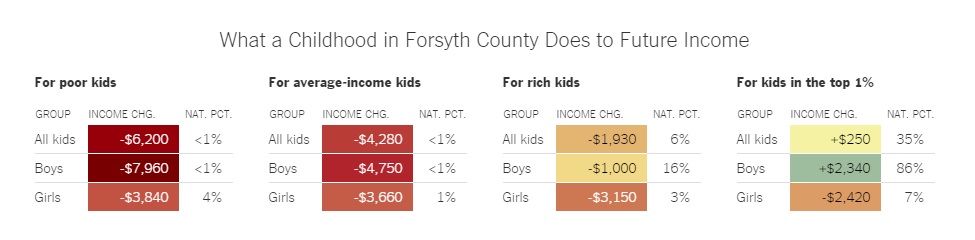
Take a look at this graphic and you can see that there’s a huge disparity between the prospects for poor kids and rich kids in the county:

Source NYtimes.com

Source NYtimes.com

Forsyth’s neighbor to the east, Guilford County, isn’t much better off:

It’s among the worst counties in the U.S. in helping poor children up the income ladder. It ranks 37th out of 2,478 counties, better than only about 1 percent of counties.

While it would be easy to say, “This should be a wake up call to the leaders of our community” I think that would be a cop out. This is the kind of thing that should concern us all because what do we think will eventually happen if we continue to allow a huge segment of our community to live in circumstances in which they perceive little chance of improving their lot in life? What do we think these young people will do when they lose hope?

So yeah, our elected leaders should view this as an early warning that they need to address these underlying causes of this disparity in opportunity, but this is bigger than them. All of us need to get engaged, through our schools, churches, civic groups, businesses and neighborhoods, in order to begin to make any progress in improving the prospects for our kids’ futures. The underlying issues are systemic – broken family structures, poor educational attainment, too many low wage jobs, etc. – and only a concerted effort by the entire community will be able to address them. If we don’t we will have much larger problems on our hands in years to come.

Winston-Salem and Forsyth County have made a great deal of progress in addressing the major economic challenges that were wrought by the declines of the local manufacturing industries, highlighted by the resurgence of downtown Winston-Salem, but now we need to make sure that the tide rises for everyone, not just those lucky enough to be born into well off families.

Jobs and Money

Why are jobs important? Well, beyond the obvious there’s the added benefit that it helps keep people out of trouble. From the May, 2015 issue of Rotarian Magazine:

Summer jobs can help prevent violence among disadvantaged students, according to a large-scale trial out of the University of Pennsylvania and the University of Chicago Crime Lab. The study involved 1,634 teenagers from 13 high-crime schools in Chicago, and a local program that places youth in part-time paid summer jobs and pairs them with mentors. The job-assignment intervention reduced violence by 43 percent over 16 months, with nearly four fewer violent-crime arrests per 100 students compared with the control group.

From the same issue of the magazine comes this little tidbit of info:

One percent of the global population owns nearly half the world’s wealth, according to a new report from Oxfam, and that share is expected to exceed 50 percent within two years. The richest 20 percent of the population owns most of the other half of the world’s resources, and the remaining 80 percent of people share just 5.5 percent. The combined wealth of the 80 richest individuals in the world has doubled since 2009, and surpasses the combined wealth of the 3.5 billion people in the bottom half.

Where the Buck Stops

A big part of being a good leader is doing the right thing when things don’t go right. Today I’d say the chief of the UNC-Greensboro campus police department is providing a small example of how to react when things go wrong. Here’s the story from my particular point of view:

Last night there was a shooting at an off-campus student apartment community. My son happens to attend UNCG and lives in an off-campus apartment, but not in the community where the shooting occurred. Knowing that his parents might hear about it and might be concerned for his safety he sent me a text saying that a shooting had happened near his apartment, but that it wasn’t in his particular apartment community and that he was fine. We definitely appreciated it, but it also caused me to start monitoring the news about the shooting. As always I turned to Twitter because that tends to be where I get news the earliest, including from the various local news outlets, and sure enough that’s where all the freshest info was coming from.

That’s why I was able to see these Tweets from UNCG:

UNCGTweet

See that top Tweet that includes a suspect description of “B/M, 6′-6’2″, Red Shirt, Red hat, Goatee and a large bottom lip”? Well that predictably struck many as a racist description and generated the responses you’d expect online. So what did the chief do? Well, among other things he sent a message to the UNCG community which my son received by email and forwarded to me:

To the UNCG Community,

On behalf of the UNCG Police Department, I want to apologize for what many considered a racially insensitive description included in one of the alerts last night. We give our staff a great deal of latitude in crafting emergency messages because safety often depends on timeliness.  Sometimes that means just repeating descriptions provided to us, as we did in this case.  However, we know our community and should be able to filter information in a way that reflects our values but still provides the information you need to stay safe.  One of our core values is Accountability, and, ultimately, I am the head of this agency, and I am accountable for the actions of those who serve you at the Police Department.  For that reason, I apologize to those who were offended. We can do better, and we will.

Jamie Herring
Chief of Police
UNCG Police Department
P.O. Box 26170
Greensboro, NC  27402

I truly can’t tell you anything about the department or the chief outside of this event because I haven’t had cause to pay any attention to them, but I can tell you that this is a very good response to a screw up that happened on his watch. It’s nice to see a leader accept the buck instead of passing it along.

A Tale of Two Forsyth Counties

If you set up a Google news alert with the keywords “forsyth county” you’ll get a lot of news about two different places – Forsyth County, NC (where I live) and Forsyth County, GA. Today I saw a story about each from their local news outlets with the following headlines:

  1. Forsyth County Remains Healthiest in Georgia (GA)
  2. Forsyth County Slips Again in Health Rankings (NC)

If you read the articles you’ll see that Forsyth County, GA ranks first in its state and Forsyth County, NC ranks 29th in its state. So is my home county significantly less healthy than its counterpart in Georgia? If you look at a comparison of the two (see table below) using data from the countyhealthrankings.org you can see that Georgia has better numbers in many categories, but they really aren’t that far apart when you take into account the population size of each county. According to the US Census North Carolina’s Forsyth had 360,221 in 2013 and Georgia’s had 195,405 so even if you looked at some raw numbers that look pretty bad for NC, the population difference changes things. For instance:

Premature Deaths: NC 7,218 vs GA 4,234 but if you adjust for population size you see that NC’s is 2% of its population and GA’s is 2.16%. Still a decent difference but not as stark.

Then there’s this number:
Sexually Transmitted Infections: NC 755 vs GA 91

No amount of adjusting for population makes that better for NC (and gross!), and as you can see we in Forsyth of NC fare worse than GA based on our behaviors in general. Luckily we’ve got an awesome doctor/resident ratio to help deal with the consequences of our sins:

Ratio of primary care physicians to population: NC 945:1 vs GA 2,506:1
Ratio of dentists to population: NC 1,657:1 vs GA 2,677:1
Ration of mental health providers to population: NC 406:1 vs GA 2,246:1

Probably the biggest difference between the two counties, and a huge contributor to the health differences, is that Forsyth, GA appears to be far more affluent than Forsyth, NC.  In addition to the numbers in the chart below (NC’s child poverty rate 3x greater, single parent homes 2.5x greater violent crime 2x greater per capita) you have this data from the US Census: median household income (2009-13) in Forsyth, GA is $86,569 and in NC it’s $45,274.

Money may not buy love, but it sure does help on the health front.

A Life is a Life

Two stories that have captivated people this last week have involved horrific crimes, and unfortunately those crimes have exposed a real weakness in our society that could actually promote more crimes just like them in the future.

In the first a man in Chapel Hill, NC, killed three young adults, who were his neighbors in their condo complex, in what the police have characterized as a dispute over a parking space. Because the three young people who were killed were Muslim the initial reaction of many people in the community was that it must be a hate crime, that the killer must have targeted them for being Muslim. Indeed, their families have asked the authorities to investigate it as a hate crime, and if the killer was found to have been engaged in a hate crime then the punishment would be more severe.

In the second story the depraved humans who make up ISIS beheaded over 20 Egyptians of the Coptic Christian faith in a move that was obviously intended to not only continue the group’s campaign of terror but to provoke Christians into a fight, to drive a wedge even deeper between the members of the Muslim faith who aren’t crazed jihadists and Christians, and to recruit even more depraved jihadists to join their side, and not inconsequentially, to juice their fundraising.

What’s truly disturbing about these stories, beyond the horrific nature of the crimes themselves, is our continued practice of assigning greater value to them because of who the victims were. We act as if the killings are worse because the victims are Christian or Muslim and we think they were killed because of it, as if that’s somehow worse than being killed for walking into the bank when it just happened to be getting robbed by someone with an itchy trigger finger. We don’t say it, but we imply by our reactions that we believe that because someone from our faith, our tribe, was killed that the tragedy is greater. That those three or twenty lives were somehow more tragic to lose than if they’d been from another tribe.

As hard as it is to see past our emotions it’s imperative to be honest with ourselves and realize that as long as we assign greater value to one killing because of who the victim is, or the sect/race/family they are from then we are dividing ourselves and perpetuating the very thing that enables the ISIS’s of the world. If anything we should be more enraged that three young lives were lost to a petty neighborhood dispute than to the interminable sectarianism that has defined humanity since the beginning of time. We should be equally horrified by the massacre of all people everywhere, no matter their race or religion or tribe, because a life is a life, and any life lost to inhumanity is a crime against us all.

That of course is what institutions like religion and government are supposed to do – to help us overcome the very base emotions that define the human being – but instead they are used by many of those very humans to continue the cycle of strife and death that we seem helpless to escape. Sadly, this will likely never end as long as people walk the Earth. We are simply too human.

Fighting Anecdotal Fire With Anecdotal Fire

This article in Slate, written by a woman whose mother did not have her vaccinated and thus suffered through mumps, measles, rubella, etc., is an excellent piece of thinking about the current hubbub related to vaccinations. I like this part in particular:

I find myself wondering about the claim that complications from childhood illnesses are extremely rare but that “vaccine injuries” are rampant. If this is the case, I struggle to understand why I know far more people who have experienced complications from preventable childhood illnesses than I have ever met with complications from vaccines. I have friends who became deaf from measles. I have a partially sighted friend who contracted rubella in the womb. My ex got pneumonia from chickenpox. A friend’s brother died from meningitis. 

Anecdotal evidence is nothing to base decisions on. But when facts and evidence-based science aren’t good enough to sway someone’s opinion about vaccinations, then this is where I come from. After all, anecdotes are the anti-vaccine supporters’ way: “This is my personal experience.” Well, my personal experience prompts me to vaccinate my children and myself. I got the flu vaccine recently, and I got the whooping cough booster to protect my son in the womb. My natural immunity—from having whooping cough at age 5—would not have protected him once he was born.

(Bold emphasis mine)

There are a lot of things that frustrate me about the vaccination debate, not the least of which is that someone else’s decision to ignore science and logic might adversely affect other peoples’ health, but what really gets my goat is the trend the author points out of people refuting evidence with anecdote.

Recently I saw a post on Facebook in which someone shared an information piece of dubious origin that said something like: “Number of deaths from measles last year: 0. Number of deaths from measles vaccines: 106” There are so many things wrong with this, but here are the most obvious:

  • First of all, if you’re going to share this kind of data then please share the source so it can be verified as legitimate.
  • Second, if it is legitimate then please share whether or not that’s in the US or the world. Why? Because if it’s the world then I can flat out tell you it’s BS. From the World Health Org.:
    WHO warned today that progress towards the elimination of measles has stalled. The number of deaths from measles increased from an estimated 122 000 in 2012 to 145 700 in 2013, according to new data published in the WHO Weekly Epidemiological Report and the Centers for Disease Control and Prevention’s (CDC) Morbidity and Mortality Weekly Report. The estimated number of measles deaths in 2013 represents a 75% decline in mortality since 2000, significantly below the target of a 95% reduction in deaths between 2000 and 2015.
  • Third, if it IS true and it is just the US then use percentages rather than raw numbers. One reason so few people would have died from measles is because so many people were vaccinated! What percentage of people who got the vaccine died? Vanishingly small. And while the percentage of people who die after contracting measles would also be vanishingly small, that doesn’t mean the disease doesn’t wreak havoc by making people very sick.

So here’s the point, and I’m going to type it really slowly so the anti-vaxxers can keep up: You are entitled to your opinion. You are also entitled to ignore science and generally do stupid things. Your entitlement ends where others’ well being begins, thus if you decide to not vaccinate your children then your family should NOT be allowed to partake in any public activities or enjoy any other societal benefits that would put you in direct contact with the vaccinated population. No schools, no restaurants, no stores, no swimming pools, no movie theaters, no malls, no amusement parks, no public parks and no places of business (okay, maybe Walmart). Nada. Nothing. Don’t want to participate in 21st century public health programs? Fine, then don’t participate in 21st century public gatherings.