Author Archives: Jon Lowder

The Importance of Good Governance

*Update 1/26/16* – Well it took a while, but they’ve indicted Powell on four felony charges. They’re Class C felonies because more than $100,000 is involved. I’m going to guess that PTP’s governance processes have been tightened significantly.*

News broke today that the former CEO of the Piedmont Triad Partnership is being investigated for financial irregularities stemming from his time at the organization. From the Triad Business Journal:

In a prepared statement released at noon today, the regional economic development group said the following:

“The Piedmont Triad Partnership has provided law enforcement authorities information about financial irregularities involving former CEO David M. Powell. When PTP learned of the irregularities following Mr. Powell’s resignation earlier this year, it immediately began its own assessment of what had happened and what amount of money is at issue. That assessment is ongoing.”…

“We’re taking this issue very seriously,” said Stanhope Kelly, who took over as CEO of PTP from Powell. “We will get to the bottom of this, and ensure it does not happen again. At the same time, the Triad needs jobs, and the Piedmont Triad Partnership’s primary goal is to attract jobs. And we’ll keep working to make good things happen in economic development.”

This caught my eye for a few reasons. First, PTP’s office is literally right across the street from where I work so it hits close to home. Second, I work for a non-profit and am in the equivalent role for my organization that Powell was for his.

Total aside – I was curious what Powell made and what kind of budget PTP had so I pulled up their 1099 from 2013. I’d say they took good care of him, because with salary plus benefits his compensation came to a little over $325k from an organization that had about $1.8 million in revenue that year.

Third, I know who’s on this board and if it ends up that there were financial irregularities with that board overseeing the organization then you can rest assured that it can happen to anyone.

Because no one owns a nonprofit the members of the board play the critical role of representing the interests of the organization as a whole, and by extension the interests of all of the organization’s constituencies. As you can imagine one of every board’s primary functions is to make sure that the organization’s resources, particularly financial, are sufficient enough for the organization to fulfill its mission. With some nonprofits that can be a challenge because the board members may not have the financial or business acumen necessary to truly understand what’s going on. A prime example would be a local food pantry with a board made up of passionate, mission-focused people who may have never seen a balance sheet in their lives.

The board for the PTP is the opposite. It’s comprised of business VIPs, mayors, bank executives and the like. If any board is loaded with people who are sophisticated enough to smell a financial rat this is it, yet they might have had money misappropriated on their watch. Now this story just broke and there could very well be a good explanation for whatever they found, but it’s also a healthy reminder that any organization can fall victim to malfeasance.

In the nonprofit world the topic of governance often gets the groans and eye rolls you usually associate with discussing taxes or budgets at home. We all recognize it’s important, a necessary evil if you will, but we usually dread doing anything about it. That’s too bad because from the perspective of the nonprofit executive and staff it really should be something we embrace. If nothing else it protects us from ourselves; if we make an honest mistake we stand a good chance of our board catching it before we get too far down the road. If we have a staff member that is taking advantage of a weakness in our systems we stand a better chance of catching it if we’re constantly vigilant because our board is demanding it of us. Is it drudgery sometimes? Sure. But in my mind the whole purpose of governance is to acknowledge the inherent weaknesses we all have as humans and to protect our organizations from them.

Now, I’m gonna go do a double check of the books at work to make sure I’m not casting stones while living in a glass house.

What Interests Moms vs Dads

So I was invited by a friend to sign up for the Flipboard magazine “Interesting Stuff” which I appreciate because it does look interesting. As part of the sign up process you’re asked to pick areas of interest so I was scrolling through the page, clicking away on topics that interested me, when I got to the category of “Kids.” Under that category four topics were listed – Pregnancy, Fatherhood, Motherhood, Parenting Teens – and when I clicked on Fatherhood this is what appeared:

Flipboard_Fatherhood

So clicking on Fatherhood added four suggested categories that included Child Support, Child Custody, Family Law and Child Psychology. As a bonus the Child Support category is accompanied by what looks like a mugshot of a man and the Child Custody category is augmented by the picture of a dead cat with blood running from what looks like its head, although the head is thankfully covered by a black box. So apparently people interested in fatherhood as a topic are assumed to be seriously effed up.

Here’s what was served up when I clicked on Motherhood:

Flipboard_Motherhood

The suggested topics are Birth Control Pill, Surrogate Mother, Stillbirth and Pregnancy Test. Doesn’t appear as bad as the Fatherhood topics, but taken in total the whole parenting thing seems kind of depressing doesn’t it?

That’s One Expensive Comma

My 10th grade English teacher would have loved to have this real-world evidence that grammar truly matters:

In May 2014, Medfusion sued Allscripts, alleging breach of contract and other claims arising from an agreement to create and market an online patient portal for health care providers. Medfusion claimed Allscripts didn’t meet its commitments under the contract and sued for more than $4 million in damages…

According to the court’s March 31 ruling, the contract stated that “in no event shall either party be liable for any loss or damage to revenues, profits, or goodwill or other special, incidental, indirect, or consequential damages of any kind, resulting from its performance or failure to perform under this agreement …”

Allscripts argued that the comma before “or goodwill” is an Oxford, or serial, comma that sets apart three independent categories of damages barred by the agreement: revenues, whether direct or indirect; profits and goodwill.

Medfusion, on the other hand, argued the “or other … consequential damages” language modifies “revenues, profits, or goodwill,” meaning these categories of damages are only excluded to the extent that they are considered consequential, or indirect.

I’ve read this three times and I’m still confused, but truth be told I’m one of those rare English majors who wouldn’t recognize a prepositional phrase if it sat in my lap. Suffice it to say that law firms might want to employ a strong copy editor just to be safe.

Where the Buck Stops

A big part of being a good leader is doing the right thing when things don’t go right. Today I’d say the chief of the UNC-Greensboro campus police department is providing a small example of how to react when things go wrong. Here’s the story from my particular point of view:

Last night there was a shooting at an off-campus student apartment community. My son happens to attend UNCG and lives in an off-campus apartment, but not in the community where the shooting occurred. Knowing that his parents might hear about it and might be concerned for his safety he sent me a text saying that a shooting had happened near his apartment, but that it wasn’t in his particular apartment community and that he was fine. We definitely appreciated it, but it also caused me to start monitoring the news about the shooting. As always I turned to Twitter because that tends to be where I get news the earliest, including from the various local news outlets, and sure enough that’s where all the freshest info was coming from.

That’s why I was able to see these Tweets from UNCG:

UNCGTweet

See that top Tweet that includes a suspect description of “B/M, 6′-6’2″, Red Shirt, Red hat, Goatee and a large bottom lip”? Well that predictably struck many as a racist description and generated the responses you’d expect online. So what did the chief do? Well, among other things he sent a message to the UNCG community which my son received by email and forwarded to me:

To the UNCG Community,

On behalf of the UNCG Police Department, I want to apologize for what many considered a racially insensitive description included in one of the alerts last night. We give our staff a great deal of latitude in crafting emergency messages because safety often depends on timeliness.  Sometimes that means just repeating descriptions provided to us, as we did in this case.  However, we know our community and should be able to filter information in a way that reflects our values but still provides the information you need to stay safe.  One of our core values is Accountability, and, ultimately, I am the head of this agency, and I am accountable for the actions of those who serve you at the Police Department.  For that reason, I apologize to those who were offended. We can do better, and we will.

Jamie Herring
Chief of Police
UNCG Police Department
P.O. Box 26170
Greensboro, NC  27402

I truly can’t tell you anything about the department or the chief outside of this event because I haven’t had cause to pay any attention to them, but I can tell you that this is a very good response to a screw up that happened on his watch. It’s nice to see a leader accept the buck instead of passing it along.

“Professional” Education

For my day job I work for a local trade association and one of our core services is to provide professional education for our members’ employees. We spend a great deal of time trying to make sure we provide the best training and continuing education possible. We have a staff member who, along with a committee of volunteers from the industry, spends a tremendous amount of time recruiting instructors for the various classes and seminars we provide, staying on top of emerging trends in the industry, organizing instructor training and anything else necessary to make sure we have a top-shelf education program. In other words, it’s something we pay a lot of attention to.

Perhaps that explains why I was irked when a friend shared a link to a calendar item on a chamber of commerce’s website. It’s a free seminar on social media that the chamber and a small business center are hosting, which on the face of it sounds pretty straight forward. The problem comes when you do a search on the instructor, which my friend did, and find out that the instructor’s Facebook page only has a few dozen “likes”, the instructor has fewer than a handful of Twitter followers and has a website that can best be described as looking like the campaign page of a kid running for junior class president in 1998.

As I said to my friend I have nothing against the person trying to build a social media business (I think that’s what’s happening), but I have a huge problem with a chamber or other business association not doing its job well by providing quality professional education opportunities. Normally I’d dismiss it as a one-off mistake, but I’ve suffered through some of this particular chamber’s educational offerings in the past and I can tell you this is not the first time it’s happened.

You might argue that it’s unfair to judge the course, or the instructor, without sitting through the seminar. My reply would be that in the world of social media you can’t simply teach theory out of a book – experience matters – and there are SO many people in this area who do have that experience and could teach this course that there’s no reason to recruit someone who clearly hasn’t walked the walk.

Doing a seminar just to say you did it, or because someone raised their hand and said, “I can do this for free” is a terrible idea. You end up diminishing your value to your members, and before long they start running away. Obviously a chamber is more than just education, and this chamber in particular has long seemed to see their small business members as a necessary evil, but if you’re going to do something you might as well do it right or not do it at all.

A Tale of Two Forsyth Counties

If you set up a Google news alert with the keywords “forsyth county” you’ll get a lot of news about two different places – Forsyth County, NC (where I live) and Forsyth County, GA. Today I saw a story about each from their local news outlets with the following headlines:

  1. Forsyth County Remains Healthiest in Georgia (GA)
  2. Forsyth County Slips Again in Health Rankings (NC)

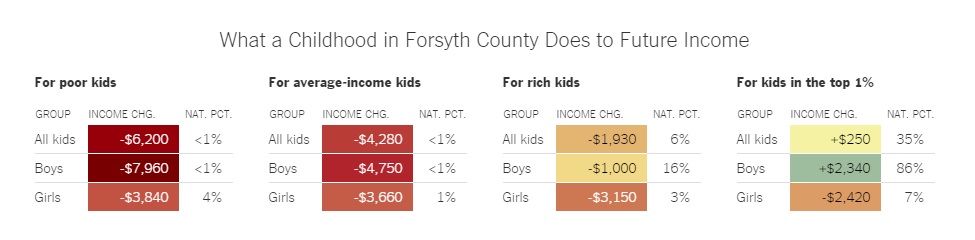
If you read the articles you’ll see that Forsyth County, GA ranks first in its state and Forsyth County, NC ranks 29th in its state. So is my home county significantly less healthy than its counterpart in Georgia? If you look at a comparison of the two (see table below) using data from the countyhealthrankings.org you can see that Georgia has better numbers in many categories, but they really aren’t that far apart when you take into account the population size of each county. According to the US Census North Carolina’s Forsyth had 360,221 in 2013 and Georgia’s had 195,405 so even if you looked at some raw numbers that look pretty bad for NC, the population difference changes things. For instance:

Premature Deaths: NC 7,218 vs GA 4,234 but if you adjust for population size you see that NC’s is 2% of its population and GA’s is 2.16%. Still a decent difference but not as stark.

Then there’s this number:
Sexually Transmitted Infections: NC 755 vs GA 91

No amount of adjusting for population makes that better for NC (and gross!), and as you can see we in Forsyth of NC fare worse than GA based on our behaviors in general. Luckily we’ve got an awesome doctor/resident ratio to help deal with the consequences of our sins:

Ratio of primary care physicians to population: NC 945:1 vs GA 2,506:1
Ratio of dentists to population: NC 1,657:1 vs GA 2,677:1
Ration of mental health providers to population: NC 406:1 vs GA 2,246:1

Probably the biggest difference between the two counties, and a huge contributor to the health differences, is that Forsyth, GA appears to be far more affluent than Forsyth, NC.  In addition to the numbers in the chart below (NC’s child poverty rate 3x greater, single parent homes 2.5x greater violent crime 2x greater per capita) you have this data from the US Census: median household income (2009-13) in Forsyth, GA is $86,569 and in NC it’s $45,274.

Money may not buy love, but it sure does help on the health front.

Time Travelers

The old blog has been neglected of late because yours truly has been preparing for, and then participating in, a week-long vacation in England. That meant we started living five hours ahead of our friends and family back home in North Carolina, at least for the first few days we were there.

At 2 a.m. this past Sunday morning the folks back in NC “sprang forward” for daylight savings time, but in England they don’t make the leap until the end of the month. That means for the last couple of days we have only been four hours ahead of everyone back home,  so we time traveled while we slept on Sunday, which is kinda cool when you think about it.

Oh and here’s some random pics of our time travels.

image

image

image

Apartments a Big Part of Winston-Salem’s Downtown Revitalization

I wrote the following for the blog at the day job and am re-posting it here because I thought it would be of interest to some people from my neck of the woods:

At its annual meeting on February 24 the Downtown Winston-Salem Partnership outlined how Winston-Salem’s downtown has been revitalized over the last 15+ years:

The nonprofit group listed 88 downtown investment projects since 2000 that have either been completed, are under way or for which a firm commitment has been made.

The combined capital investment value is $1.23 billion, topped by the $106 million spent on Wake Forest BioTech Place and the $100 million commitment by Wake Forest Baptist Medical Center toward a major medical education facility. Both buildings are in Wake Forest Innovation Quarter.

The investment is divided into eight categories: health and technology (eight projects, total $445.4 million); infrastructure (10 projects, total $188.4 million); institutional and public development (15 projects, total $181.6 million); residential (15 projects, total $140 million); multiple use (eight projects, total $95.1 million); office (five projects, total $88.4 million); arts and entertainment (five projects, total $50.3 million); and commercial (22 projects, total $42.2 million).

The Nissen Building, a PTAA member, was the largest residential project at $32 million, although far from the only project downtown – Winston Factory Lofts, Plant 64, Hilltop House, The Gallery Lofts, and Link Apartments Brookstown to name just a few. The transformation of the former Reynolds HQ building into a Kimpton Hotel and apartments has recently captured the city’s imagination as well as the soon-to-open Mast General Store project that will add another marquee destination for the downtown. In other words the revitalization shows no signs of slowing down.

Meanwhile over in Greensboro the entity charged with leading its downtown revitalization, Downtown Greensboro Inc, is going through a transitional phase and is looking for a new leader. That’s important because there are several projects in the works that will alter downtown Greensboro significantly over the next few years and it’s essential that there be someone at the wheel who can bring together the various constituencies – city government, elected leaders, industry, educational institutions, etc. – and provide a strategic direction for downtown redevelopment. If Greensboro can manage to bring some strategic direction to the downtown then we’re sure to see even more apartments developed in the downtown area in addition to those like Greenway at Fisher Park, CityView and the Southeastern Building.

As for High Point, well they have a new mayor, lots of new city council members and a new city manager and one of their primary tasks is figuring out how, and where, to revitalize their city. With the furniture market they do have a unique challenge so it will be interesting to see how things evolve there.

These are indeed interesting and (finally) dynamic times in the Piedmont Triad.

A Life is a Life

Two stories that have captivated people this last week have involved horrific crimes, and unfortunately those crimes have exposed a real weakness in our society that could actually promote more crimes just like them in the future.

In the first a man in Chapel Hill, NC, killed three young adults, who were his neighbors in their condo complex, in what the police have characterized as a dispute over a parking space. Because the three young people who were killed were Muslim the initial reaction of many people in the community was that it must be a hate crime, that the killer must have targeted them for being Muslim. Indeed, their families have asked the authorities to investigate it as a hate crime, and if the killer was found to have been engaged in a hate crime then the punishment would be more severe.

In the second story the depraved humans who make up ISIS beheaded over 20 Egyptians of the Coptic Christian faith in a move that was obviously intended to not only continue the group’s campaign of terror but to provoke Christians into a fight, to drive a wedge even deeper between the members of the Muslim faith who aren’t crazed jihadists and Christians, and to recruit even more depraved jihadists to join their side, and not inconsequentially, to juice their fundraising.

What’s truly disturbing about these stories, beyond the horrific nature of the crimes themselves, is our continued practice of assigning greater value to them because of who the victims were. We act as if the killings are worse because the victims are Christian or Muslim and we think they were killed because of it, as if that’s somehow worse than being killed for walking into the bank when it just happened to be getting robbed by someone with an itchy trigger finger. We don’t say it, but we imply by our reactions that we believe that because someone from our faith, our tribe, was killed that the tragedy is greater. That those three or twenty lives were somehow more tragic to lose than if they’d been from another tribe.

As hard as it is to see past our emotions it’s imperative to be honest with ourselves and realize that as long as we assign greater value to one killing because of who the victim is, or the sect/race/family they are from then we are dividing ourselves and perpetuating the very thing that enables the ISIS’s of the world. If anything we should be more enraged that three young lives were lost to a petty neighborhood dispute than to the interminable sectarianism that has defined humanity since the beginning of time. We should be equally horrified by the massacre of all people everywhere, no matter their race or religion or tribe, because a life is a life, and any life lost to inhumanity is a crime against us all.

That of course is what institutions like religion and government are supposed to do – to help us overcome the very base emotions that define the human being – but instead they are used by many of those very humans to continue the cycle of strife and death that we seem helpless to escape. Sadly, this will likely never end as long as people walk the Earth. We are simply too human.

Church, the Most Segregated Place in America

From a piece written about Dean Smith by Charles Pierce comes this paragraph with a sentence that rings uncomfortably true:

His father integrated a high school team in Kansas in the early 1930s. Smith himself walked into a Chapel Hill restaurant as part of the first great wave of protests in the 1950s. He tried to recruit Lou Hudson, and then he did recruit Charlie Scott, blowing up the color line in the Atlantic Coast Conference forever. He brought Scott home to dinner, and he brought Scott to church, always the most segregated place in America, even, alas, today. (Emphasis mine)

Unfortunately he speaks the truth, and of all the places it shouldn’t be it’s the church. Any church.