Category Archives: Interesting

The Life Magazine Published the Week I Was Born

Here'sa link to the issue of the Life Magazine that was published the week I was born.  Check out the cool products being advertised, like the "New Admiral 25" Rectangular Color TV in slim new cabinets" or the Fujica Single 8 the "only instant load movie camera that fits into your pocket." Groovy!

By the way, you can check out the entire Life magazine archive at GoogleBooks.

How Sin Taxes Would Work Better in NC

Some geographers at Kansas State University had a little fun and mapped the Seven Deadly Sins throughout the US.  It appears that we North Carolinians are an envious, lustful, proud, wrathful and gluttonous bunch.  Especially gluttonous.  Maybe instead of increasing taxes on alcohol and tobacco we should look at upping the taxes on guns and BBQ.

Hat tip to Ed Cone for the pointer.

Random News: W Offered Job as Greeter; Laid Off Wall Streeters Offered Lifeguard Jobs; Mom Assaults Son’s Middle School Coach; More Stories

I figured we could all use a little Random News today.  The following items came from various feeds in my Google Reader:

That's it for this edition of Random News.

President’s Day, MLK Day and Confederate Memorial Day?

Here's an interesting item from our neighbors to the south.  A Democratic state senator in South Carolina has gotten a subcommittee's approval of a bill requiring all cities and counties in South Carolina to give their employees a paid day of vacation on Confederate Memorial Day or lose state funding.  Here's the kicker: the senator is African American.  From the article on ABC News:

Democratic Sen. Robert Ford's bill won initial approval from a Senate subcommittee Tuesday. It would force county and municipal governments to follow the schedule of holidays used by the state, which gives workers 12 paid days off, including May 10 to honor Confederate war dead. Mississippi and Alabama also recognize Confederate Memorial Day.

Years ago, Ford said, he pushed a bill to make both that day and Martin Luther King Jr. Day paid holidays. He considered it an effort to help people understand the history of both the civil rights movement and the Confederacy in a state where the Orders of Secession are engraved in marble in the Statehouse lobby, portraits of Confederate generals look down on legislators in their chambers and the Confederate flag flies outside.

"Every municipality and every citizen of South Carolina, should be, well, forced to respect these two days and learn what they can about those two particular parts of our history," Ford said Tuesday.

In a state steeped in a segregationist past, "there's no love in this state between black and white basically," he said. That's not apparent at the Statehouse, where black and white legislators get along, "but if you go out there in real South Carolina, it's hatred and I think we can bring our people together."

Not surprisingly the leader of the state's NAACP doesn't agree with the Senator.  It's an interesting story so go ahead and read the whole thing.

Newspapers Have Faced Hard Times Before

Mark Cuban wrote an interesting piece about pro sports teams forming a company that would essentially provide beat writers that would cover local sports teams in exchange for a certain number of pages being dedicated to pro sports in each paper.  Newspapers would maintain editorial control, but they wouldn't have to pay the writers.  He provides much more detail in his post and it's a worthwhile read, but almost as interesting was a Time article he linked to at the end.  Here's an excerpt:

Consolidation. As a result, the era when newspapers produced some of
America's great fortunes (e.g., Hearst, E. W. Scripps, Pulitzer, et
al.) is past. Publishers who like to consider themselves primarily
"editorial men" find themselves spending more and more time on business
affairs. Even such dailies as the wealthy, institutionalized New York
Times, which has about 4,700 employees on its payroll, have been hard
hit. Last year's ten-day newspaper strike (TIME, Dec. 7 et seq.) says
Times Publisher Arthur Hays Sulzberger, wiped out "virtually all, and I
mean that literally, of the anticipated profit from 1953 operations."
The Times has also been forced to pare down its voluminous news space,
e.g., it recently cut its foreign news 10%.

One of the few U.S. newspaper companies that publicly report their
profits, the Boston Herald-Traveler Corp. has seen its profits fall off
from $1,270,813 in 1946 to $526,283 last year. In cities where there
are monopolies, the papers are doing better. Greensboro, N.C.'s
Jefferson Standard Life Insurance Co., which helps finance 23 papers
all over the U.S., reports that the profit margin of its papers in
competitive cities has slipped to less than 5%, while in monopoly
cities it is nearly 18%.

High costs have already taken their toll. Last year 22 dailies were
suspended or merged, leaving 82% of all U.S. towns and cities that have
newspapers with only one daily (v. about 40% in 1900). The Washington
Times-Herald recently found rising costs too much to bear, sold out to
Eugene Meyer and Philip Graham of the Washington Post. High costs have
also made starting a big, new daily virtually impossible without
millions in reserve capital.

If you paid close attention to the details you probably noticed some strange names associated with the newspapers and you're probably wondering why you never heard about the newspaper strike.  It's because the article ran in 1954, but it sounds eerily similar to something you'd read today.  Later in the article the author talks about newspaper companies finding some cushion in their radio and television stations, much like current newspaper companies are looking for a cushion in their online operations.

If you have a couple of minutes it really is an interesting read.
Predictable News: Group Moving Homeless People Into Empty Foreclosed Houses

It was only a matter of time before something like this happened:

But in nearly every other respect, he is unlike any real estate
agent you've ever met. He is unshaven, drives a beat-up car and wears
grungy cut-off sweat pants. He also breaks into the homes he shows. And
his clients don't have a dime for a down payment.

Rameau is
an activist who has been executing a bailout plan of his own around
Miami's empty streets: He is helping homeless people illegally move
into foreclosed homes.

“We're matching homeless people with peopleless homes,” he said with a grin.

Rameau
and a group of like-minded advocates formed Take Back the Land, which
also helps the new “tenants” with secondhand furniture, cleaning
supplies and yard upkeep. So far, he has moved six families into
foreclosed homes and has nine on a waiting list.

Later in the article Rameau says he's not afraid of being arrested and that he's doing the homeowners a service by helping prevent vandalism and destruction of property.  I guess that's why he has to break in.

Latisse: For Your Lashes, Not Your Garden

According to Scientific American a new drug that promotes eyelash growth has been approved by the FDA.  From the article:

The med, called Latisse, should be available by March from a doctor or
with a prescription from one. Price tag: $120 for a month’s supply.
According to manufacturer Allergan, the drug usually nets results two
to four months after users start it. Potential side effects: Some 4
percent of users experience eye itching and redness, and it may also
temporarily darken the skin of the eyelid, according to the company.

You'll know when the drug has hit the market when you start to see lots of women walking around with eyelids that look like Lon Chaney's. On another note, if you're spending $120 a month for eyelashes then they better be long enough to string a violin.  Sheesh.

How Much is Netflix Really Costing You?

We've been members of Netflix forever and I've noticed that we use it in fits and starts.  Really it's my fault because I'm generally the one that goes to the website and selects the movies, and I get in trouble when I try to anticipate what everyone will want to watch.  When I do I pick "blah" movies that no one wants to watch, but I think the family is afraid to tell me because they don't want me to feel offended.  On the other hand, I don't want to turn them in because I figure at some point we'll all sit down to watch them.  So there they sit on top of the DVD player, sometimes for weeks on end.

Our heavy usage tends to occur when I find something I really like, say The Wire, and order all of the DVDs and watch them as soon as they come in and return them promptly so that I can watch the next DVD in the series.  Unfortunately that happens about every third month so our droughts are longer than our downpours and I've suspected for a while that we've been paying more than we would renting on an as-needed basis from Blockbuster.

All that's to explain why I immediately tried out FeedFlix when I read about it on Lifehacker.  I just plugged in an RSS feed from our account and within a few seconds I had all the info I could ever want on my family's Netflix usage (see image to the left).  Because our droughts are so long our average hold time for a movie is 7 days and our average cost to rent a movie over the lifetime of our account is a whopping $23.79.  That's nuts!

Now we could pull that down over time by making sure that we recycle our movies very quickly, and now that we can watch Netflix movies online at no additional cost and/or watch them via Tivo once our Tivo is updated then we could really pull that number down quickly.  As it is we're Netflix's dream customer and I hate being that.

So you Netflix customers out there: what are you spending per movie?

Lest You Think all Sheriffs are Old, Fat or Both

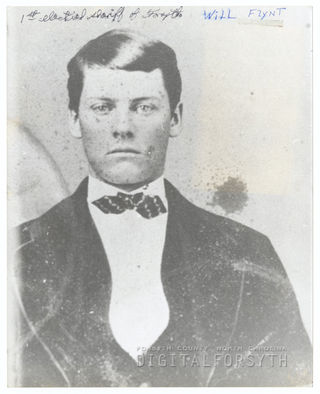
Sheriff will flynt Who's that strapping young fellow pictured to the left?  Why that's Forsyth County's first duly elected sheriff, one Will Flynt who served as sheriff from 1850-1854.  Is it just me or does he look like he's 12 in that picture?  More photos like that can be found at Digital Forsyth. (Picture courtesy of the Forsyth County Public Library Photograph Collection)