5 MB/1,000 Kilo Disk in 1956

4 GB/19.8 Gram Flash Drive in 2014
5 MB/1,000 Kilo Disk in 1956
4 GB/19.8 Gram Flash Drive in 2014
If you want to know why it’s important that we have strong, trustworthy government and media in our society then all you need to do is look at the developing ebola situation.
Unless you’ve been asleep for the last six months you’ve seen news about the growing ebola epidemic in Africa and the worldwide angst that has ensued as cased have popped up in Europe and the U.S. Here in America the government – the Center for Disease Control in particular – is under intense pressure and scrutiny after they bumbled in their initial response to the first U.S. case in Dallas. Unfortunately those early mistakes have created a scenario in which people who were already skeptical of the government’s competency will now disregard anything the authorities say about the disease. They’ll also be susceptible to overreacting to suppositions or improbable outcomes ginned up by media outlets desperate for their attention. Here’s an example from Fox & Friends:
So while the story isn’t totally irresponsible in that the interviewee and the Fox on air talent repeatedly say that nothing currently indicates the disease can be transmitted through the air, they also say repeatedly that at some point the virus could mutate and become transmittable by air. While the interviewee couldn’t put a number on the probability he also couldn’t call it a zero probability.
You can guess what happens next. People who will look for any reason to discount the government because it’s led by their arch-nemesis President Obama, and that would be the vast majority of Fox’s audience, take to their social media accounts and start sharing the story and saying things like, “We knew that Obama/the CDC was lying about this to keep us from panicking” or “The CDC is so incompetent that they didn’t know that ebola could go airborne.” What makes it even worse is that the clip that Fox & Friends put on their Facebook page is a 22 second excerpt that includes only the pieces of the interview where the expert says it’s possible for the virus to go airborne. Here’s a link to it.
In my mind that’s just plain irresponsible. They have to know full and well that people will be sharing that clip, that it will spread quickly with their viewers, and it will play into their audience’s preconceived notions about the Obama administration and the federal government. That’s par for the course with just about any topic these days, but it’s especially bad when you’re talking about a public health situation.
Back to the government’s side of this equation. They admit they bungled the initial response to this situation. That’s good, because while people might be unhappy, critical, calling for someone’s head to roll, etc. they will at least be working under the assumption that the authorities are being straight with them. Unfortunately the government has not always been straight with the public (think Watergate or any of the other “gates” that have happened over the last 40 years) so there exists a baseline of distrust in the American public that the media outlets exploit to appeal to their audiences. In other words, no matter how transparent the CDC is on this they will have a very hard time getting anyone to trust them. Just take a look at Matt Lauer’s interview with the head of the Department of Health and Human Services to see how even morning TV shows are disinclined to accept the government’s word at face value:
http://www.nbcnews.com/id/32545640
Visit NBCNews.com for breaking news, world news, and news about the economy
The really tragic part about all of this is that the public trust has been exploited to the point that when the American public is confronted by a true crisis they won’t know who to trust. How will they be able to discern a legitimate threat from a minimal threat that’s been hyped by various media outlets to discredit their favorite target? Hopefully we’ll never have to find out.
The Frandom, shorthand for “The Friday Random”, might be:
If I had to bet I’d put my money on number 2. Anyway, it’s intended to be a place where I share random stuff I found interesting this week. If you go through the thousands of posts on this blog you might find I’ve tried something like this before – I honestly can’t remember – but this will be the first time I’ve created a category called Frandom that I can use to organize these posts if they happen. Here we go:
10% of Americans Have 10+ Alcoholic Drinks Every Day
NFL’s Pink October Breast Cancer Campaign Misguided?
Walmart Heirs’ Net Worth Greater than 1,782,000 Average Americans Combined
Wake Forest Lab Working on Lab-Grown Penes
The Most Boring Men’s Club Calendar – if ever there’s a calendar I’d be in, this is it.
7 Netflix Hacks You’ve Probably Never Heard Of
How to Get Your Pictures Printed on Wood
Video of the Week – Insane Bike Ride
Not sure how this escaped the local press, or if it didn’t escape the local press how I missed it when they covered it, but it seems that Wake Forest’s Institute for Regenerative Medicine has graduated from creating lab-grown bladders to lab-grown penises:
Penises grown in laboratories could soon be tested on men by scientists developing technology to help people with congenital abnormalities, or who have undergone surgery for aggressive cancer or suffered traumatic injury.
Researchers at the Wake Forest Institute for Regenerative Medicine in Winston-Salem, North Carolina, are assessing engineered penises for safety, function and durability. They hope to receive approval from the US Food and Drug Administration and to move to human testing within five years.
While it is fun, in a very immature way, to play word games with this story it really is serious science that will mean a lot to the men it helps. It’s also quite cool that it’s happening here in Winston-Salem.
FYI, they’re working on a LOT more than bladders and penises:
Atala’s team are working on 30 different types of tissues and organs, including the kidney and heart. They bioengineered and transplanted the first human bladder in 1999, the first urethra in 2004 and the first vagina in 2005.
Finally, a random fact for you: the plural of penis can be either penises or penes. Who knew?
If you need proof that the American populace is terrible at assessing risk, then look no further than the current ebola hysteria. Is ebola a serious disease? Yep. Is it scary that it’s spreading like never before? Yep. But is it worth all the hysteria that we’re seeing, what with the CDC holding press conferences seemingly every half hour to calm America’s nerves? Well, let’s put it in perspective:
# of people in America who die each and every day from the flu or pneumonia: 147
# of people in America who have died of ebola in the history of the country: 1
Yeah, I’d say we’re over reacting just a tad.
For those of us who grew up in the DC area in the 70s and 80s the closest thing to a home baseball team we had was the Baltimore Orioles. My friends and I spent a good amount of time driving up I-95 to go to games first at Memorial Stadium and then at Camden Yards. The 70s and 80s were heady times for the Orioles who were perennial contenders in the AL East division against the hated (by Os fans) Yankees. The 70s and 80s were also a great time for Royals fans; their team dominated the AL West for years and they probably hated the Yankees almost as much as Boston fans do today since the Yankees seemed to always beat the Royals in the AL Championship Series.
Here’s an interesting twist though – the Royals and Orioles never faced off in the playoffs when they were both so strong. According to this Wikipedia page on the AL Championship Series the teams both appeared numerous times in the ALCS, but they never faced each other head-to-head. Checking out the Orioles team page confirms that they’ve never met, and that surprised me because in my notably fallible memory I could have sworn they had. All that’s to say that the fans who are old enough to remember the teams’ heyday should really enjoy this series.
Second Harvest Food Bank of NWNC has a great event coming up next Sunday that offers a unique opportunity to have some fun and help feed the hungry in the process. It’s called Wine, Women & Shoes and it will be held at Revolution Mills in Greensboro from 3-6 p.m. on Sunday, October 12, 2014. Details below and you can visit the website to order tickets.

Boiled down to their essence, social media platforms like Facebook, Twitter, Instagram, Pinterest, etc. are communication tools. They enable anyone who has them to communicate in a way that used to be restricted to people who could afford to buy their own printing press, radio station or TV station. That’s pretty cool, but just like any other tool it can be dangerous for those who maybe shouldn’t be allowed to walk with sharp scissors. A couple of cases in point:
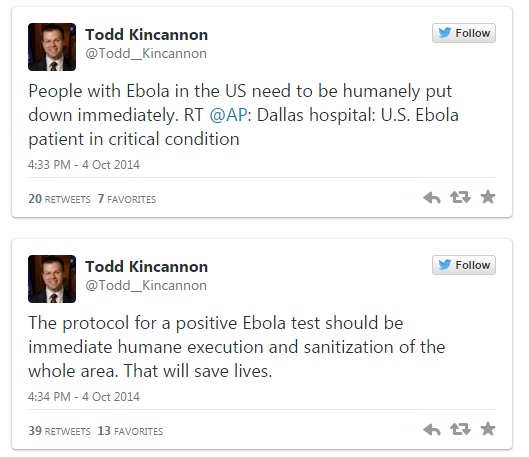
The former executive director of the South Carolina Republican Party has tweeted that Ebola victims should be euthanized to help prevent the spread of the disease. Here’s a couple of his tweets:
The second example is an image of Vladimir Putin that some conservatives are sharing on Facebook and suggesting that we Americans should follow his lead:

If you’d told me 20 years ago that Republicans would be looking for policy inspiration from a Russian autocrat I’d have said you were nuts. Ronald Reagan must be spinning in his grave.
The first example is obviously pretty extreme, but it’s a big deal because the person who posted it is prominent in his field and is seen to represent a large group of people. In the past, before he could express himself directly to so many people with just his two thumbs and a smart phone, he would have needed a witness to capture the moment and then share it via one of the traditional media outlets in order for anyone to really see it. In other words he likely would have had a media professional around to say, “Whoa, that’s some bat**** crazy stuff you’re spewing. Let’s not share that with the rest of the world.” Now he has all the tools he needs to reveal himself as a tool without anyone’s help.
The second example is a classic case of someone sharing what they think is an astute observation, no matter how half-witted it is, and then have it shared by like-minded people. This is interesting to me because it tends to say as much about the sharer as the creator and so over time people reveal their character and intellectual outlook by what they support and share. The only corollary I can think of from days gone by would be people posting signs in their yards or putting bumper stickers on their cars, and that by it’s very nature provides a much smaller window to the soul than do peoples’ social media activities.
Of course there’s a positive side to this. People can share inspiring messages, truly insightful observations, interesting facts, etc. on social media just as easily as they can negative/hateful thoughts, dumb ideas or historical inaccuracies. All-in-all it’s a net positive, especially when you consider that in addition to all the positive stuff we find via social media we also have a much more effective way to identify the tools in our midst.
This story won’t surprise anyone who’s been involved in trade show or event management:
The Marriott-run Gaylord Opryland resort in Nashville was faced with a dilemma. Like all hotels and exhibition centers, it charges exhibitors and conference organizers exorbitant amounts for Internet access on trade-show floors, as well as nightly fees for guests…
Thanks to fast cellular networks and portable WiFi hotspots, though, these halls are losing their extortionate edge. A carryover from the days of a captive audience who had no other choice, the wheeze was always factored in as a cost of participating in trade shows and other events. Now, however, the 4G LTE standard–whose frequency range penetrates buildings far better than most older cellular technologies–offers data rates in the tens of Mbps…
The Gaylord Opryland came up with a clever plan. Some level of hotel management understood that its Wi-Fi intrusion-mitigation system came with a feature that could kick people off networks — and not just their own. So, as the FCC explains in a press release and consent order [PDF] released today, Marriott staff at the facility made it impossible for people in the vicinity to use personal hotspots, portable routers, and the like. This is a big no-no: a violation of Section 333 of the Communications Act. A clever visitor to the convention center — likely someone irritated at being knocked off his portable router over and over again — discovered the deauth behavior and reported it in March 2013 to the FCC…
Marriott (which acquired the property in 2012) is paying a $600,000 fine, and under the terms of the consent decree, must halt its Wi-Fi blocking and implement and report on a compliance plan at all its properties in America.
The lesson here? If you’re staying at a hotel and you keep getting knocked off of your own hotspot you might want to go in search of a geek to help you find out if the hotel is messing with you.
BTW, about ten years ago I sold trade show booths for one of my clients and the one thing I could count on was getting phone calls from exhibitors complaining about the cost to rent carpet, furniture, electrical service and, more than anything, the cost of internet connections. After the trade show was over the number one complaint on follow up surveys with the exhibitors was the crappy speed of the internet connections or the connection going down for hours at a time. Mobile hotspots were just coming online at the time and their signal strength was often terrible in the concrete bunkers that convention centers often resemble, but as the quality got better more and more exhibitors relied on them. That’s why it’s not a surprise a convention center would try this and, in fact, it’s really more surprising that it’s taken this long for someone to get caught.
I might need to dust off the old resume, because apparently my English degree makes me a hot commodity:
…the skills you develop as an English major are the skills American business always says it needs more of: critical thinking, analytical ability, and the ability to communicate clearly. That was true 32 years ago and it remains true today. Those skills will prepare you for jobs that don’t even exist yet. I know that’s true because they did for me.
In fact, American business’s global competitors are finding they need the same skills, and that their job-focused college educations aren’t providing the people they need who have those skills. So they’re retooling their higher education along the U.S.’s traditional liberal-arts model.
And if you don’t believe Lex, well then check out this piece from American Express that he linked to. The article outlines some of the skills that employers are looking for that English majors have in spades; communication, writing, researching, critical thinking and empathy. That’s all great and good, but if you really want to be a stud you still might need to add a specific area of expertise to those broad skills:
The Association of American Colleges and Universities conducted a recent survey of what employers want from new hires. Its survey report, It Takes More Than a Major: Employer Priorities for College Learning and Student Success, shows that more than half of business executives want college graduates to have not only field-specific knowledge and skills, but a broad range of skills and knowledge. They place less value on the undergraduate major and more on a capacity to think critically, communicate clearly and solve complex problems. In an interview, Debra Humphreys, vice president at The AACU, said that the economic downturn has “put a premium on college graduates who are really multifaceted … people who have both broad knowledge and skills, as well as field-specific skills.” According to Humphreys, this concern has intensified over the years.
So if I dust of that resume I might want to consider adding a line to the education section. As an English major I’m sure I’d find a second degree, perhaps in nuclear engineering, to be a piece of cake.

