Health Insurance – Caveat Emptor

One of the problems with buying health insurance is that it's one of the most complicated purchase any one of us will make in any given year. With the advent of Obamacare scores of people will be buying insurance on an open market for the first time – versus opting from a limited set of options from an employer – and that means the complexity of the process will have an ever greater impact in the coming years. That's what makes this story on Planet Money so scary:

Any day now — assuming the government manages to fix HealthCare.gov — millions of people will start shopping for health insurance.

Will those shoppers know what they're doing? More to the point, if you're one of those shoppers, will you know what you're doing?

Here's a quick quiz, courtesy of economists George Loewenstein and Saurabh Bhargava, who study what people know (and what they think they know) about health insurance. The economists have used longer versions of these quizzes in their research…

While the share of people who answered each question correctly varied, the vast majority of people who took the quizzes got at least something wrong.

And this isn't just some academic artifact: Bhargava and Loewenstein are leading an ongoing study of some 50,000 real-world choices that people make when shopping for insurance — and found that 65 percent of the time, people choose plans that are more expensive than other options but don't provide more benefits.

You should go take the quiz. You might be surprises at how much you think you know that you really don't.

The Art of Becoming

Letters of Note has a great letter from Kurt Vonnegut to some NY high school students:

What I had to say to you, moreover, would not take long, to wit: Practice any art, music, singing, dancing, acting, drawing, painting, sculpting, poetry, fiction, essays, reportage, no matter how well or badly, not to get money and fame, but to experience becoming, to find out what's inside you, to make your soul grow.


Is Lack of Competition Killing Americans’ Pay?

An interesting article in the Wall Street Journal ties fat corporate profits to a lack of competitiveness in American industry which eventually leads to skimpy worker pay:

Never before have American companies seen so much of their sales drift down to the bottom line. In 12 months that ended in the second quarter, U.S. after-tax corporate profits as a share of gross domestic product, a measure of profit margins across the entire economy, came to 10.9%, according to the Commerce Department. That was the highest level according to records going back to 1929. Nor are there signs of erosion: S&P Dow Jones Indices estimates profits at companies in the S&P 500 as a share of sales hit a high in the third quarter…

Why aren't historically wide profit margins getting competed away? One reason may be that there isn't a lot of up-and-coming competition…

To some extent, the dearth of young businesses reflects an environment in which keeping your day job seems wiser than starting something new. But in a lending environment in which funding for newer, smaller businesses is constrained, many would-be entrepreneurs are willing but not able. Facing fewer newcomers, established businesses have one less reason to spend more on wages and equipment; why put effort into building a moat that isn't needed? This is great for profits but not the long-term health of the economy.

News Flash: Lewisville Residents Already Have Recycling

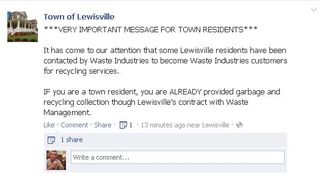
The Town of Lewisville recently posted the following on its Facebook page:

***VERY IMPORTANT MESSAGE FOR TOWN RESIDENTS***

It has come to our attention that some Lewisville residents have been contacted by Waste Industries to become Waste Industries customers for recycling services.

IF you are a town resident, you are ALREADY provided garbage and recycling collection though Lewisville's contract with Waste Management.


LewisvilleRecycle

In Support of Coach Grobe

Some folks in Demon Deacon land have been grumbling about Wake Forest's football coach Jim Grobe. His teams haven't had a winning record since the 2008 season and he has a .500 record as Wake's coach since 2001.  Personally I love having the guy lead Wake's football team and here are just a few reasons why:

  • His record is the best since "Peahead" Walker had a 77-51-6 record from 1937-50.
  • He's coaching one of the smallest  FBS schools in the country.
  • As the coach has said himself, it's a challenge coaching an "academic" school.
  • His team plays in a tiny stadium relative to other schools in the ACC/FBS.
  • Those last three items combined make Wake a tough place to recruit.
  • He runs a clean program.
  • He holds his players accountable.

That last point is a big one, and the following quote from a recent piece about Grobe's handling of a couple of players who aren't living up to behavioral expectations is a perfect example of his approach:

"I try to tell our football team – and they don’t always listen – talented people are a dime a dozen, people with really good talent,'' Grobe said. "And the last thing in the world that you want to have happen is 10 or 15 years from now, everybody is still talking about your talent but not talking about what you did. There’s a lot of kids that before they can blink their college careers are over.

"Of course, honestly, football is not really as important as ultimately being a good dad, being a good father, being a good worker, having a meaningful career and helping others – all those kinds of things that we know are more important than football.

"But you hate to see guys have all the talent in the world to play football and not use it. We’ll see going forward. The key word in all of this is hope.''

Personally I'll take this and a .500 record over a winning record and a program running amok any day.

Another note: I suspect fans might be a little less anxious about the football program if the basketball team hadn't been so atrocious the last few years.  In other words he's getting sucked into the "Fire Wellman/Bzdelik" vortex, which will hopefully start to disappear after this upcoming basketball season. It better or there could be a serious housecleaning afoot in Winston-Salem.
How to Write a Book

Lately I've seen a rash of "Easy Ways to Write a Business Book and Make a Killing" type posts on the various social media channels I frequent. You'd be right to be suspicious of anyone shilling those programs because the truth of the matter is that any book worth reading likely had a great deal of blood, sweat and tears poured into it. Scott Adams, he of Dilbert fame, offers a glimpse into his writing process and reveals how hard writing a book really is:

Part of the problem is that writing a book is the loneliest job in the world, and an immense amount of work. It's hard to get started on a project so daunting. My new book, How to Fail at Almost Everything and Still Win Big: Kind of the Story of My Life, took two years to write. For most of that time, no one but me saw any part of it. My publisher and I have a long history, so he lets me run free after the general concept for the book is nailed down. I probably worked for 18 months without anyone else seeing a word of it…

For nearly two years I plugged away on a collection of ideas around my theme and I have to say that none of it worked until the next-to-last round of edits. With my layered writing process, success tends to be binary. The book is a lifeless bunch of ideas until the moment it isn't. As a writer, you hope that moment comes, but you can never know for sure. This is yet another case in which my natural inclination for optimism comes in handy. I tell myself I can smell a book before I can see it. I know it's in me; I just need to write until I find it. I'm not entirely sure if I am intuitive or irrational, or even if those things are different.

If you're planning to write a book, ask yourself if you are the type of person that can spend that much time completely alone, doing unpleasant work, while receiving nothing in the way of encouragement or positive feedback along the way. You won't even know if anyone will read your book when you're done. If you answered "Yes, I can do that," I recommend these steps:

He then goes on to detail the six major steps in his writing process and they are indeed daunting. As he points out, every writer has his own method but what the good ones have in common is that their methods all include a great deal of hard work.

On the LDS Hit List

Let's start with a little background: when my parents were married my dad was Mormon and my mom was Methodist. Mom converted to being a Mormon a couple of years into their marriage and for the first eight years of my life our family was very active in the church. Then my parents got divorced and left the church. For years afterwards the church would call our house and invite me and my younger brother back to church without my mom with whom we lived. Understandably, I declined.  

All of my adult life whenever I've moved my name has eventually ended up on a list in the local ward (kind of like a Catholic parish) and I've started to get regular visits from the missionaries. I've always been cordial and have even taken the time to sit and chat with them, give them my background story, give them something cold to drink and then sent them on their way. The visits were usually about six months apart and generally not too bothersome so I didn't feel compelled to do anything about it, but that all changed over the last couple of months.

For some reason the local ward in Clemmons has decided to ratchet up the visits.  Our household has had three visits in the last month, and unfortunately for my wife I haven't been home for a couple of those. She was born and raised Catholic – I converted to Catholicism soon after we were married – and we now attend a Moravian church. Literally, there's no reason for her to talk to these young people other than she's married to me. Last week the missionaries showed up and my wife had finally had it. She asked the young ladies to leave us alone (the last few months our missionaries have been young ladies) and was curt enough that one of the young ladies started crying. She asked what she was supposed to do about our situation and talked about how stressed she was being away from home and of course my wife felt terrible about it. She commiserated with the young lady, explained it wasn't anything personal, but that we just desired to be left alone. That's when it got weird.

According to the missionaries the only way to stop the visits is for me to meet with the local bishop (think priest/lay minister) and fill out paperwork requesting that I be removed from their list. That of course floored my wife, but she took the bishop's information and it's sitting on our kitchen counter where it will continue to sit until I act. I'm not sure exactly what I'm going to do, but I do know this: I don't respond well to unreasonable demands and this most definitely feels unreasonable.

Here's what I'm likely to do in the short term:

  • Contact the bishop and ask him to remove me from their list immediately. 
  • If he refuses I'll put up a no soliciting sign on our property and doors and tell him that any representative from the church, missionaries or otherwise, who set foot on my property without being invited will have the sheriff called on them and I'll ask that they be charged with trespassing
  • Under no circumstance will I meet with him, in much the same way I won't meet with a salesperson to fill out paperwork to get him to stop selling to me.

That's about as far as I've gotten. I should note that I really respect these kids who leave home for two years to do what they consider their calling in faraway places, and I really don't want to have to take out my frustrations on them, but if the LDS is going to demand I jump through some silly hoops to get my name off of some list I never put myself on then their messengers will have to deal with it.