Five Fact Friday #8

Five random facts for Friday:

If the National Basketball Association (NBA) is not able to hold its playoffs this year it will be the first time that the NBA Finals have not been played since the league’s inception in 1946. – Wikipedia

Over 54,000 Slazenger tennis balls are used each year for The Wimbledon Championships. Since the tournament was not held in 2020 there’s no word on if the balls were returned to the wild 😉 – Wimbledon Debenture Holders

The largest ball of string on record is one 4.03m (13ft 2.5in) in diameter and 12.65m (41ft 6in) in circumference, amassed by J.C. Payne of Valley View, Texas, USA between 1989 and 1992. – Source: Guinness Book of World Records

In 2016 beer brewers in the United States produced 221 million hectoliters of beer, which is a lot but not as much as China’s 381 million hectoliters.  – Source: Statista.com

The Pan American Highway is the longest road in the world. It stretches from Buenos Aires, Argentina to Edmonton, Canada. – Source: ListSurge

Stories by the Numbers

Some interesting numbers. First, check out this graphic from today’s (May 8, 2020, 1:00 p.m.) Wall Street Journal website that highlights why the stock market is a pretty lousy proxy for the economy:

This next number caught my eye because it features a small Nebraska city, Grand Island, where Celeste and I spent one night last summer when we were driving home from Colorado. It’s from an article in the May 7, 2020 Wall Street Journal:

Local officials have now confirmed hundreds of coronavirus cases, with more than 200 linked to a local JBS USA beef plant and another 40 to area nursing homes. There were 1,228 Covid-19 cases as of Tuesday in a city of roughly 51,000, according to the regional health department. That puts its per capita rate of infection well above that of New York, the hardest-hit state in the nation by the coronavirus pandemic.

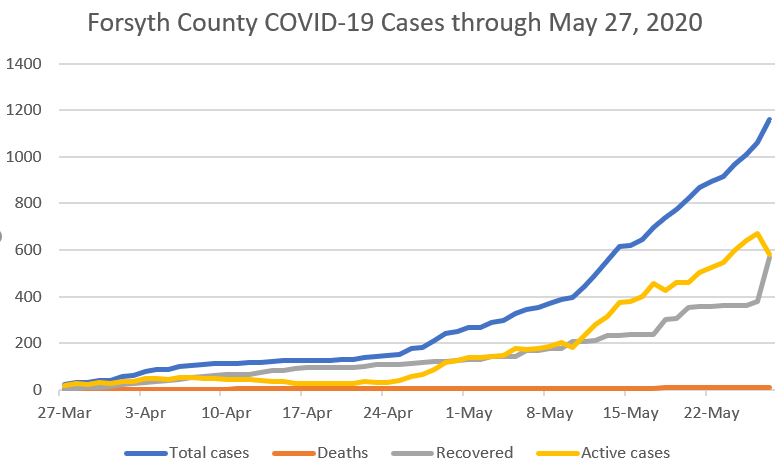
Compare those numbers to my hometown of Winston-Salem, NC, which has a population of 246,000, 347 confirmed COVID-19 cases and five deaths as of 5/8/2020. So despite have five times the population of Grand Island, Winston-Salem has had less than a third the number of confirmed cases. One interesting piece of info though: Winston-Salem has seen a recent spike in cases and a high percentage of those cases are tied to people who work in a Tysons Food poultry plant located in a county that’s an hour away.

Long story short: food processing plants are becoming a significant hotspot in the less urban parts of the country, and since those operations are all essential and can’t be done remotely, it wouldn’t be a stretch to think that small cities and towns across the country could see a significant per-capita impact for months into the future.

Five Fact Friday #7

Five random facts for Friday and posted on Saturday this time around:

Mother’s Day is (normally) the busiest day of the year. – National Restaurant Association via Town & Country

Cinco de Mayo is a holiday that celebrates the date of the Mexican army’s victory over France on May 5, 1862 in the Battle of Puebla during the Franco-Mexican War. It is a relatively minor holiday in Mexico, but has involved into a commemoration of Mexican culture in the United States. (It’s also a great excuse to drink tequila). – Source: History.com

According to the American Kennel Club the most popular dog breed is the Labrador Retriever. The 192nd most popular, of 192 total, are Sloughis. – Source: American Kennel Club

Paid circulation of daily newspapers in the United States was 62,766,000 in 1985 and 28,554,000 in 2018 – Source: Statista.com

In 1999 the average American man over the age of 20 was 69.2 inches tall (just over 5’9″), weighed 189.4 pounds and had a waist size of 39 inches. In 2016 those numbers had changed to 69.1 inches, 197.9 pounds and 40.2 inches. For American women the 1999 numbers were 63.8 inches (almost 5’4″), 163.8 pounds and 36.3 inches and in 2016 they were 63.7 inches, 170.6 pounds and 38.6 inches.
So if you do the math in less than 20 years adult American men are essentially the same height on average, but are 4.5% heavier and have an average waist size that is 3% bigger. American women are also essentially the same height, are 4.15% heavier and have an average waist size that is 6.3% bigger. – Source: CDC

What if…

As I write this the world is in the midst of the COVID-19 crisis and America is essentially shut down. The vast majority of Americans have been living under “stay at home” orders for several weeks, a majority of businesses have been shuttered, unemployment is growing by millions of people per week and there is a growing debate about when to open the country back up.

A central argument in the debate about reopening, and its timing, is about whether the lives saved by shutting down justify the economic damage and human suffering the shutdown is incurring. Of course there are a few problems we face when we have this debate:

  • We have no way of knowing how many lives we’ve saved with this action, partially because we don’t have widespread testing to know how many people have been infected, also because we have imperfect reporting of causes of death (numbers are constantly revised) and partially because we have imperfect models with which to estimate the true infection and mortality rates of the virus.
  • We don’t, as a society, have an agreed upon threshold for the lives we are willing to sacrifice in order to keep our economy functioning at a “normal” capacity.
  • We don’t, as a society, even agree what a normal economy should look like. At a time when we are experiencing extreme wealth disparity it’s almost a given that people will disagree with whether or not the economy that COVID-19 blew a hole in is the economy the majority of Americans want to return to.

I think we can all agree that we will disagree in fundamental ways about when and how we will get back to normal since we will disagree about what normal even is. But, for the sake of this exercise let’s just accept that we want to get the country working again so we can get back to some semblance of normalcy. So, what do we need to do that and what will “normal” look like when we do?

Let’s do this for a thought exercise: let’s assume that we decide that the benefits of some form of social distancing are great enough that they should be considered normal. Why? Well, let’s look at one of the arguments that people on social media seem to love when arguing for ending the stay at home orders: Since X number of people die every year from the flu and we don’t shut the country down then, why should we shut it down for COVID-19?

Again, we have no idea what the true number of COVID-19 deaths would have been without the shutdown, so let’s not argue about that. Instead let’s argue about whether we should do some form of social distancing every flu season. Here are the data points for the debate – all of the numbers are made up simply for the sake of debate:

  • In an average year we lose 100,000 people to flu-related deaths and 500,000 people hospitalized
  • After this COVID-19 crisis we learn that thanks to social distancing we reduced the probable mortality rate by 50% and hospitalization rate by 25% and if we implemented some forms of social distancing during flu season we would see a similar effect for flu-related deaths/hospitalizations.
  • We also learn during the crisis that because of the economic shutdown we, as a society, “lost” $10 million per person killed or $2.5 million per person hospitalized

What do we do? We know that we could save 50,000 lives but is it worth risking the trillions of dollars it would cost the economy to totally shut down the economy every year? Or do we find a middle ground? Do we decide to leave businesses open but require the wearing of face masks and gloves in any public space during flu season or when the signs of an outbreak are spotted? Do we reduce occupation limits on all businesses that serve the public? To help offset the economic impact on those businesses do we provide them tax breaks? If we discover that implementing socialized medicine reduces the overall impact on the economy – keeps us open while reducing the overall economic cost – do we go for it?

I’ve yet to hear anyone who isn’t a crackpot argue that we should have done nothing in the face of COVID-19. Rather, all the arguments have been about what and how much to do. That’s not surprising, because COVID-19 is new, very scary and in the absence of experience and accurate data our leaders have erred on the side of extreme caution. We literally go in the other direction with the flu because it’s a known quantity; as a society we’ve come to accept the tens of thousands of deaths that happen every year and shrug our shoulders and accept it. If we flip this debate we’re having on its head and ask ourselves, “If we can flatten the curve on COVID-19 can we do the same for the flu?” then maybe we can be honest with ourselves. We can ask the hard questions, that need to be asked, not just about COVID-19 but about our society’s priorities in general.
Five Fact Friday #6

Five random facts for Friday and posted on Saturday this time around:

The most popular baby names in the United States in 1966 were Lisa and Michael. Celeste, my wife’s name, was 356th most popular. Why do I bring this up? Well, it’s a certain someone’s birthday next week and she was born in 1966. – Source: BabyCenter.com (for the baby name ranking, not my wife’s birthday).

The daily US movie box office sales for March 19, 2020 (day 79 of the year and last day the movie theaters were open during COVID-19 crisis) were $143,641. On day 79 in 2019, March 20 (a Wednesday) sales were $8,995,950. – Source: BoxOfficeMojo

In North Carolina twice as many adults identified as Atheist (2%) than did as Mormon (1%), Jewish (1%) or Orthodox Christian (1%) . – Source: Pew Research Center Religious Landscape Study

William Shakespeare was born on April 23, 1564. 402 years later Celeste Lowder was born on April 23, 1966. – Source FamousBirthdays.com

On April 18, 2020 the average price of regular gas in the United States was $1.821/gallon, down from $2.836 on the same date in 2019. The highest average price ever recorded in the US was $4.114 on July 17, 2008. – Source: AAA

Five Fact Friday #5

Five random facts for Friday and posted on Saturday this time around:

Alcohol sales were up 55% the week ending March 21. – Source Axios via my mom.

Thanks in part to the cancellation of March Madness there is a glut of chicken wings. The price has tanked from $2/lb during the Super Bowl to $1.09 in April, 2020. – Source Marketplace

The state sport of Maryland is jousting. – Source Futility Closet

In 2017, according to the National Confectioners Association, 16 billion jelly beans were bought and consumed by the American people. – Source HelloGiggles

According to the US Census Bureau, in 2016 there were 5.6 million employer firms and 99.7% employed fewer than 500 people, 98.2% employed fewer than 100 people and 89% employed fewer than 20 people. – Source Small Business & Entrepreneurship Council

Five Fact Friday #4

Five random facts for this Friday:

Roughly 281 billion email messages were sent each day in 2018. That number is expected to increase to over 347 billion daily mails in 2022. – Source: statista

On March 23, 2020 Zoom was downloaded 2.13 million times worldwide, up from 2.04 million the day before, according to app tracking firm Apptopia. Two months prior, the app had just under56,000 global downloads in a day. – Source: KYMA.com

Netflix users spend 1 billion hours watching movies weekly. – Source: Muchneeded.com

There are 6,146 hospitals in the United States. – Source: AHA.org

The country with the lowest population (799) in the world is Vatican City. The country with the highest population (1.43 billion) is China. – Source: WorldPopulationReview.com

Five Fact Friday #3

Five random facts for this Friday:

jetBlue has 264 aircraft in its fleet – Source: Planespotters.net

New York City’s 14 wastewater treatment plants treat 1.3 billion gallons of wastewater per day – Source: New York City Environmental Protection

In 1985 a first class stamp was 22 cents, which is the equivalent of 54 cents today (currently a first class stamp costs 50 cents). – Source: Kiplinger.com

As of 2017 there were approximately 500 zoos and aquariums in America (no mention on whether or not the US Congress was included in that count) – Source: WhyAnimalsDoTheThing.com

There are 195 countries in the world. 193 are member states of the United Nations and two, The Holy See and the State of Palestine, that are non-member observer states – Source: Worldometer

Five Fact Friday #2

Five random facts for this Friday:

There have been 57 women members of the US Senate – Source: Wikipedia

Buckingham Palace has 775 rooms, 78 baths, 1,514 doors, and 40,000-plus lightbulbs. – Source: Architectural Digest

According to a survey by Charmin the averageperson uses 57 sheets of toilet paper per day.- Source: Reference.com

114 people have served as US Supreme Court Justices – Source: Wikipedia

According to a Newsweek magazine poll married couples have 6.9 times more sex per year than unmarried people – Source: Marriage.com

Five Fact Friday

Five random facts for this Friday:

North Carolina ranks 1st in the US for women representation in the tech sector – females make up 35.5% of the workforce – Source: Business North Carolina, March 2020

There are 4,319,768,895 more people on Earth than when I was born in 1966. – Source: Life Stats, which is a fun site to play with.

When you lose weight fat is converted to carbon dioxide and water. You exhale the carbon dioxide and the water mixes into your circulation until it’s lost as urine or sweat. – Source: Universal-Sci

Deaf moths absorb up to 85% of incoming sound energy from bats to help evade them. – Source: PhysOrg via BookofJoe

As of 2015, 62.7% of Americans live in cities, but those cities only comprise 3.5% of the country’s land area. – Source – US Census