Category Archives: Religion

Fox News Tries to Demote Christianity

Fox News' flagship personality, one Bill O'Reilly, has tried to demote Christianity from a religion to a philosophy – apparently in a battle fought in the War on Christmas. Jon Stewart, Comedy Central's flagship personality who happens to be Jewish, is there to set Fox and Bill straight:


Moravian Star Emergency

Good friend Ruth Burcaw has an excellent post that ties together the topics of Moravian stars, Advent and being Moravian:

A Moravian star emergency is likely only to happen during Advent, the season of the church year leading up to Christmas. That is when Moravians (& others) display the Moravian star, beginning with the first Sunday in Advent and ending with Epiphany, the celebration of the wise men’s arrival on January 6. So, back to my pastor friend, for whom Advent is quickly approaching (three days!) and for whom the sanctuary’s 110-point Moravian star is not working! He has called all experts in the workings of Moravian stars, and as you can imagine, this is not a very long list. Having done all he can, he realizes with some anxiety, all he can do now is . . . wait.

Waiting. . . we all do it, though it seems in these days of immediate gratification that we are not content to wait long before we become frustrated and irritated by our waiting . . . for traffic to clear, the doctor to appear, for the web page to load, for dinner to arrive. Waiting frustrates us because we have so many expectations . . . expectations of clear roads, efficient service, quick internet speeds, fast food. We are impatient people, full of expectations. Our waiting is not peaceful or contemplative.

Yet Advent turns all this on its ear. During this holy season, we are required to be expectant, to wait. Waiting is an intentional part of Advent as we anticipate the coming of the Christ child. We hear in Jeremiah 33:14 the words of promise . . . “Behold, the days are coming, says the LORD, when I will fulfill the promise I made to the house of Israel and the house of Judah.” We wait.


A Different Look at Amendment One

Greensboro blogger David Wharton, a Catholic, has decided to defy his bishop's endorsement of Amendment One for a very specific reason – he feels that endorsing the amendment is a violation of the Second Vatican Council's Declaration on Religious Freedom Dignitatis Humanae:

After due consideration, I've come to the conclusion that Bishop Jugis is wrong to support the amendment.

The Church holds that marriage is a sacramental, lifelong union between one man and one woman, founded in the love between the partners and for the procreation of children; however, it blesses sacramental marriages between infertile and post-fertile opposite sex couples. Thus its position is prima facie contradictory, but let that lie for now.

Even granting the Church's definition of marriage, I believe Bishop Jugis's endorsement of Amendment One violates the Second Vatican Council's Declaration on Religious Freedom Dignitatis Humanae. Here are some excerpts from that document, with the most relevant language highlighted by me. Pardon the length.

Despite the length of the post it's worth reading.

Imposing Religion

In reading an article that a friend sent to me I found this quote from President Kennedy:

I believe in a President whose religious views are his own private affair, neither imposed by him upon the nation or imposed by the nation upon him as a condition to holding that office.

With a slight change it adequately reflects my view on the proper role of religion in American society:

I believe in a citizen whose religious views are his own private affair, neither imposed by him upon the nation or imposed by the nation upon him as a condition of citizenship.

Two Ears, One Mouth

Kim Williams, a friend I met through the local social networking scene, has written a very thought provoking piece at his blog Wishful Preaching:

One day a religion professor – a educated, kind and openly Christian man – suggested I take the risk and talk with one of the better known atheists on campus. He suggested I NOT talk with him with the intent of changing his mind, but rather seek to listen and understand why and what he believed. I forced myself to listen, to ask questions and allow myself to hear another point of view.  At one point he said, "I don't believe in God." Seeking to be open, I asked him, "Tell me about this God you don't believe in." He talked for an hour or more . When he was done I could honestly say to him, "It is interesting. I don't believe in that god either." When spent many hours together over the following years talking about our personal beliefs and similar hopes and fears. He never came to believe as I did (perhaps he did admit a few times he had grown to be more agnostic than atheist),  and I never lost my faith (although I did learn some difficulties with my beliefs). We would both agree, however that we were better because of the friendship.

Perhaps there is something to fear in the failure to listen to others of different beliefs and traditions – that's scary!

Reading this I had multiple thoughts, the most prominent being a question I first asked in my late teens/early adulthood – how is it that the people I find most personify the positive qualities associated with religion are often atheist or agnostic? If being a "believer" is a prerequisite for being a good person then my eyes and ears were lying to me, because I could see for myself that it wasn't true. Heck, some of the nastiest people I've ever met have never missed a day of church so obviously the reverse could be true as well. Over time my belief system evolved to incorporate this bullet point – The fact that people without faith in a higher being could be among the great people in the world is in itself proof of some kind of higher being. 

I know that last sentence sounds like a pretty lame piece of philosophy that your average 14 year old would come up with, so maybe it would be better to explain it this way. I think it's a mistake to say that an atheist or agnostic is not a believer. They simply don't believe in God or a higher being the way I do; I think they believe in humanity, in the basic goodness of people, in the idea that mankind is a net-positive for the world. If you think about it their faith, in the face of all the evidence to the contrary (war, capable people parking in handicapped spaces, reality TV), is as great or greater than the faith of those of us who believe in a higher being. In the end their faith in humanity affirms my faith in a higher being.

The other thought I had while reading Kim's post related to the old saying "you have two ears and one mouth for a reason, and you should use them accordingly" and with the propensity of some folks to constantly proselytize. What I truly loved about Kim's post was that he engaged in the conversation with his friend without the intent to "convert" him or to convince him of anything. Instead Kim engaged him to listen and to learn and in the end I think they both gained immeasurably from it. By using his ears Kim did more to exhibit his faith than he could have done with a million hours of proselytizing, and I think there are quite a few folks out there who could learn from his example. 

In Sickness and In Health

There is an excellent piece in the Washington Post that I found to be at turns heart warming and heart wrenching.  It's a story about love, the vows of marriage, and at the most basic level, love.  I don't want to provide any excerpts for you here because quite frankly the story is too well written as a whole to be sampled in pieces. I've shared it with a few people and have been fascinated by their varying reactions; people I trust and with whom I almost always agree have disagreed with me and each other on certain aspects of this story. Despite those disagreements I feel safe in stating that after reading it all of us found our own "issues" paled by comparison.

Here's the link to the story – I can't recommend it highly enough.

I’ll See Your Bible and Raise You a Pagan Spell Book

Last month a public elementary school in Buncombe County, NC was in the news because the school's administrators allowed Bibles to be distributed to students. Here's an excerpt from a story in the Asheville Citizen-Times:

Jackie Byerly, principal at North Windy Ridge, defended the availability of the Bibles. She said they were not handed out, and students had the option to take them. She checked with Superintendent Tony Baldwin and was given permission to make them available.

She said the Bibles arrived Monday morning from a local group of Gideons International, and the box containing the books was opened in the main office. Byerly said the students picked them up during their break time.

“If another group wishes to do the same, I plan on handling that the same way as I have handled this,” she said.

When I read that last quote I said to myself, "Self, I sure hope someone calls her on that." Thankfully my wish has been granted.  From today's news:

Ginger Strivelli delivered on her promise to bring Pagan spell books to North Windy Ridge after the intermediate school made Bibles available in December. She said school officials said they would allow for the availability of her materials, just as they did the Bibles from a local group of Gideons International.

When Strivelli brought the Pagan books to the school Wednesday morning, she said she was told “a new policy is being crafted.”

In all fairness the policy review is a direct result of the backlash from the Bible incident so I don't think this is necessarily an anti-Pagan move by the school system. I'd be seriously worried if they didn't have a policy review.

Having had three kids go through public schools I can tell you that elementary school was an interesting experience – the kids were like sponges soaking up what the adults at school spilled out of their mouths and I can tell you there were a few times I wondered what their teachers were thinking. My favorite example was when my son, who was in 1st grade at the time, asked me who I was voting for in the 2000 election.  I asked him why he wanted to know and he told me he really hoped I'd vote for Bush because his teacher told him Al Gore killed babies in Vietnam.  Seriously.  After several similar experiences through the years I came to the conclusion that elementary school teachers should stick to the same rules we have for polite party conversations: whatever you do don't talk about religion, politics or sex.
Christmas and Flying Spaghetti Monsters

Remember our little local dust-up about flying the Christian flag at the veteran's memorial in King?  Imagine how nutty folks around here would get if, like Leesburg, VA, we had the Church of the Flying Spaghetti Monster vying for space with the traditional manger scene.

For the better part of 50 years, a creche and a Christmas tree were the only holiday displays on theLoudoun County Courthouse grounds.

Then came the atheists. And the Jedis. And the Church of the Flying Spaghetti Monster – each with its own decorations. A skeleton Santa Claus was mounted on a cross, intended by its creator to portray society's obsession with consumerism. Nearby, a pine tree stood adorned with atheist testimonials.

Flying Spaghetti Monster devotees are scheduled to put up their contribution this weekend. It's a banner portraying a Nativity-style scene, but Jesus is nowhere to be found. Instead, the Virgin Mary cradles a stalk-eyed noodle-and-meatball creature, its manger surrounded by an army of pirates, a solemn gnome and barnyard animals. The message proclaims: "Touched by an Angelhair."

Given our recent debates about the Christian flag and the controversy over the right (or not) to carry concealed weapons in local parks, there's a little part of my brain that would love to see what would happen around here if we had a similar setup to Leesburg's.  In that juvenile little part of my head I picture this scene:

Bible-quoting sharpshooters taking aim at spaghetti-eating atheists and agnostics who dive for cover, sending sauce and meatballs skyward during their panic, asking Mama Celeste for help since God's out of the picture until their own contingent of pistol packers can get their firearms unholstered and de-trigger locked to return fire.  Thankfully no one's hurt since none of the participants ever served in the military and thus never received truly effective arms training, although two bullets do somehow hit something – one Christian is saved by the lucky (divine?) presence of a condensed pocket-sized King James and one innocent bystander who picked a wildly inopportune time to squat for a meditation is spared when his tattered copy of Zen and the Art of Motorcycle Maintenance takes a direct hit. Eventually cooler heads prevail when the Occupy Wall Streeters, who were minding their own business in their designated protest box, step across their chalk line to broker a truce in which the atheists and agnostics provide a spaghetti supper for everyone at the park free of charge, the Christians put on their Christmas production, collection plates are passed and everyone splits the proceeds.

I'd pay to see it.

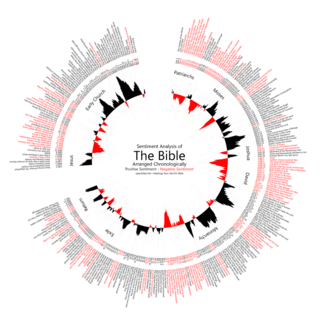
Sentiment Analysis of the Bible

Biblesentimentanalysis
I was taught to never talk about politics, religion or sex in polite company, but since neither you or I is polite I'm going to talk a little religion here.  Some smart people applied sentiment analysis to the Bible and created a very interesting graphic.  I also like their little descriptor:

Things start off well with creation, turn negative with Job and the patriarchs, improve again with Moses, dip with the period of the judges, recover with David, and have a mixed record (especially negative when Samaria is around) during the monarchy. The exilic period isn’t as negative as you might expect, nor the return period as positive. In the New Testament, things start off fine with Jesus, then quickly turn negative as opposition to his message grows. The story of the early church, especially in the epistles, is largely positive.

Here's their description of sentiment analysis:

Sentiment analysis involves algorithmically determining if a piece of text is positive (“I like cheese”) or negative (“I hate cheese”). Think of it as Kurt Vonnegut’s story shapes backed by quantitative data.

I'm beginning to understand why Bible study sometimes creeped me out.