A useful video this eve of the (supposedly) apocalyptic 2012 election:
How the Electoral College Works
3 Replies
A useful video this eve of the (supposedly) apocalyptic 2012 election:
Sasha Dichter's blog is fast becoming a favorite. His take on the "intangible dividend" of happiness:
Of course it’s hard to measure, of course it is squishy and self-reported, but if we’re ever going to get anywhere we have to have the comfort and confidence to say out loud that things like human dignity, pride, and yes happiness are the whole point, the only point really, and that everything we’re doing is aimed at loose proxies to those results – what could be more real or concrete than that?
Just think how much we’ve punted on this issue, if we’re really honest with ourselves. We’ve come to a point where we’re saying with a straight face that if we put a lot of money into the impact investing sector and that money realizes a healthy level of financial return then we’ve had success. That puts us about seven degrees removed from actually understanding if anyone is better off, happier, freer, more proud or connected or more able to realize their potential, if someone is more likely to realize justice if they’re wronged or less likely to fall back into poverty if they get sick.
An interesting piece at the Atlantic Wire shows the change in who pays for health care services (hospital care, physician and clinical services, prescription drugs, etc.) from 1960 to 2010. In 1960 a far higher percentage of the payments were out-of-pocket and a lower percentage came from private insurance, Medicare and Medicaid. In 2010 a much smaller percentage was paid out-of-pocket and, with the exception of dental services and "other medical products", the vast majority was paid by private insurance, Medicare and Medicaid.
That's interesting in and of itself, but what's downright unbelievable is the change in the amount spent on health care each year that's shown in the article. In 1960 the total amount spent was $23.4 billion and in 2010 it was $2,186 billion or a 93.4-fold increase. Of course there are more people in America in 2010 so a good question would be, "What's the per-capita increase in health care spending?"
The answer is that in 1960 the per capita spending was $147 and in 2010 it was $8,402 – a 57-fold increase. To give you an idea of how big a jump that is you need only note that the buying power of $1 in 1960 was the same as $7.35 in 2010. In other words health care spending literally exploded; if it had been even roughly analogous to inflation the per capita spending would be more like $1,080 than $8,402.
Some thoughts to ponder as you digest this information:
The health care industry is facing some signicant changes thanks to "Obamacare," but it remains to be seen whether or not those changes will rein in costs. It's hard to imagine the health care system getting any less efficient, but then again in 1960 it was hard to imagine a man walking on the moon within a decade.
The Department of Veterans Affairs office in Winston-Salem might need some help from an organizational consultant:
At the VA's Winston-Salem Regional Office in North Carolina, an estimated 37,000 claims folders had been stored on top of file cabinets, according to the Inspector General's report released last week. Those piles had been stacked two feet high and two rows deep. The file cabinets were so close to each other that drawers could not be opened completely. More files had been stored in boxes on the floor and stacked along the wall.
A load-bearing study found that the weight of the files exceeded the floor's capacity by 39 pounds per square foot.
"The excess weight of the stored files has the potential to compromise the structural integrity of the sixth floor of the facility," said the Inspector General report. "We noticed floors bowing under the excess weight to the extent that the tops of file cabinets were noticeably unlevel throughout the storage area."…
In June, after learning that the floor load exceeded capacity, the office removed all folders sitting on file cabinets and placed them on separate floors. The office also intends to purchase a high-density file system for the basement, which will cost an estimated $405,000.
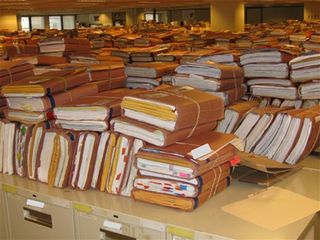
This looks suspiciously like my desk.
If you're a member of the NC House and make a mistake with your vote, and want to change it, you can do so only if changing your vote doesn't change the result. That sounds like something out of a Seinfeld episode.
The 10-year veteran lawmaker hit the wrong button on her desk. Carney punched the thumbnail-sized green button that says “AYE” just above the red one that says “NO.”
“Oh, my God,” she said on the floor. “It won’t let me change my vote.”
For all the maneuvering, arm-twisting and political horse-trading Republicans employed to get a handful of Democrats to void their party leader’s veto just before 11:30 p.m. Monday, it came down to a mistake.
“You ever see my golf game?” said state Sen. Bob Rucho, a bill sponsor, after the vote. “It’s based on luck, not on skill.”…
The vote took her by surprise. Republicans limited debate on the fracking legislation – Senate bill 820 – and called the vote. Green button to override. Red button to sustain.
Carney hit the button and looked to the board above the chamber that shows the results: 72 to 46. The color next to Carney’s name matched the Republicans.
She panicked. She hit a different button to turn on her microphone and called to the House speaker on the dais. He didn’t recognize her. So she rushed to the front, 20 steps from her seat in the eighth row down the red-carpeted middle aisle.
Carney asked the clerk to check her vote. Green. Override.
She then asked Tillis if she could change her vote. Tillis said House rules prevented it.
Lawmakers mistakenly vote all the time but they are not permitted to change a vote if it affects the outcome.
Four years after the economy melted down there's still a serious lack of understanding among the general populace as to the root causes of the collapse. It's not that the causes aren't well documented, they're just complex and opaque, and that's probably just as well as far as those driving the economic train are concerned.
The latest example of this disconnect between economic cause and effect is the movement to blame seemingly every municipal deficit on public employees, their benefits and their unions. Obviously exploding pension obligations play a role in putting stress on the cities' or states' coffers, but those obligations were far from the only reason the municipalities started to bleed red ink. Thomas Ferguson explains in his article on AlterNet (h/t to Fec for the pointer):
What has driven cities and towns to the brink is not demands from their workforce but the collapse of national income and the ensuing fall in tax collections. Or, in other words, the Great Recession itself, for which Wall Street and the financial sector are principally to blame. But many powerful interests have jumped at the opportunity to use the crisis to eviscerate what’s left of the welfare state, roll back unionization to pre-New Deal levels, and keep cutting taxes on the wealthy. The litany of horror stories that now fills the media is ideal for their purposes…
At a time when cities and states are taking hatchets to services and manically raising fees and fares, the group’s analysis merits a closer look and a much, much wider audience.
Its starting point will be familiar to anyone who recalls the debate over financial “reform” of the last few years. In the bad old days of pre-2008 deregulated finance, bankers started pedaling hot new “structured finance” products that they claimed were perfect for the needs of clients who had thrived for decades using cheaper, plain vanilla bonds and loans. The new marvels – swaps and other forms of so-called “derivatives” whose values changed as other securities they referenced fluctuated in value – were often complex and frequently not priced in any actual market. Their buyers thus had difficulty understanding how they really worked or how they might be hurt by purchasing them...
The result, for years now, has been literally billions of dollars of losses for cities, states, and other local authorities, including school boards and state college loan agencies. Locked in by the termination fees, they can stay in the swaps and pay and pay as the banks’ payments to them dwindle. Or they can buy their way out of the swaps at preposterous prices – Morgenson indicated that New York State recently paid $243 million dollars to get out of some swaps, of which $191 million had to be borrowed.
One of the common themes found in almost every accounting of the financial meltdown has been the complexity of the financial products that Wall Street used, without oversight, to reap billions, if not trillions, of dollars in profits while setting the economy up for a massive fall. Who really knew what mortgage backed securities and credit default swaps were before the crisis? Very few people knew what they were, and even fewer understood how they worked, and that's why when it came time to start assessing blame it became a whole lot easier to point the finger at moderate-to-low income homeowners who took a too-good-to-be-true deal on their mortgages and then failed to make good. It was easy to blame them, the first dominoes, because the average person could understand what they did wrong. On the other hand the financial Masters of the Universe were happy to let the little guys take the fall while they hid behind the opaque curtain of financial shenanigans they'd hung around the rest of us.
And the banks' shenanigans were quite possibly intentional and coordinated. From Matt Taibbi at Rolling Stone (again h/t to Fec):
The defendants in the case – Dominick Carollo, Steven Goldberg and Peter Grimm – worked for GE Capital, the finance arm of General Electric. Along with virtually every major bank and finance company on Wall Street – not just GE, but J.P. Morgan Chase, Bank of America, UBS, Lehman Brothers, Bear Stearns, Wachovia and more – these three Wall Street wiseguys spent the past decade taking part in a breathtakingly broad scheme to skim billions of dollars from the coffers of cities and small towns across America. The banks achieved this gigantic rip-off by secretly colluding to rig the public bids on municipal bonds, a business worth $3.7 trillion. By conspiring to lower the interest rates that towns earn on these investments, the banks systematically stole from schools, hospitals, libraries and nursing homes – from "virtually every state, district and territory in the United States," according to one settlement. And they did it so cleverly that the victims never even knew they were being cheated. No thumbs were broken, and nobody ended up in a landfill in New Jersey, but money disappeared, lots and lots of it, and its manner of disappearance had a familiar name: organized crime…
USA v. Carollo involved classic cartel activity: not just one corrupt bank, but many, all acting in careful concert against the public interest. In the years since the economic crash of 2008, we've seen numerous hints that such orchestrated corruption exists. The collapses of Bear Stearns and Lehman Brothers, for instance, both pointed to coordinated attacks by powerful banks and hedge funds determined to speed the demise of those firms. In the bankruptcy of Jefferson County, Alabama, we learned that Goldman Sachs accepted a $3 million bribe from J.P. Morgan Chase to permit Chase to serve as the sole provider of toxic swap deals to the rubes running metropolitan Birmingham – "an open-and-shut case of anti-competitive behavior," as one former regulator described it.
Now let's be clear – if the banks' actions and the extent of their screwing of us were more easily understood we would probably have such a huge popular outcry against them that even our Wall Street-coddling Congress and Obama administration would be forced to go after their friends. As it is the average Joe is too busy trying to keep food on the table to pay much attention to this stuff, and quite frankly it's just easier to blame the deadbeat down the street than to try and figure out how guys in the pink ties and cuff links took him and the rest of us to the cleaners. Sadly the denizens of Wall Street continue to reap the rewards of their corrupt system while the rest of us get to eat cake.
If we only knew.
Fec points to a piece at Naked Capitalism that takes the unions and President Obama to task for creating the environment that led to voters in two California cities, San Jose and San Diego, voting overwhelmingly to cut city employees' pensions:
This is not a Republican initiative – the San Diego Mayor is a Democrat. And pension cuts like this are happening nationally, mostly with full support from voters in the Republican Party and a good chunk of the Democratic Party as well. The union representing city workers, of course, went to the courts rather than pursuing a strategy of engagement with the public. These unions will probably end up losing the fight, because they have no ability to persuade voters that they represent anything but a self-interested group of insiders.
The states and localities suffering from budget crises are having problems because Wall Street blew up the economy, and in many cases, ensnared these municipalities in extremely bad deals. The wealth of taxpayers was and is being transferred to banks. In 2008, the choice before Bush, and then Obama, was clear. They could hand taxpayer resources to Wall Street and oversee a series of budget crises in states and localities, with the opportunity for later privatization of public assets and the breaking of public sector unions. Or Bush, and then Obama, could crack down on Wall Street, and make sure that bailout monies went to states and localities, and, with record low interest rates, spur tremendous investment in new energy, infrastructure, and education initiatives. It was a choice. Bush picked Wall Street. Obama also picked Wall Street, with public sector unions supporting Obama like turkeys cheering on Thanksgiving.
Now voters are making their own choice. Once again, this is a direct consequence of how Barack Obama has led the Democratic Party and redefined liberalism, into a party and an ideology that is defined by wage cuts, foreclosures, debt, and acceptance of dramatic political and economic inequality. Voters don’t want to pay for a government and for government workers who they perceive as out of step with their interests.
Maybe. Another consideration is that people tend to not like seeing people that they perceive to be peers, or even worse, people lower in class benefiting at their own expense:
Instead of opposing redistribution because people expect to make it to the top of the economic ladder, the authors of the new paper argue that people don’t like to be at the bottom. One paradoxical consequence of this “last-place aversion” is that some poor people may be vociferously opposed to the kinds of policies that would actually raise their own income a bit but that might also push those who are poorer than them into comparable or higher positions. The authors ran a series of experiments where students were randomly allotted sums of money, separated by $1, and informed about the “income distribution” that resulted. They were then given another $2, which they could give either to the person directly above or below them in the distribution.
In keeping with the notion of “last-place aversion”, the people who were a spot away from the bottom were the most likely to give the money to the person above them: rewarding the “rich” but ensuring that someone remained poorer than themselves. Those not at risk of becoming the poorest did not seem to mind falling a notch in the distribution of income nearly as much. This idea is backed up by survey data from America collected by Pew, a polling company: those who earned just a bit more than the minimum wage were the most resistant to increasing it.
It's awfully hard for the average person not to be resentful of a public employee, someone who is ostensibly your employee, pulling in a livable wage and "Cadillac" benefits while everybody else has watched their IRA evaporate in the heat of the Great Recession. It's even harder to accept that their taxes might have to go up to cover deficits that are caused in part by those benefits, so it's not surprising at all that people would vote to cut those same benefits.
Sure, the "macro" politics described in the Naked Capitalism piece played a role in creating the environment that led to the recent votes curtailing public pensions, but it would a mistake to ignore the role of "micro" politics in these results. Let's face it – people don't like seeing their neighbors doing better than they are.
Greensboro blogger David Wharton, a Catholic, has decided to defy his bishop's endorsement of Amendment One for a very specific reason – he feels that endorsing the amendment is a violation of the Second Vatican Council's Declaration on Religious Freedom Dignitatis Humanae:
After due consideration, I've come to the conclusion that Bishop Jugis is wrong to support the amendment.
The Church holds that marriage is a sacramental, lifelong union between one man and one woman, founded in the love between the partners and for the procreation of children; however, it blesses sacramental marriages between infertile and post-fertile opposite sex couples. Thus its position is prima facie contradictory, but let that lie for now.
Even granting the Church's definition of marriage, I believe Bishop Jugis's endorsement of Amendment One violates the Second Vatican Council's Declaration on Religious Freedom Dignitatis Humanae. Here are some excerpts from that document, with the most relevant language highlighted by me. Pardon the length.
Despite the length of the post it's worth reading.
This story of exploding toilets that injured two GSA employees in Washington is perfect on so many metaphorical levels that I just can't think of anything to add:
As Supervisory Property Manager Chris Litsey tells it, he responded to an emergency call from a restroom to find a nurse on the scene treating someone injured “by the fragment of a broken toilet bowl.”
“People on site told us that the toilet ‘exploded,’” the manager wrote. “We found at the time that the waterlines to toilets in that restroom were dry and flushing the toilets created a loud and startling sound, and also ejected the remaining water from the bowl.”
As the manager finished surveying the scene, another call came in for a person injured by a toilet on a separate floor. Litsey put out an announcement that the restrooms had closed and purged the system of compressed air that had been flowing into the building’s water tank.
Several other toilets were found damaged while Litsey and staff corrected the issues. The next day, as news reports circulated, Litsey’s theory was that someone had turned the compressor on manually and “left it unattended.”
In celebration of CPA Liberation Day I bring you a link to a column by two professors at the University of Pennsylvania's Wharton School about how we might think differently about tax deductions if we (properly) identified them as government spending:
Here’s a way to see through the fog. Instead of looking at all the breaks for mortgage interest, health care, retirement savings and so on as deductions, picture the government writing you a check for each item. This equivalence between tax deductions and government spending leads economists to call them “tax expenditures.” Reformers have hit on an even more pointed description: spending through the tax code.
The tax system is also equivalent to a collection of individual mandates, like the one in the Obama health-care law, with penalties for Americans who fail to buy insurance. For many people, that’s how our system works. You and your neighbor might have the same income, but if, unlike your neighbor, you fail to have a mortgage or buy as much health insurance, then you have to pay higher taxes…
Here’s our proposal: Let’s replace all tax expenditures with explicit subsidies — that is, with actual federal payments — so we can really see the costs and debate all spending programs on an equal footing. Doing so would help us answer crucial questions, such as whether we get more bang for our buck by subsidizing homeownership or by spending more on schools.
There’s one more payoff to getting rid of the myriad breaks hidden in our byzantine tax code: It will be a lot easier to get your taxes done before midnight.
 Befuddled