Category Archives: Food and Drink

A Tale of Two Cities

I live in Lewisville and I work in Greensboro for a trade association that works with companies throughout the 12 counties of the Piedmont Triad so you could say I live the whole "regionalism" thing.  Because I'm paid to stay on top of what's going on throughout the Triad I track the news in Winston-Salem, Greensboro, High Point, Burlington, Mebane, etc. and every once in a while I'll notice an interesting contrast between the various municipalities.  Today after checking my news feed I came to the startling realization that if you went by the local blogs alone you'd have to believe that Greensboro is a graveyard for restaurants while Winston-Salem is experiencing a veritable renaissance of eateries.

From the Downtown Winston-Salem Partnership blog in the last day or two:

Via Ed Cone's blog I found this post on 99 Blocks titled Vanishing Eateries – Can you help us out? about the restaurant closings in Greensboro.

As commenters at Ed's place pointed out the restaurant business is notoriously risky and in any given downtown you're going to see any number of restaurants come and go on a regular basis.  My point is that if you were to base your assessment of the health of these two cities' restaurant sectors on what you read online you'd think that the folks in Greensboro are going to all be burning up the travel lanes on westbound I-40 to get a decent meal. I know some folks in Winston-Salem who'd claim that's always been the case, but I'm here to tell you that there are some great places to eat in both cities.  If you feel like picking up the tab I'll be happy to take you on a tour.

YardDawg’s Grilling

YardDawg, aka Doug Grimes, is featured in a Winston-Salem Journal story about grilling:

Grimes, 61, grew up around Kinston. He remembers his grandfather and other male relatives barbecuing whole hogs. "I'd hang out with those guys and watch them — I was probably 4 or 5 years old the first time I saw that."

Later, he watched his father grill on the weekends. "Every Friday or Saturday night he was cooking something outside," Grimes said.

His father is now 88 and no longer grilling himself, but Grimes will cook for him on visits to Kinston on the grill that Grimes gave him as a present in 1971.

Grimes even grilled on the many days spent away from home as a tobacco buyer. "Even little towns inKentucky would have a motel, and we'd set up a little grill on the balcony," Grimes said. "It might be just hot dogs or hamburgers, but it was still better than McDonald's."

A beef lover, Grimes took two grills with him when he moved to Zimbabwe for three years to work as a tobacco export manager.

He's eaten grilled food in MexicoThailandArgentina and other countries. "I've always been a fan of street food," he said. "When I was in Bangkok or wherever, I'd find the stall that had a line with like 20 people."

He has found that a love of grilled meat is universal.

"I've done it (grilling) just about everywhere I've ever been," he said. "We even had a pig pickin' in China, inYunnan province."


Popcorn Porn

Below is popcorn popping in super-slomo.  I l-o-v-e popcorn, so much so that I only eat the microwave variety when I have no other choice.  Needless to say my Stir Crazy popper gets a regular workout.  All that said, even I am a little turned off by the voice over on the video below, especially when the narrator describes the inner part of the kernel as "starchy endosperm." Seriously?


Forget Atkins, Go for the Hostess Diet

This is my kind of diet:

For 10 weeks, Mark Haub, a professor of human nutrition at Kansas State University, ate one of these sugary cakelets every three hours, instead of meals. To add variety in his steady stream of Hostess and Little Debbie snacks, Haub munched on Doritos chips, sugary cereals and Oreos, too.

His premise: That in weight loss, pure calorie counting is what matters most — not the nutritional value of the food…

For a class project, Haub limited himself to less than 1,800 calories a day. A man of Haub's pre-dieting size usually consumes about 2,600 calories daily. So he followed a basic principle of weight loss: He consumed significantly fewer calories than he burned.

His body mass index went from 28.8, considered overweight, to 24.9, which is normal. He now weighs 174 pounds.

But you might expect other indicators of health would have suffered. Not so.

Haub's "bad" cholesterol, or LDL, dropped 20 percent and his "good" cholesterol, or HDL, increased by 20 percent. He reduced the level of triglycerides, which are a form of fat, by 39 percent.


Soft Serve Chicken

Chickstrawberrysoftserve
 Via the Fooducate blog:

Folks, this is mechanically separated chicken, an invention of the late 20th century. Someone figured out in the 1960’s that meat processors can eek out a few more percent of profit from chickens, turkeys, pigs, and cows by scraping the bones 100% clean of meat. This is done by machines, not humans, by passing bones leftover after the initial cutting through a high pressure sieve. The paste you see in the picture above is the result.

This paste goes on to become the main ingredient in many a hot dog, bologna, chicken nuggets, pepperoni, salami, jerky etc…

The industry calls this method AMR – Advanced Meat Recovery.

Just think about that picture the next time you get ready to bite into a hot dog.  Yuuuum! 

Karo Syrup

For as long as I can remember I've had a hate-hate relationship with Karo Syrup.  My Granny used to serve waffles and pancakes with it and I found it absolutely revolting.  When my Mom ran out of maple syrup there was always a bottle of God-knows-how-old Karo in the back of the pantry to substitute, and I think that's largely why to this day I eat my 'cakes and waffles with almost no syrup.  I was reminded of my Karo-hate when I stumbled on this Boing-Boing post regarding an unbelievably disturbing vintage ad for Deep South Peanut Pie, which looks like a pecan pie with peanuts substituted for the pecans.  I don't think I'll be able to eat for a few days.

Goodness Grows in NC – Guest Post from Yarddawg

Frequent commenter and buddy of mine Yarddawg sent this along and it's worth sharing.  Enjoy!

There are many sources of information concerning organic foods. There are also many viewpoints and information sources on the subject. There is also a significant price premium (up to 60% more) consumers pay to go "organic" versus conventionally grown foods. This is BIG business and therein lies the crux.  Although highly disputed by organic proponents, in 2009, the British Food Standards Agency found “There is no evidence of additional health benefits from eating organic food,” declared Gill Fine, the FSA’s director of dietary health. Organic proponents have fought back. The full Times of London article gives more insight. Another article by the popular garden writer Don Engebretson AKA The Renegade Gardener also paints an even harsher, more frightening, critique of the popular myth of the benefits of organics. Click on The Renegade Gardener and then click on Myth of the Week. It's the first article listed, named  "Organically produced food is safer than conventionally produced food". It is eye-opening and, pardon the pun, food for thought. If that's not enough to make you question things this Business Week article titled, The Organic Myth, will at least make you think. 

The British findings conclude, both organically and conventionally grown foods are equal in taste, nutrition, and both equally safe for consumption.Proponents of organics went bonkers, in my opinion, due in part to the unpleasantness associated when the inconvenience of scientific facts disputed the prevailing organic propaganda. It's also a bit of the smallest person in the room who's usually the loudest. Organic food production is estimated to be maybe 3% of the total US food production.  And, oh yeah, price too…. 60% more than "regular" food is quite an incentive to raise Hell and protect your turf. Many in the "religion" of organics have gained a rather elitist, almost cult-like following. The bad news on organics is this price premium all but excludes families struggling to make ends meet. After all, why should consumers pay way more for the same taste, safety, and nutritional value?  Supermarket chains like Whole Foods and others, virtually built their businesses on the heels of the organic movement and its appeal to granola heads. If you don't believe me pick an afternoon, any afternoon, and observe the regular cast of characters frequenting any Whole Foods Supermarket. Now don't get me wrong I shop there too but I'm very selective on the items I purchase. 

Here's something to be aware of. Both organic growers and non-organic growers, distributors, wholesalers, and retailers have to make a profit to survive. Wal-Mart, to the dismay of many, has now joined the organic fray and many in the organic camp are not at all pleased with this development.  Again, the elitist attitude possibly comes into play. The evil empire strikes again. This move is a potential game changer. If organic food ever becomes more price competitive and available to lower income consumers, a large company like a Wal-Mart will likely lead the way. I have no lower or higher opinion of a Wal-Mart than I do of a Whole Foods. They are both the same for me…. Corporations. Both businesses operate for profit and shareholder return and will do what they have to do to optimize business results and profits. It baffles me though why one entity is considered as an evil empire and the other a good corporate steward. You can also throw Trader Joe's into the same mix. TJ's $8 billion in sales and the fact it is so secretive and less than transparent makes this firm even more troubling.

As you may have guessed I'm more than a wee bit cynical about organics and the purveyors of organics but not totally close minded. I like to hear differing viewpoints. I just don't buy into all the organic hype at this point.  Admittedly opinions on this subject are all over the place and frankly there are many on both sides pumping out hyperbole and misinformation. Profiteers are also lurking trying to make a quick buck. The best advice for anyone seeking true information on organics is to seek out university or extension based research information which is probably the most reliable and certainly the least biased. This NC based info from NC State University is a pretty good starting point.
GrimesTomato
 

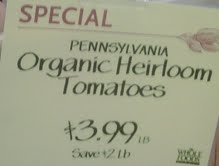
The best advice I can give is this. If you don't grow your own food, make every effort to visit or get to know and buy from a reliable local farmer or from a local farmer's market rather than a corporation or supermarket chain. Stay close to individual farmers and eliminate as many middlemen as you can. In season follow the 40 mile rule. In other words support local and regional farmers whose transportation costs are much lower and the savings are passed on to consumers. I have routinely purchased local produce such as heirloom tomatoes for $1.50 to $2.00 per pound at local farm markets all season long. The same products from the aforementioned trendy chain were $3.99 per pound (see photo) just today and from Pennsylvania. I've seen them for as much as $5.99 out of season or when there is no local competition. By the way, is there a town named Pennsylvania, NC? Other deals of the day at WF were Bison Tenderloin for a mere $26.99 per pound and some unpronounceable French cheese for $24.99 per pound. And don't get me started on bottled water which costs somewhere in the neighborhood of $8.00 or more per gallon. Get it? The quote often attributed to P.T. Barnum ; " There's a sucker is born every minute." Well if he really said it he certainly wasn't kidding. So, when possible, I only buy fresh, in season, produce from local growers. Organic vegetables and fruits or any produce coming from Chile or milk powder shipped from New Zealand to go into a French owned, US made, organic yogurt or other place 9,000 miles away isn't very green. Fruits and vegetables from Chile in February are picked green, shipped green, arrive green,are sold green, and usually taste green for my taste. Some importers also use an artificial ripening chemical (ethylene, acetylene, calcium carbide, to name a few lovelies we consume) to mask the early harvesting taste. Canning and preserving local stuff offers superior taste versus the plastic tasting stuff available in winter any day. To find local farmers and producers in our area click on NC Farm Fresh. Then select a product and county from the drop down menus. Other options are available to filter search results even more.

When possible Buy Local and remember….. Goodness Grows in North Carolina.

Yarddawg

Red Velvet Cake? Good! Fried Chicken? Good!

One of my kids' favorite Friends episodes is the one where Rachel makes half of an English Trifle and half of a Shepherds Pie.  Whenever we have something interesting to eat at least one of them will say "What's not to love? Custard? Goood! Jam? Goood! Meat? Goooooooood!"

That's what this fried chicken with red velvet cake batter reminds me of:

To make the dish, the brined chicken is first dunked in the red velvet batter before receiving a second coating of toasted red velvet crumbs. Once it's been caked-up properly, it's into the fryer and onto your plate.

And because red velvet cake is incomplete without cream cheese frosting, the chicken is served with a side of cream cheese infused garlic mashed potatoes.