Category Archives: Current Affairs

More on that Prayer Thing

As you may recall the esteemed leaders of Forsyth County, NC have decided to fight the ACLU on sectarian prayers being used to open county meetings. Our county leaders say they don’t want to tell anyone how to pray or be told by the ACLU that they have to tell people how to pray and they argue that they invite people of all denominations to pray.  Well, after a little digging I found that their idea of religious diversity is a bit wanting, but they’ve enacted a very technical system called "thumbing through the phonebook" that might lead to a more diverse set of religious leaders giving the opening invocation.  (BTW, a similar system was recently upheld in Georgia).

So what will happen when the first Muslim or Hindu is invited to give the invocation?  Well, if what happened in the US Senate is any indication we might be in for an interesting ride. From TPM:

Today was a historic first for religion in America’s civic life: For
the very first time, a Hindu delivered the morning invocation in the
Senate chamber — only to find the ceremony disrupted by three Christian
right activists…

The three protesters, who all belong to the Christian Right anti-abortion group Operation Save America,
and who apparently traveled to Washington all the way from North
Carolina
, interrupted by loudly asking for God’s forgiveness for
allowing the false prayer of a Hindu in the Senate chamber. (Emphasis added)

Think of how much fun these yokels will have in their home state when they don’t even have to travel!  Here’s the video of the happenings from YouTube:

Money-Money-Money, Mooooney

One of the things I consistently hear from friends and family who read my mind dribblings is that they read everything except for the "boring stuff" about politics and government.  Invariably they say something like "I’m just not as into it as you are" which is fair since I’m interested in lots of boring things, including my navel.  Still, it got me to thinking that maybe I need to be a little more entertaining when I write about that stuff since so here goes my first try:

Today’s topic: War and Money

Important takeaway: We’ve spent a buttload of money on the war in Iraq and it’s not ending any time soon.

Interesting hook: Some folks are putting a $1.2 Trillion price tag on the war, but back in 2003 when one of the Bush administration’s economists predicted the war might end up costing us about $100-200 billion dollars he was canned. The other administration estimates at the time were closer to $60 billion which means they were only off by, oh, $1.14 trillion.

Entertainment Value: Think about what $1.2 Trillion could buy.  If I were writing my typical, boring, wonky stuff I’d write about all the teachers it could pay for, doctors it could provide, yada, yada, yada.  But for fun lets look at the number of the following that you could purchase:

Man that’s a lot of spare change.  Now, if you want to talk about real money take a look at what Fec’s pointing to re. the coming crisis due to the healthcare and retirement costs of the aging (finally) baby boomers. 

Boring? Yes.  Important? Hell yes.

It’s Not About the Truth

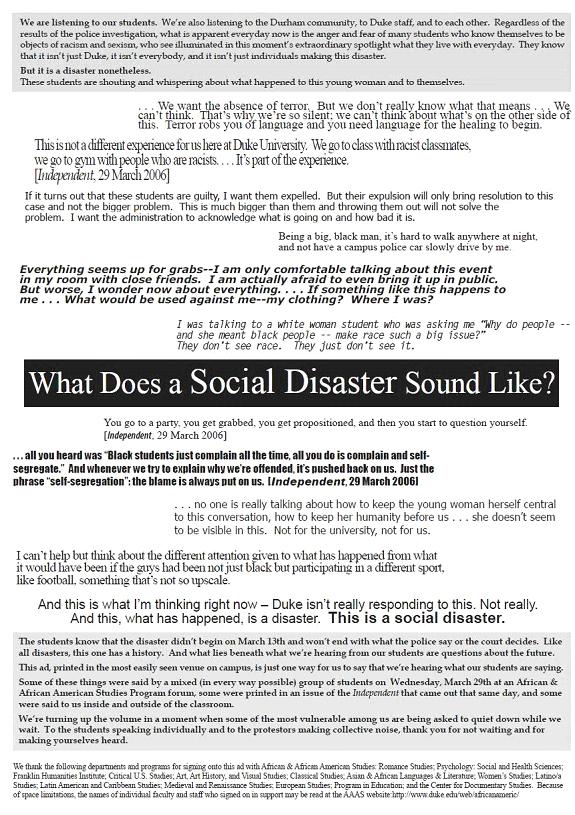
A few weeks ago I got an email from Barry Porter, Director of Marketing, Adult Publishing Group at Simon & Schuster, who is responsible for promoting "It’s Not About the Truth" a new book about the Duke lacrosse team case from last year.  The book was written by Don Yaeger with Mike Pressler, the former Duke lacrosse coach.  Mr. Porter asked me if I’d like to review the book and I told him I would.

Last weekend I got my copy of the book in the mail and I read it over the last several days.  Since I’m not a professional book reviewer I figured the best approach would be to provide some bullet points of my initial impressions.  I’ll start with a couple of negative impressions I had, but for the most part they’re positive.  Here goes:

  • It’s no surprise that the book is pro-Pressler and pro-Duke lacrosse players.  What did surprise me were some of the one-liners that Yaeger used that I felt were an unnecessary distraction from his narrative.  For instance at the beginning of the 10th chapter Yaeger writes, "Nifong jumped on his media opportunity like a fat kid on a cake."  Chapter 16 has this nugget: "Nifong may have been a political virgin, but he did know something about being a whore."
  • Yaeger seems to be a political conservative and he tends to use "liberal" as an epithet.  Part of his thesis is that Pressler and the players were undermined by a group of liberal professors, the "Group of 88", who used the case as a way to promote their radical-left theories, but in the process he seems to lump all "liberals" with those who penned their names to a controversial ad that appeared in the Duke Chronicle student newspaper.  The first sentence of Chapter 12 reads, "It is one of America’s worst-kept secrets: College campuses are a breeding ground for radical left-leaning faculty."  Um, I think the faculty at Grove City College, Brigham Young University or Liberty University would take exception to being classified as "radical left-leaning."  Not that the faculty in question at Duke aren’t radical or left-leaning, but making such sweeping, blanket statements detracts from the writer’s credibility.
  • Yaeger discusses the influence of blogs on the developing story, and even uses some blogs in his research and background materials.  One such blog is Durham-in-Wonderland, which is run by KC Johnson who is a professor of history at Brooklyn College. I can’t think of another book I’ve read that references blogs as a resource.
  • Putting aside the author’s biases, and at least he doesn’t hide them, he does offer a lot of background information on the case and in particular there is a lot from the perspective of the coach.  While most of us, especially here in North Carolina, have read about the prosecutor’s (Mike Nifong’s) alleged misconduct and have read about the alleged rape victim’s changing stories, I think many people will be surprised by the information contained in the book.  There’s a lot of information about police behavior that’s downright creepy, some of Nifong’s unbelievable decisions and some decisions by Duke administrators that I’d call ill-conceived at best (chicken-shit would be another description).
  • Yaeger writes over and over that as the "true" story came out lots of people could see themselves in the players’ shoes if they hadn’t been lucky.  In other words the poor decision the players made in hiring strippers to come to their house to perform is not dissimilar from decisions made by many of us, but we never had the misfortune of having that decision turn our lives inside out.  That is definitely true for many folks, including myself.  Put bluntly I can remember at least two bachelor parties that featured private dancers (and their requisite 300 lb. escort) and it’s not hard to imagine a situation like that spinning out of control.
  • I don’t think this book will change anyone’s world view.  For those who are offended that young men would hire a stripper to come to their home they’ll probably see this case as "justification for all those other men who get away with subjugating women to such humiliation".  For those who think that all cops/DAs are crooked they’ll see this as further evidence of that "fact", and for those who think that "all liberals care about is political correctness and not the truth" this book will really stoke their fires.  Still, I think the book provides value in that it offers a detailed timeline and overview of the events that make it easier to understand how it all happened.  The author did a lot of interviews with the principals involved; the players, the coach, the attorneys and school representatives and as such the book offers lots of good information for those interested in the case.
  • Unless the author totally botched his research, and I seriously doubt he did, Nifong is toast as soon as his disbarment hearings are complete.
  • Finally, it’s not a bad read. I’m not a particularly fast reader and I was able to finish it in a few hours.  Sure I didn’t like some of the adjectives and adverbs that Yaeger used, but on the other hand the narrative flowed well.  If you have any interest at all in the case then it’s definitely worth the time.

More on Lewisville Teacher Alan Snow

============================================
As more and more online college degrees become available the number of online degrees that you can earn also have been diversifying. You can not only learn about medical billing at a large number of online colleges you could also get yourself an elementary education degree online if you wish.
============================================

Lots of interesting comments on the original post about the new set of allegations against Alan Snow, Lewisville Elementary’s science teacher.  From a comment by "Concerned Parent":

I was speaking earlier on how people are repsonding to the accuser and
on the wxii website there was a person that was asking for the "names
of the accuser and he was begging so that he could contact them because
they were horrible people"…I contacted wxii and asked to have this
taken off and they did…the victim and family are now scared for their
safety by the way they have heard people respond.

This has the potential to get really ugly and it could tear at the fabric of this community.  I’m begging the sheriff and the school system to handle this right and as promptly as possible for the sake of everyone.

BTW, the Winston-Salem Journal’s article has comments at the bottom.  I’d like to thank the commenters here for being a little more civilized (and thoughtful) than those at the Journal.

Cream of the Crop?

Over at Freakonomics they’ve posted an interesting item from one of their readers on the subject of military officer promotions.  Here’s an excerpt:

Officers rise through the system without relevance to merit; promotions
are based on the length of time the officer has been in the system. (Up
to the rank of Lieutenant-Colonel, anyway — to make Colonel you have to
have done more than serve time.) Enlisted men are subject to a
completely different rule: you see them studying for months, mastering
the contents of a book this thick (makes gesture, thumb and fingers
about three inches apart).

To be an officer you must either have been to one of the military
academies or to college. Because promotion is not based on merit, smart
officers get frustrated and leave for jobs where they can make better
money; less able officers have every reason to stay, since incompetence
is no impediment to career advancement. Since the effect of the system
is to retain the least able, it perpetuates the elimination of the
able: the norm is for smart young officers to find themselves reporting
not to superiors like themselves (the ablest left early in frustration
at the stupidity of the system), but to superiors who a) were not
frustrated by the system and b) feel threatened by clever subordinates
… And that’s how we get the leadership of our defense services.

They ask for input from other readers to see if this is in fact an accurate representation of the military system today.  My guess is that they’ll find this a somewhat simplistic portrayal of the system that is, unfortunately, closer to true than not.  Of course this problem isn’t unique to the military, as anyone who grew up in the DC area could tell you.  There’s a reason a lot of us who were the children of civil servants decided not to follow our parents into the government.  We heard way too many stories about "idiots and a-holes" who’s rise through the ranks seemed to the defy the gravity of their incompetence.  Sure the job security and benefits are great, but how many people want to work for or with a brown-nosing, sniveling incompetent?

Okay I’m a little cynical about the federal government, but I think there’s plenty of reason to be cynical and I’m willing to bet the Freakonomics boys will find as much cynicism regarding the military.   

What Does Niger’s Embassy in Rome Have to Do With Us?

What does a petty robbery of Niger’s embassy in Rome in January, 2001 have to do with us?  Plenty it seems:

The case is a simple one: Thieves broke into the apartment-sized
embassy of Niger, located on the northern cusp of Rome’s historical
center, while the staff was away the day after New Year’s in 2001. The
intruders made off with a few seemingly unimportant items that included
a few sheets of stationary and a stamp with the country’s official seal.

More than two years later, the case for taking the US-named War on
Terror to Iraq was made based on forged documents made from those items
– the falsified information behind US President George W Bush’s now
famous 16-word State of the Union claim that "The British government
has learned that Saddam Hussein recently sought significant quantities
of uranium from Africa."

That Iraq never sought uranium from Africa is now well known. But
the tale of how the claim came to be made still offers new and relevant
lessons.

The case is detailed in a new 250-page book – "Collusion:
International Espionage and the War on Terror" – written by Italian
investigative journalists Carlo Bonini and Giuseppe D’Avanzo. The book
points a finger at disgraced former Italian secret agent Rocco Martino
who allegedly forged the documents and sold them for cash to his former
bosses with the Italian intelligence agency SISME, with no idea how
important they would become.

Also to blame is Silvio Berlusconi, who in 2001 was Italy’s newly
elected prime minister eager to curry favor with Washington and its
allies. Berlusconi’s government passed the information on to London and
from there it made it to the White House. It was not thoroughly checked
out at either stop.

Source: ISN

It seems the information wasn’t thoroughly checked out at its destination either.  You know, if this was a movie no one would believe it because they’d assume that there’s no way that three governments could bumble so badly.  I think one of the byproducts of growing up in Washington is that I absolutely find it believable. One rubber stamp, plus one moronic ex-spy, plus three western governments equals the death of tens of thousands?  If you’ve been in Washington for more than 10 minutes you know that it’s more than possible, it’s probable.

In a Vacuum

As I mentioned in my previous post we lost power on Sunday night and we’ve been without power and/or cable for about two days.  A consequence of our blackout is that we (Celeste and I) had no idea that something was going on at Virginia Tech until one of the people sitting at the table next to us at Panera started playing the video from CNN on his laptop.  After that the only update I got for hours was on the radio while I was driving my son to his orthodontist.  We stayed at a hotel last night so I was able to watch the news there, but really I felt like I was in a vacuum.

This reminded me of 9/11 when I was stuck on the streets of DC trying to get home and didn’t hear about the towers falling down until someone told me as we waited to get on the Metro.  After that I had no idea what was going on until I got home that evening and saw for the first time the video that the rest of the world had seen hours earlier. 

This also reminded me that my habits have changed considerably in the last few years. I used to get most of my information from broadcasts, radio or television, but now I get most of it via RSS feeds in my reader or by browsing any number of news sites.  I’m beginning to realize how limiting the broadcasts feel, because when I’m online and getting my usual news stream I’m seeing one story from literally dozens of viewpoints.  With TV I’m getting that one story from a limited number of sources who all feel compelled to package events like this as "The Massacre at Virginia Tech" and then in two days will package it as "The Massacre at Virginia Tech: The Aftermath", and then in two more days will package it as "The Massacre at Virginia Tech: The Recovery Begins", etc.

Of course I could have read my feeds on my PocketPC but I had the slight problem that I’d deleted my mobile feed reader (long story) and had neglected to restore it.  Once I get the chance that’s now a high priority, because I can’t take much more of the broadcasters.

Venting Ye Old Spleen

Maybe I’m cranky because this is the most stressful time of the year for me at work.  Whatever it is I’ve had it with some of the crap that passes for news and public dialogue these days and I figured what better way to blow off a little steam than to spell it out for the three people who read this thing.  So here we go.

Item #1: Forsyth County Commissioners and the ACLU re. Sectarian Prayers to Open Public Meetings

A while back the ACLU sent a letter to a bunch of municipalities in western North Carolina threatening to sue them if they didn’t end the practice of opening public meetings with sectarian prayers said by preachers invited from various churches.  All of the municipalities were told by their lawyers that they didn’t have a leg to stand on and some came to the decision to either open their meetings with non-sectarian prayers or with moments of silence.  Of course my county commissioners aren’t listening to their lawyer and are considering going to court to fight the ACLU even though there is a ton of case-law, i.e. precedents, that have held against prayer at government meetings.  The commissioners are also getting a lot of vocal support for fighting the ACLU from local citizens with only a smattering of dissent. (For a taste check out the letters to the editor of at the Winston-Salem Journal).  What really gets my goat, though, is that the arguments put forward in support of sectarian prayer are downright obtuse.

One rationale that the sectarian prayer supporters use to argue their point is that the establishment clause should not be interpreted to allow a small minority to deny the majority their right to sectarian prayer.  This is as dumb an argument as you can make for this reason: Not allowing a government meeting to open with a sectarian prayer is not denying anyone the right to pray. If you feel like it you can go and sit in the meeting and pray to anyone or anything you like, but the government can’t invite you to come and pray as their representative.  What’s being denied is the government’s "right" to sanction any one religious group or sect.

Another argument being floated is that denying Christians the right to invoke Jesus is also barring Jews, Muslims, etc. from praying to their God.  No one, including the ACLU, has said that the prayer before a meeting can’t invoke "God", they’ve only said you can’t invoke a specific deity like Jesus or Buddha.  I’ve mentioned that to a couple of people and they think I’m lying.  Whatever.

The Forsyth County commissioners and sectarian prayer supporters consistently point out that the commissioners invite representatives of different religions to open their meetings and so the current policy is fair.  I’m left to wonder if they think that inviting Baptists, Methodists, Catholics, Lutherans and Moravians qualifies as different religions?  Exactly when was the last time a Pagan was invited to give the opening prayer?  How about a Muslim or Buddhist?  Heck, what about those Mormons that scare the crap out of your average Baptist?

Finally, I’m willing to bet that the commissioners know this is a losing cause.  They’ve been hemming and hawing while they try to come up with a resolution that protects them from the vocal choir of voters who want to fight the ACLU. It looks like they might have found a way out of their jam by deciding to fight if, as todays Winston-Salem Journal reports, some Christian-folk get together funding to privately finance the legal fight.  That would mean that the commissioners wouldn’t have to worry about any political fallout for spending public dollars on what everyone knows is a losing battle.  In other words they can pander to the vocal Christian majority of their constituents without risking anything.  Cowards. 

The county commissioners have been elected to represent all of their constituents, not just the majority who are Christians.  Every single one of them has an atheist, agnostic, and other non-Christian in their district but instead of looking out for this small minority’s interest they’re pandering to the majority.  They seem to think that their job is to do what the majority wants them to do, but if that’s how representative government worked then we could run our government like American Idol.  Their job, first and foremost, is to uphold the law for all of their constituents and if they fight a battle that their own legal advisors say is wrong then they all deserve to be canned in the next election.  And for anyone who doesn’t know me, I say this as a life-long Christian.

Issue #2: This Whole Imus Thing

What’s to say that hasn’t already been said?  Well, I’ll just add a couple of thoughts. 

Number one: How did Al Sharpton become the black community’s "representative"?  That’s like the white community being "represented" by some strange hybrid of Pat Robertson and Donald Trump. Sharpton’s an opportunistic gas-bag who’s cause is his own wallet, period.  If there wasn’t any money in it he wouldn’t be "representing" anyone.

Number two:  Sharpton’s antics took Imus from being a has-been listened to by a couple of million people who lost half their brain cells while dropping acid in the 60s and 70s to being the most prominent person in media. And it happened in less than a week.  Sharpton would argue that Imus is hurting because he lost a bunch of sponsors and has lost his simulcast on MSNBC (viewed by the tens of thousands!).  Of course now even my kids know who he is so when he starts streaming his schtick online, putting out podcasts, writing his autobiography, etc. he’ll make a gazillion dollars.  But Sharpton doesn’t care because he’s reaping the benefit during his own show’s sweeps weeks.

Number three: Imus and Sharpton both know that they’re going to get even richer off this thing and they literally have a symbiotic relationship now.  I imagine that in a month they’ll be toasting their success with a glass of Cristal at a restaurant in Harlem.  They’re playing us for suckers and it’s working.

Number four: Who thinks that by Monday we’ll still be engaging in the productive "discussion of race" that this episode supposedly opened up? If you raised your hand I know of a bridge in Brooklyn that Sharpton would love to sell you.

That’s it for now.  I do kind of feel better.

News Flash: We Boys are Crotch Watchers

I know you ladies will find this shocking, but there’s now some proof that most men won’t look you in the eyes when they’re talking to you.  In 2005 two researchers did an eyetracking study on 255 people, or in other words they tracked where people looked on a screen when browsing the web, and came up with some interesting info.  The full article is here, but for our purposes we’ll concentrate on this part:

When photos do contain people related to the task at hand, or the
content users are exploring, they do get fixations. However, gender
makes a distinct difference on what parts of the photo are stared at
the longest. Take a look at the hotspot below.

Although both men
and women look at the image of George Brett when directed to find out
information about his sport and position, men tend to focus on private
anatomy as well as the face. For the women, the face is the only place
they viewed.Brettcrotch

This
image of George Brett was part of a larger page with his biographical
information. All users tested looked the image, but there was a
distinct difference in focus between men and women.

Coyne adds
that this difference doesn’t just occur with images of people. Men tend
to fixate more on areas of private anatomy on animals as well, as
evidenced when users were directed to browse the American Kennel Club
site.

We really are a bunch of dogs.

Found via Boing Boing.

Trickle Down and the Sticky Leg

I had a professor in college (this is during the Reagan years) who hated the whole trickle-down economic theory and to express his distaste would say that "all trickle down economics is going to get us is a sticky leg."  At the time I had the distinct impression that a lot of the prevailing economic theory involved the rich getting richer and then the rest of us benefiting from the drippings they left in their wake.  Some people said a rising tide raises all boats, but since a lot of us didn’t own boats (those damn things are expensive) I didn’t find that statement particularly encouraging.  It seemed to me that while theoretically trickle down economics should benefit everyone it seemed to benefit the wealthy most. That made my perception of trickle down economics to be a scheme by the rich and powerful to line their pockets with extra dollars while keeping the rest of us happy with extra nickels.

I’ve mentioned before that I’ve been reading about the history of the US tax system, and what I read discouraged me a great deal and reminded me of the feelings I earlier had about trickle down economics.  Despite what you might expect I wasn’t that discouraged by the favorable tax treatment that the super-wealthy get relative to the middle class.  Rather I was discouraged by the argument made by supporters of that treatment, and the fact that many of us actually accept it.  Essentially what the supporters say is that the super-wealthy, while making up some miniscule percentage of the overall population, contribute a larger percentage of overall taxes.  Well pardon me, but that argument’s a load of horseshit.  What matters is the percentage of their wealth that they pay in taxes compared to the percentage of our wealth that the rest of us pay.  By that measure the super-wealthy are essentially paying the same or less in taxes than the Average Joe. (See David Kay Johnston’s book for details).

Some would argue that it doesn’t matter if the super wealthy pay the same effective tax rate as the middle class because in the end they are still contributing significantly more dollars than the middle class.  The problem is that the effective tax rate the super wealthy pay is partly due to fancy tax schemes and shelters concocted by their professional tax advisers and which are not realistically available to the rest of us.  And a lot of those schemes and shelters exist in the tax code thanks to lobbying by the super wealthy and their corporate counterparts.  Even if it’s fair, it looks and feels shady.

I’m bringing all this up because of a letter to the editor I read in the Winston-Salem Journal the other day.  The writer was opining against those folks who think the Bushies have done a bad job (war, Katrina, immigration, job losses) and he uses the following argument to bolster his stance that things are just rosy right now: the stock market is doing great and unemployment is historically low.   To me his argument rings hollow for the same reasons that trickle down economics does; it sounds like something the wealthy/powerful want us to believe to keep us in line while they walk off with the big bucks.  Sure unemployment is low, but how many of those jobs are paying people below the poverty level?  The stock market?  That’s a risky thing to lean on as regards to arguing prosperity, and I’d venture that the writer’s perspective might be a little different right now than it was 48 hours ago (see this story about the tumble of markets worldwide).  Of course the markets could rebound in another 48 hours, but the point is that whether or not the market rises or falls most people in this country don’t perceive that they get a direct benefit from the market’s rise.  Maybe their employers do, and maybe that keeps their jobs around for another paycheck, but their perception is that the market is for the wealthy’s benefit.  That’s their perception so that’s their reality.

And the author of the letter disregards other pieces of the economic puzzle.  Savings rates are at historic lows, debt levels at historic highs and the Average Joe is leveraged to the eyeballs (just like Stanley Johnson).  Whatever gains we might get in our 401K or IRA accounts is effectively offset by our outrageous credit card balances/interest and our lack of rainy-day funds when things go wrong. I’m not saying it’s anyone’s fault but those who have built up their debt, but it helps explain the Average Joe’s perspective.

To put this in a nutshell, even if trickle down economics works and even if the stock market is doing great and unemployment rates are low, I don’t think the Average Joe sees it as directly beneficial to himself.  His perception is that the wealthy are winning the game by riding his back and I have to wonder how long it will be until the Average Joe starts to rebel.  If we don’t want some sort of socialist-democratic system foisted upon us (think France, or God forbid, teachers unions) then we need to clean things up so that the Average Joe doesn’t feel screwed.  I’m not saying that we need to de-wealthy the rich, or that we need to subsidize the middle class, I’m just saying that we need to make sure we’re all playing under the same rules.    If we don’t we’re gonna have a lot of people who think their legs are sticky.