Category Archives: Current Affairs

Addressing Homelessness

At the day job I work for a trade association that represents the apartment industry, thus the companies I work with are on the front lines of our nation’s housing situation. You may not be aware of it, but we do indeed have a housing situation that can be best summed up as this: we have too many people who don’t make enough money to pay for the housing that’s available, and/or we don’t have enough housing units that are affordable for people at the bottom of the income scale. Even worse, we have a LOT of people who, thanks to any number of life events, lose their housing and thus end up living in flop houses, cars, tents or under a bridge.

Because apartment owners and managers provide over a third of the housing in the U.S, and a majority of the rental housing, they are often looked to for a solution to the problem of affordability and homelessness. It would be great if they could snap their fingers and solve the problem, but due to the complexity of the issue (static income, increases in the costs of everything from health care to food, lack of housing inventory in general, etc.) this is not something housing providers can solve on their own. That’s not to say that people in the industry aren’t trying, and a perfect example is a woman named Lori Trainer who has been working for years down in Florida to address homelessness in her community. (Here’s a link to a video about some of her work, and I’ll embed it below as well). She just wrote an article for Multifamily Insiders titled The Story Behind the Sign that helps put homelessness in perspective. Here’s an excerpt:

We’ve all seen the homeless person with the sign on the side of the road and when we do, many people think these thoughts.    What the people offering these judgments don’t realize is that the overwhelming majority of people don’t “choose” to be homeless.  In fact, nearly 50% of the homeless in America are working.  Why are they homeless then?  Well, that is the “564,788 person question” (the number of homeless on the street each night according to the National Alliance to End Homelessness).

The causes of homelessness range from sad to tragic.  Job loss, foreclosures, divorce and natural disasters such as the tragedies we are seeing in the Midwest and in Canada are a few examples.  These storm victims certainly didn’t choose to be homeless or do anything wrong but they are indeed homeless now.  If their insurance isn’t perfect, takes a year to work out the details or worse yet, doesn’t pay, what do those families do?  They have lost everything; their homes, belongings and jobs.  They are now homeless…

Another very prevalent and sad demographic in the homeless arena are families.  Approximately 206,268 were identified in the last count. Divorce, domestic violence, death, single parents and low wage workers are all in this category.  Children are resilient but often suffer irreparable damage when forced to live in vehicles, shelters or motels for weeks or months on end.  60 Minutes did a great job highlighting this epidemic:https://youtu.be/L2hzRPLVSm4   (Be sure to have tissues handy!)

Then Lori goes on to point out that there are many, many more people who are just a misstep away from becoming homeless themselves.

Many people think it could never happen to them.  But the truth is that one out of three people are two paychecks away from being homeless.  There are 12 million renters pay more than 50% of their annual income for housing and 37 million people living in poverty in America.  Simple fact, a minimum wage worker cannot support a household and pay rent.  There is a critical shortage of affordable housing in the US and, according to the National Low Income Housing Coalition; approximately 200,000 units are destroyed annually.  That combined with the “aging out” tax credit population and the mile long waiting lists for section 8 vouchers, we have the perfect storm.

One of the initiatives we are working on at the national level in the industry is to identify the programs that industry groups are participating in at the local level around the country. For instance, my employer is working with Partners Ending Homelessness to help match their clients with available apartment units in Guilford County. What we’ve found is that like many things in life, the concept is simple but the implementation is complex. Still, we’ve seen progress and we will continue working because this is an issue that will be with us for the foreseeable future.

That’s just one initiative in one community, but that’s the kind of effort we’re going to need in every community around the country to address homelessness, because quite frankly this is not an issue that can be solved from Washington. What our national leadership CAN do is address the big picture issues that underlie homelessness, including:

  • An economy that is not providing adequate income for average workers
  • A health care “system” that bankrupts some, and financially cripples many
  • A crumbling infrastructure that threatens all of us
  • A byzantine regulatory structure (think HUD & EPA) that makes affordable housing development a challenge

Another chief culprit is an under-performing, and some would say under-valued, education system, but that’s not just a Washington issue so let’s not throw it entirely on them. The point is that homelessness is the most severe symptom of an ailing nation. If we are truly measured by how we treat the least of us, then as a nation and a community we have a lot we need to do to heal ourselves.

Here’s the video about the effort in Florida that Lori’s been a big part of:
Proactivism

Unless you’ve lived under a rock for the last couple of months you’ve heard about a small issue we’ve had here in North Carolina. It’s a piece of state legislation called HB2, aka “The Bathroom Bill”, and it has actually grown into a national issue thanks to the combination of national media attention, acts of protest by well known companies and entertainers and the recognition by many politicians that it is a perfect “wedge issue” for this monumental election year. From amidst the increasingly nasty din that surrounds the issue has emerged a fleetingly rare voice of sanity, and it came to my attention from, of all places, an issue of a trade newsletter I receive called Associations Now, that has a piece about a group that is encouraging musicians to use their shows to protest HB2 instead of cancelling their shows outright in protest:

As an alternative, a pair of activists launched North Carolina Needs You, which encourages musicians to hold shows in the state and use them as platforms to speak out against the measure, known as HB2.

The initiative was born when Grayson Haver Currin, a prominent North Carolina music journalist and onetime codirector of the state’s Hopscotch Music Festival, came up with the strategy after Springsteen canceled. Currin and his wife, Tina, created the campaign out of concern that, in the long run, artist boycotts would do more harm than good.

Almost immediately, the band Duran Duran, which had struggled with whether to cancel its show, collaborated on Currin’s initiative and decided to perform, using the show to draw attention to the cause by bringing critics of the law onstage and by donating money to political nonprofits working to fight the law.

The website also found quick support from those nonprofits, including Equality NC, Progress NC Action, and the state chapters of the NAACP and the ACLU…

The artists choosing to stay have received positive notices from music-industry peers who are directly affected by the law.

The band Against Me!—whose lead singer, Laura Jane Grace, publicly came out as transgender in 2012—announced that it would keep its May 15 show in Durham on the schedule specifically to protest the law. The band is encouraging attendees to use gender-neutral bathrooms at the concert venue.

While it’s easy to understand where acts like Bruce Springsteen are coming from when they cancel shows, this approach seems much more productive. Hopefully more voices like the Currins’ will emerge here in North Carolina and we can get back to some level of sanity.

Perception IS Reality

In the ongoing North Carolina saga that is the aftermath of the state legislature’s passage of HB2, it has become clear people are still people. Essentially, people who support the bill focus on the parts they agree with – namely the “bathroom bill” portion – and seem perfectly willing to ignore or minimize the parts that they may or may not agree with if they bothered to look past the headlines related to the bathroom-related stuff. On the other hand opponents of the bill focus on the discriminatory aspects of the bill and the egregious rollback of employees’ rights to sue for wrongful termination -rightly so in my opinion – yet they also minimize the feelings of people confronted with the confusing spectrum of human sexuality and gender and belittle as “ignorant” those who don’t know the difference. In other words, our state legislature has drawn a big red line on either side of which the citizens of the state are lining up.

One real rub here is that there are many people who hate the bill, but don’t want to admit that sharing a restroom with a transgender person gives them pause. Given enough time to think about it they probably realize that they already have and just didn’t know it, but the fear of the unknown and different is something that must be addressed and it does no good to belittle those who have those fears.

Another issue is that a certain percentage of the backlash against the bill is coming from people and institutions from outside the state, so people who support it are able to fall back on the old “we’re not going to let those California liberals (or Yankee, or whatever other pejorative) tell us how to live our lives, so they can take their business elsewhere” argument or, even better, the “those people are hypocrites because they still do business in <fill in the blank place with some hot-button issue>” tack. When these people hear that yet another performer is cancelling a North Carolina gig, or another conference is cancelling and moving to another state, or another company is halting expansion plans for the state, they shrug it off as inconsequential or hypocritical. Yet, you can be dead certain that if Charlotte’s bathroom ordinance that was supposedly the justification for HB2 was in place and a Christian rock band cancelled a show there, then they would instantly invoke the right of the band not to violate its principles and decry the lost economic impact due to the ordinance. Hypocrisy, meet thyself.

So here’s the deal – both sides have their perceptions of the issue and so each has its own version of reality. What the supporters of the bill will have to reconcile themselves with is the reality that their perception, and thus their version of reality, is out of step with much of the rest of the country. You know what? That’s their right, but when some of them wake up one day and are unemployed because the state has lost so much business because it is out of step with the rest of the country then they will have a whole new reality to face and that might change their perception of what IS important to worry about and what’s maybe a red herring of an issue that’s been used to screw them over.

Civility and Intelligence

Here’s a quote from a post at the AVC blog on the importance of civil and intelligent debate that hit home when I read it this morning:

I was reminded of that when I read Ruth Bader Ginsburg’s comments on Antonin Scalia, in particular this part:

We disagreed now and then, but when I wrote for the Court and received a Scalia dissent, the opinion ultimately released was notably better than my initial circulation. Justice Scalia nailed all the weak spots—the “applesauce” and “argle bargle”—and gave me just what I needed to strengthen the majority opinion.

and this:

Maybe the most important part of the title to this post is the word civil. Without civility (and respect), it is hard to have intelligent debate. Respecting those with opposing views, working to understand them, and listening closely to them is the key. Even if they don’t change your mind, they can reshape how you discuss and present your views. And that can make all the difference in the world.

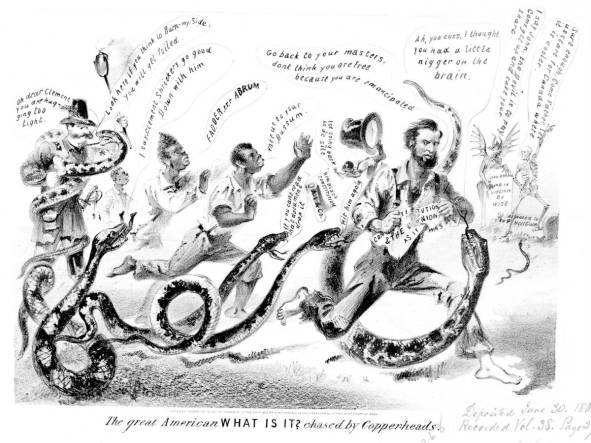
The scary thing about the current state of political discourse in America is the very real lack of civility. As much as we’d like to think this is a modern phenomenon, we actually have a long history of pretty nasty behavior during the political silly season. Check out this political cartoon about Lincoln:

civilityLincoln

Source: HarpWeek

That’s some pretty nasty stuff by any measure. What’s new to our elections these days is the ability of any one person to create or spread nastygrams like this via their social media channels, with nary a thought to whether or not it’s true. With the click of a button they can share personal attacks on candidates, falsehoods about a candidate’s past and beliefs, or launch character assassinations on political candidates or members of a political party faster than you can say “fact check.” It’s truly becoming an overwhelming cacophony of negative, schoolyard name-calling that is drowning out increasingly fruitless attempts at civil discourse.

Lest you think I’m exaggerating, check out these images I found in just five minutes of scrolling through my Facebook feed:

So what commonalities do you find in these images? What I see are personal attacks and name calling with no attention paid to the stated policies of the candidates. How, pray tell, does this advance the cause of the Union in any way?

Now I do understand that much of what people share are things they consider funny. Many of the memes poke fun at the generalizations the sharer has about the folks on the other side of the fence, and normally I wouldn’t be such a stick in the mud about it since I enjoy a good joke as much as the next person. However, when you see people share literally dozens or hundreds of these memes that do nothing but insult people with a different set of beliefs then you have to come to the conclusion that they truly feel that their opposites are stupid, lazy, cruel, etc. When you begin to believe that then you inevitably come to the conclusion that there’s no room for honest debate, and quite frankly you begin to not care what they think because all you see are personal attacks completely divorced from the issues.

So maybe you think I’m overreacting and that I should just ignore what I’m seeing on my social media channels. I might agree except that I think our current crop of political leaders, both liberal and conservative, from the local level to the national level, are exploiting these sentiments and profiting from our separateness. Until we can find a place to have civil and intelligent debate they’re going to play us for the suckers we are.

In other words, folks, we have met the enemy and it is us.

Trust Us

If you walked down just about any street in America and randomly asked people their opinions of “government” they would almost certainly describe it as bloated, bureaucratic, incompetent, invasive, etc. You would likely be challenged to find someone with something good to say.

Some of these negative assessments are earned – many governments are bloated, bureaucratic and, at times, incompetent – but some of the sentiments are the result of a cacophony of anti-government or small-government advocates. Some of them believe in their heart of hearts that all services, with the exception of public safety, would be most effectively provided by the private sectors. Others believe government is inherently evil and hold an Orwellian world view that just about anything the government does is an assault on individual liberty.

On the flip side of the coin you have people who see the government as the best option for addressing many of society’s ills, but they might see the folks running the show as a lesser light or the systems in place as overly bureaucratic and inefficient.

What all sides have in common, though, is a healthy case of cynicism about the government. Most simply do not trust it, whether from negative personal experiences dealing with the government (DMV lines come to mind), or from stories they’ve heard repeatedly from friends and from the media.

Luckily, for the most part the lack of trust is fed by relatively harmless inconveniences like long lines, higher than expected water bills or slow permitting processes for home improvements. That gives us all some ammunition for running jokes, but since we’re relatively safe and secure in our daily lives it doesn’t give us much cause for doing much more than telling jokes.

That’s why the Flint, MI water story is so important. Multiple governments failed to protect the health and safety of Flint’s residents, and apparently even worked to cover up their failings. This wasn’t a normal hot button issue, like the police shootings and “Black Lives Matter” stories that we heard so much about. While those stories were important and people were hurt, not everyone could identify with them because not everyone has had interactions with the police or could empathize with what it’s like to be black in America.

The Flint water story is about the failure of government to provide a fundamental service that affects everyone, safe drinking water, and then trying to cover it up. EVERYONE can picture themselves in that situation, and they can empathize with the plight of the citizens of Flint. The government violated the public trust and by doing so it weakened the very foundation upon which a civil society is built.

Not to overstate it, because we still do live in an incredibly stable society relative to the rest of the world, but if we don’t start demanding responsible governance from our elected leaders then we are going to see more and more failures like this one. We get enough of those and our society won’t seem so stable anymore.

So, let’s stop with the “all government is bad” rhetoric, along with its “all taxes are bad” cousin, and start having intelligent discussions about how government can best serve our citizens’ needs and take it from there.


Do We Really Want To Be the United Whimps of America?

In the aftermath of the terror attacks in Paris we’re seeing some predictable reactions from a segment of our American crowd. They can be boiled down to the following:

  1. If France didn’t have such strong gun control, in other words was more like American, then there’s no way the terrorists could have killed so many people indiscriminately.
  2. If France and the rest of Europe had closed their borders to refugees then the terrorists couldn’t have gotten into the country to do the damage.
  3. We need to immediately stop taking any refugees lest we let in terrorists.

I’m going to tackle these one at a time:

  1. Terrorists who will wear suicide bomb vests, who aren’t afraid to die, won’t be dissuaded by locals with guns. And it’s not like they wear shirts that say “Terrorist!” on them, so the element of surprise is kind of a given. Basically your average gun-wielding citizenry is likely to die quickly or inadvertently kill innocent bystanders in their efforts to fight the terrorists.
  2. Closing the borders might make it more difficult for the terrorists to get in the country, but since these are extremists who spread their ideology like a virus you will never be able to prevent them from recruiting people who are already in the country. In other words these folks are like an airborne virus and closing the borders would be the equivalent of fighting it with band aids.
  3. This is the big one. As a nation we profess to be a safe harbor for the tired, huddled masses. It’s literally inscribed on one of our greatest symbols. Why then, when the time comes to deal with a huge number of desperate people fleeing their homeland as it goes up in flames thanks to a geopolitical catastrophe that we played a large role in creating, do we endeavor to turn them away?

    Using the logic in #1 above, we of all nations should be the most prepared to accept refugees who may be infiltrated by some terrorists. We are absolutely armed to the teeth here, so if anyone is (literally) armed to deal with this crisis it’s us. Why then does our armed citizenry, many of whom are avowed Christians who should be chomping at the bit to help these desperate souls, seem so eager to turn them away? There’s only one answer I can think of and it’s fear, and that’s what boggles my mind. Many of the very same people who insist that profligate gun ownership makes us safer are also screaming that we need to close our borders. If we leave it up to them we will come to be seen as the United States of Whimps and personally I prefer that not to be the case.

    Don’t get me wrong; I don’t think you just open the gates and let everyone in without doing everything you can to screen out potential terrorists or other threats. What I do believe is that as a nation that is supposed to be a world leader we should show true bravery by welcoming those desperate souls, providing them with a shelter in the storm while we lead the world in doing the hard work necessary to annihilate the cancer that is extremism, Islamic and otherwise.

    Leaders don’t shy away from risk, danger and hard work and America now has a choice to make – lead bravely from the front or bolt our doors, turn off the lights, hug our guns and pray that the bogey man outside tries to get in our neighbors’ houses instead of ours.

What Happens When News Anchors Don’t Listen

Things went awry for Headline News from the very beginning as they put together a piece on Edward Snowden. First, they contacted the wrong person to interview; they thought they were interviewing journalist John Hendren, but instead they were actually interviewing Jon Hendren. A simple mistake, but one that led to an embarrassing on-air interview (see below) that was exacerbated by the anchor’s inability to actually listen to Hendren’s answers. Had she listened she would have quickly figured out that he wasn’t talking about Edward Snowden, rather he was talking about Edward Scissorhands.

Oh, and one clue they might have had that they were interviewing the wrong guy was that his Twitter handle is @fart. Seriously.

Living in a World of Red Herrings

Every time we have another gun-related tragedy in the United States, like yesterday’s killing of a reporter and her cameraman live on air during a morning news broadcast, we are all fed a predictable diet of red herrings. It’s tiresome and, worse, prevents us from even starting to address the problem. For those of you not from these parts here’s how things currently work:

  1. On a daily basis some Americans die of gunshot wounds for a variety of reasons, but on a fairly regular basis multiple people are killed in such a way that it makes the news.
  2. Before the gun smoke has even dissipated people in favor of gun control cite the story as a prime example of why we need <fill in the blank gun control proposal>.
  3. At the same time gun rights advocates invoke the mental health argument, i.e. “The shooter was mentally ill, and if he didn’t have a gun he would have found another way to kill him”, or the “if the victims were armed they could have killed the attacker” argument, or the “gun control only takes the guns out of the hands of honest citizens since criminals would still find a way to get them” argument, or some combination of all three.
  4. Everybody argues about it for a couple of days.
  5. We move on.
  6. The next tragedy happens.

Quite frankly both groups are right and wrong. They’re also being manipulated by various constituencies – the most obvious being the NRA – in those groups’ attempts to avoid any kind of rational approach to dealing with what everyone agrees is a national problem yet might require them to make some kind of compromise from their entrenched positions.

Since people can’t seem to be rational about this issue, and since I’ve long since grown tired arguing about it, I’m starting to take the following approach when people bring it up to me:

If a gun rights advocate uses the “he was mentally ill and would have found a way to kill them” argument I simply ask: “Given the choice of being confronted with a nut-case armed with a gun or knife (or hammer, or crossbow, or bottle full of acid, etc.) which would you prefer?” If any of them answer “gun” then I stop talking to them because they either aren’t interested in having a rational discussion or they shouldn’t be allowed to walk without a helmet.

If a gun control advocate invokes an “it’s all about the guns” arguments then I ask, “If confronted by a mentally deranged man armed with a handgun would you rather have a gun or a knife (or hammer, or crossbow, or bottle full of acid, etc.) to defend yourself?” If they answer anything but a gun then I react the same way I do to the answer from the gun rights advocate.

My purpose in asking these kinds of questions is to try and move the discussion away from the red herrings thrown out there by the gun rights/control advocates and toward a discussion about how we might take a rational, comprehensive approach to solving a very serious societal problem. Of course that won’t work with those who firmly believe that ONLY gun control or ONLY absolute gun ownership rights are the solution, but those folks could never be part of the solution anyway. The people who can and should come up with a solution are those who believe the answer is somewhere in between.

The Changing American Jobs Landscape and What It Might Mean for Men

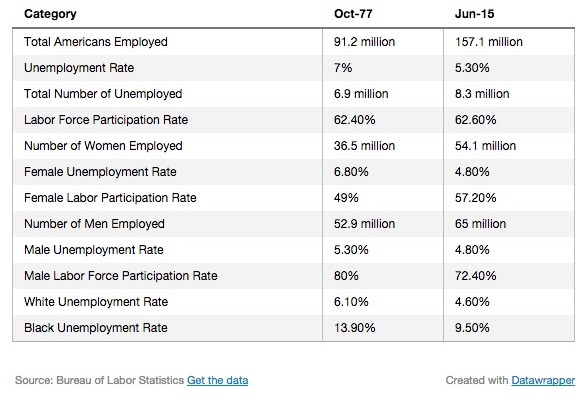
The Atlantic Monthly has a fascinating look at how the jobs picture has changed in America since 1977. Why that date? Because that’s the last time our labor-participation rates were as low as they are today. From the article:

A couple things jump out here: Even though the labor-participation rate is almost as low now as it was then, the workforce has grown faster than the population (which was 220 million then and is around 319 million now). The big jump is in the number of women employed—from 36.5 million in October 1977 to 54.1 now. Male employment has also climbed, but not as much. So as the female labor-force participation rate has climbed, the male rate has dropped, from eight in 10 to barely seven in 10 men working full time. And whereas the male unemployment rate was much lower in 1977, now there’s gender parity.

Even as the gender balance has shifted, it’s noticeable that the racial balance hasn’t. Now, as in 1977, the black unemployment rate is much higher than the national rate, and lags far behind white unemployment.

This isn’t all just evidence of a bad economy—much of the decline comes from Baby Boomers reaching retirement age and checking out, though some of it comes from would-be workers who simply can’t find work, and millions more Americans are underemployed. That isn’t without challenges: An aging population could draw more in benefits than the government collects in social-security taxes. Massive spending on health care for older Americans could be a drag, too.

There’s more to read at the site, in particular what Americans were doing for work back then versus today, but I find the role of women in the workforce to be most interesting. With more women now graduating college than men how many households of the future will see a reverse of the traditional roles of breadwinner (men) versus secondary income/homemaker (women)? We’ve already seen a huge shift in household composition away from the traditional roles  – more dual income homes, single parent homes, women as primary breadwinners, etc. – but it seems clear that the shift will continue over the next generation. What will the impact be on our society?

We’ve already lived through a generation of women struggling to balance work and home life, to face the never-ending tension of career versus kids, but we’re about to be confronted with men having to confront a similar situation over the next generation. The reality that men’s traditional role as primary breadwinners or “heads of household”, at least according to our societal norms, is beginning to dawn on America. Over the next generation the big question is going to be how men will handle being the secondary earner and likely primary caregiver to their children? How will society, especially other men, react to them and treat them when they do? I suspect they will go through many tumultuous days trying to find the right balance, just as many women have for years, and it’s often going to be ugly. Can they do it? You bet, but it’s going to be a painful process as they learn to do it.

*Update*
This Planet Money post also highlights what’s going on:

The share of marriages where women work full time but men don’t is highest for low-income families.

The story here has as much to do with the decline of working men as it does the progress of women in the economy. In just the 10 years between 2000 and 2010, the manufacturing sector lost an astounding 5 million jobs. Since manufacturing jobs historically have been held predominantly by men, this left lots of men out of work. Women, on the other hand, have benefited from the employment boom in the service sector, which employs more women than men.

High-income families are much more likely than average to have both spouses working full time. The message is pretty clear: It’s pretty hard to be rich with only one income.

The Race from Race and Guns

Speaking, or writing, about race in America is almost always an exercise fraught with risk and anxiety. Because we each bring our own racial identity to the table, our own experiences and perspectives, our own preconceptions and expectations of other races, we almost always struggle with overcoming our own obstacles to express our views. Maybe we’re afraid of offending so we salt our statements with ample disclaimers. Maybe we’re enraged so we salt our statements with hyperbolic adjectives. Maybe we’re confused and salt our statements with conflicting viewpoints. Maybe we’re so wrapped up in our own experience that we close our ears to the stories of those we’re trying to talk to. Likely we’re a combination of some or all of these things and as a result our attempts at talking about anything race-related are uncomfortable at best. The result? We do as much as we can to not talk about race in anything but the most generic terms.

Then we have something happen like the Charleston shootings of this week, or the events in Ferguson and Baltimore in the last few months, and race catapults to the top of our minds and the tip of our tongues. We can’t avoid addressing it and that’s when a great divide appears between us. That’s when we most need for people who can articulate the issues in a way that helps us better understand them. but unfortunately that’s when opportunists, the self-appointed leaders of their constituencies, appear on camera claiming they represent the whole of their race and instantly closing the ears of just about everyone. (How long do you think it will be before Al Sharpton shows up in Charleston?) That’s also when those who would like anything but reconciliation, the haters, step up with a megaphone and barf their venomous propaganda all over the rest of us.

Then there’s the matter of talking about guns in our country. The reaction to mass shootings like those in Charleston (and Connecticut, Virginia, Colorado, etc.) is depressingly predictable and divisive. It is near impossible to have a conversation about guns without it spiraling into a heated, virulent argument in which no one seems to think there’s some point between absolute freedom to own ANY weapon or a total ban on weapons.

In its own way gun control as a topic is as divisive as race and when you combine the two topics, as you most definitely are when you start to address the shootings in Charleston, you have the recipe for a witches brew of misunderstanding and divisive rhetoric.That’s why it’s so important that we DO have people who can say what’s needed in a way that we can all hear and understand. Once again the comedian shows us the way:

And then there’s this from David Remnick on President Obama’s reaction to the events in Charleston:

Obama is a flawed President, but his sense of historical perspective is well developed. He gives every sign of believing that his most important role in the American history of race was his election in November, 2008, and, nearly as important, his reëlection, four years later. For millions of Americans, that election was an inspiration. But, for some untold number of others, it remains a source of tremendous resentment, a kind of threat that is capable, in some, of arousing the basest prejudices.

Obama hates to talk about this. He allows himself so little latitude. Maybe that will change when he is an ex-President focussed on his memoirs. As a very young man he wrote a book about becoming, about identity, about finding community in a black church, about finding a sense of home—in his case, on the South Side of Chicago, with a young lawyer named Michelle Robinson. It will be beyond interesting to see what he’s willing to tell us—tell us with real freedom—about being the focus of so much hope, but also the subject of so much ambient and organized racial anger: the birther movement, the death threats, the voter-suppression attempts, the articles, books, and films that portray him as everything from an unreconstructed, drug-addled campus radical to a Kenyan post-colonial socialist. This has been the Age of Obama, but we have learned over and over that this has hardly meant the end of racism in America. Not remotely. Dylann Roof, tragically, seems to be yet another terrible reminder of that.

Nearly all of South Carolina was in mourning Thursday. Flags were at half-mast. Except the Confederate flag, of course, which flew high outside the building where Tillman still stands and the laws of the state are written.

I’m with Jon Stewart in feeling confident that nothing will change as a result of Charleston, or the dozens of similar events that have preceded it, or the dozens of similar events that are sure to follow. Why? Because change comes only when enough of us want it, and right now there just aren’t enough people who want it. Too many people benefit from the racial divide, from scaring the crap out of people – “They’ll take your guns, rape your women, steal your jobs… – and playing both sides to the middle for any real change to happen. The odds of that changing in my lifetime are minuscule and shrinking by the day, but my hope is that my children and their children can fix what the rest of us have so royally screwed up.