Category Archives: Business – Opinion

That Vintage Sears Catalog Is Gonna Get Vintagier

After reading Fec's Sears Death Watch I'm wishing I'd saved an old Sears catalog.  It might be a valuable relic in the near future.

The last time I set foot in a Sears was five years ago when Celeste and I bought a stove and a dishwasher.  Let's just say our experience directly led to me being highly motivated to never return.

The Most Patriotic Thing You Can Do

Mark Cuban says the most patriotic thing you can do is "Bust your ass and get rich." More:

I’m not against government involvement in times of need. I am for recognizing that  big public companies will  continue to cut jobs in an effort to prop up stock prices, which in turn stimulates the need for more government involvement.  Every cut job by the big companies extracts a cost on the American people in one way or another.

Entrepreneurs are needed to create and grow companies to absorb those people in new jobs. If entrepreneurs don’t create those jobs, the government ends up having to spend more money to help them one way or another…

In these times of “The Great Recession” we shouldn’t be trying to shift the benefits of wealth behind some curtain. We should be celebrating and encouraging people to make as much money as they can. Profits equal tax money. While some people might find it distasteful to pay taxes. I don’t. I find it Patriotic.

I’m not saying that the government’s use of tax money is the most efficient use of our hard-earned capital. It obviously is not. In a perfect world, there would be a better option. We don’t live in a perfect world. We don’t live in a perfect time. We live in a time where the government plays a big role in an effort to help lead us out this Great Recession. That’s reality.

So I will repeat my point. Get out there and make a boatload of money. Enjoy the shit out your money. Pay your taxes.

It’s the most Patriotic thing you can do.

Anchor Baby

This is a description of Steve Jobs that I can almost guarantee is unique:

So, who is this man? He's the anchor baby of an activist Arab muslim who came to the U.S. on a student visa and had a child out of wedlock. He's a non-Christian, arugula-eating, drug-using follower of unabashedly old-fashioned liberal teachings from the hippies and folk music stars of the 60s. And he believes in science, in things that science can demonstrate like climate change and Pi having a value more specific than "3", and in extending responsible benefits to his employees while encouraging his company to lead by being environmentally responsible.

The description comes from Anil Dash who also writes:

Every single person who'd attack Steve Jobs on any of these grounds is, demonstrably, worse at business than Jobs. They're unqualified to assert that liberal values are bad for business, when the demonstrable, factual, obvious evidence contradicts those assertions.

Agree or disagree he makes an interesting point.

Investor Ethics

Seth Godin argues that businesses can't be ethical, but people can:

It comes down to this: only people can have ethics. Ethics, as in, doing the right thing for the community even though it might not benefit you or your company financially. Pointing to the numbers (or to the boss) is an easy refuge for someone who would like to duck the issue, but the fork in the road is really clear. You either do work you are proud of, or you work to make the maximum amount of money. (It would be nice if those overlapped every time, but they rarely do).

"I just work here" is the worst sort of ethical excuse. I'd rather work with a company filled with ethical people than try to find a company that's ethical. In fact, companies we think of as ethical got that way because ethical people made it so.

I worry that we absolve ourselves of responsibility when we talk about business ethics and corporate social responsibility. Corporations are collections of people, and we ought to insist that those people (that would be us) do the right thing. Business is too powerful for us to leave our humanity at the door of the office. It's not business, it's personal.

Godin makes a great, if uncomfortable, point. No business can be ethical in and of itself, but it can be a reflection of the ethical decisions of the people who run it.  Earlier in his post Godin wrote this:

The unhappy theory of business ethics is this: you have a fiduciary responsibility to maximize profit. Period. To do anything other than that is to cheat your investors. And in a competitive world, you don't have much wiggle room here.

If you would like to believe in business ethics, the unhappy theory is a huge problem.

So the problem appears to be that since a business manager's fiduciary duty is to maximize the profit of the shareholders then it's almost impossible to do the right/ethical thing if it's not in the best interest of the shareholders.  It's an argument we've heard often throughout the recent past in our country and here's my problem with it: it absolves investors from having their own ethics.

There is nothing that I know of that stops investors from saying to the company's managers that keeping its employees on the payroll is a higher priority than returning a 10% profit.  Investors can also tell the company's managers that preserving the environment is a higher priority than higher profits, that avoiding taxes by playing offshore games will not be tolerated, etc.  Sure, at some point you might have to make some hard decisions in order to help the most people – as Godin writes The local store gets very little long-term profit for its good behavior if it goes out of business before the long-term arrives – but investors can at least let it be known that layoffs are the last consideration, not the first.

*Side note – I do understand that some investors are institutional investors, but guess what?  Institutional investors are managed by people wo when you think about business you have to remember that at the top of the pyramid there is always a person or team of people making decisions.*

To be clear, I'm not disagreeing with Godin.  He's absolutely right that all of these "business decisions" are really a series of individual decisions made under the "it's only business" cover.  What I'm honing in on is this penchant for business writers/commentators to bemoan the complexity of the issue because managers must do everything they can to maximize profits because that's what investors demand.  That's probably true, but as Godin pointed out the managers chose to work there and I pointed out that investors chose to set the tone/goals for the organizations in which they invested.  The reality, as most of us have sensed for years, is that many of those "business decisions" are actually individual decisions made by the people who are directed by one very basic human motivation: greed.

You Can’t Please Everyone

I'm constantly fascinated by the perceptions that different people will have of one business. For instance there's a BBQ restaurant that I absolutely love, I think it's the best in town, but during a casual conversation about weekend plans I had a relative tell me she thought the food was terrible.  I couldn't for the life of me understand it.  On the other hand I have friends who LOVE a certain downtown restaurant that I think has mediocre food (at best) and terrible service.  I gave the place three tries and in my mind it failed to please all three times so it struck out with me.

From a business's standpoint it just has to try and please enough people enough times that it can be profitable.  Of course it, or rather the people who run it, should always strive to improve and provide the best product/service possible, but they will never please everyone all of the time.  I was reminded of this when I read this comment at Consumerist about the service one family got from American Express:

In 1989, my father died while traveling in another country. We were told by the State Dept. that we needed to deposit $2500 into an account to cover all costs of cremation, processing, and shipping him and his belongings home. Any monies not spent would be refunded to us.

It was a Sunday and none of our banks were open. My mom was frantic. In the course of a conversation with… someone from one of the banks? I don't remember… the woman whispered into her phone that if I had an AmEx card, I should call them, but not tell anyone she had suggested it.

So I called AmEx and spoke with an impossibly perky 15-year-old-sounding person who promised to take care of everything for me. Fifteen minutes later, she called with the transfer confirmation number and said that the State Dept. now had our funds. She also wanted to send the AmEx rep to take care of everything, but by then my poor dad was so wrapped up in red tape that no one could have gotten near him or his stuff.

In the course of the next few days, the State Dept. managed to lose my father in transit so he missed his own funeral, but that's another story. During that time, I got two more calls from managers at AmEx, asking if there was anything they could do to help us…

I know a lot of vendors don't take AmEx because their fees are higher, but I will never forget what they did for us when we had no other way out, and that they actually paid the substantial State Dept. fee for us and wouldn't let us repay them.

We have a friend who has had similar experiences with AmEx.

It's a pain to have to pay it all off every month, but well worth it to me, just to ensure that they are in my corner if, God forbid, I ever need them.

The same relative who disagreed with me about the BBQ place has a lifelong animosity towards AmEx for a reason I can't remember, but I can tell you that Hell will likely be frozen over before she ever uses an AmEx card again. There again we have the same company with two wildly divergent perceptions.  Obviously AmEx has pleased enough people to build a very profitable business so I suspect the 'lovers' outweigh the 'haters,' but it's good for all of us to keep in mind that no matter how well we think we're doing we absolutely have someone out there who isn't pleased with us.

BTW, my wife and I just applied for our Costco/AmEx card.  Hopefully we'll find our experience to be more like the Consumerist commentor's and less like my relative's.

*I posted this piece at the work blog as well.


Science and Art

I'm a big believer in providing students with a well-rounded liberal arts curriculum.  I also believe that we made a critical error with our education system when we marginalized the "industrial arts." Not that I think every kid needs to learn how to fix an engine, anymore than I think every kid needs to write poetry on a daily basis, but I do think that our education system is letting down our kids and our industry by not finding a healthy balance between what could be called a "practical education" and a "liberal arts education."  Thus you may understand why I found this post by Fred Wilson so interesting:

I've been thinking about what happens at the intersection of science and art, how science impacts art, and how art impacts science, how New York City has been blessed to be at the intersection of science and art for at least two centuries, and how much of what is interesting to me in the technology revolution of the moment, the Internet, is at the intersection of science and art…

Science and art are seen as two very distinct endeavors and I suppose they are. But I see science and art as the yin yang of creative culture and innovation. To quote from Wikipedia, science and art are seemingly contrary forces that are interconnected and interdependent in the natural world, and they give rise to each other in turn.

I was talking to a longtime reader of this blog, Chris Dorr, last night. Chris has been working in the film industry for a long time and blogs at the Tribeca Film Festival Blog. We were talking about changes in the film business and Chris blurted out that "filmakers and software developers need to start sleeping together and it is starting to happen." Filmmaking is art, particularly great filmmaking. But the art of filmmaking has always been based on a number of fundamental scientific inventions. And Chris' point is that the art of filmmaking will continue to be impacted by scientific inventions that are happening in real time…

I was at a meeting yesterday with an economic development group in NYC. We were talking about 3D Printing, an important new technology that was "science" a decade ago. The economic development types were explaining to me why 3D Printing technology is so important to NYC. They explained that our artist and design communities need 3D Printing technology because it allows these artists to turn their ideas into objects rapidly and at lower cost. It is a game changer for artists, designers, and architects. Our portfolio company Shapeways and other innovators like MakerBot are doing just that right here in NYC.

Sad That This Is Considered ‘Pioneering’

In an interesting article in the Wall Street Journal about Apple's retail strategy I came across this:

Still, Apple is considered a pioneer in many aspects of customer service and store design. According to several employees and training manuals, sales associates are taught an unusual sales philosophy: not to sell, but rather to help customers solve problems. "Your job is to understand all of your customers' needs—some of which they may not even realize they have," one training manual says. To that end, employees receive no sales commissions and have no sales quotas.

"You were never trying to close a sale. It was about finding solutions for a customer and finding their pain points," said David Ambrose, 26 years old, who worked at an Apple store in Arlington, Va., until 2007.

Apple lays its "steps of service" out in the acronym APPLE, according to a 2007 employee training manual reviewed by The Wall Street Journal that is still in use.

"Approach customers with a personalized warm welcome," "Probe politely to understand all the customer's needs," "Present a solution for the customer to take home today," "Listen for and resolve any issues or concerns," and "End with a fond farewell and an invitation to return."

Read more: http://online.wsj.com/article/SB10001424052702304563104576364071955678908.html#ixzz1PNc5

I find it sad that a business is considered a pioneer because it asks its front line employees to listen to customers, help them solve a problem and warmly invite them back.  I'm not shocked, hey I saw Glengarry Glen Ross too, but I am saddened.  I know many small businesses that do what Apple is being lauded for in this article, but when the Journal of Big Business Wall Street Journal points out that this is different from what you see in corporate retail America I think that's a pretty good indicator of how lots of large companies treat their customers – as raw meat for the sales mill.

Ammo for Those of Us Who Hate the Incentive Game for Biz Recruiting

I'm going to state up front that until Congress legislates them out of existence the incentives that governments now routinely dangle in front of businesses in an effort to locate their operations in their state/county/municipality those inducements are a necessary evil.  I'm not going to sit here and say that my local/state reps are wrong for playing the incentive game because if they didn't play then we wouldn't be in the game at all. Still, I don't like the rules of the game at all and that's why when I saw this article from David Cay Johnston come across my feed reader I was most interested in reading it.

Johnston is reading a book called Investment Incentives and the Global Competition for Capital, a book that looks at what governments around the world are giving away in incentives, and he believes that the authors' estimate of $70 billion/year in giveaways by state and local governments in America is on the low side. Oh, and the Canadians and Europeans are doing a much better job minimizing the costs of these projects.  From the article:

"Estimating aggregate state and local subsidies in America is a difficult proposition because of the lack of transparency at all subnational levels of government," Thomas writes.

Thomas estimates American state and local government giveaways to business have grown to $70 billion per year. I am confident that his estimate is on the low side, for reasons that will become apparent.

While competition to give money to companies is a worldwide problem, the problem is much worse in the United States, Thomas shows. He estimates that American state and local subsidies to relocate existing businesses are six times the location subsidies in the 15 original EU members.

And here's Johnston's take on what's going on here in America:

But what takes the breath away is the increasing size of the welfare given big businesses as governments compete to shower gifts on companies with capital to invest, even when it means hardly any new jobs.

Back in 1967 I got onto the front page of my local weekly with my first exposé, which dealt with tens of thousands of dollars going to a building contractor that had bid low and charged high for a new county courthouse. Thomas showed that today's state and local welfare for businesses requires mechanized shovels to scoop up the cash, compared with spoons for the giveaway I wrote about 44 years ago.

Many investment incentives cover 30 to 45 percent of a factory's cost, Thomas showed. He said that the biggest recent American incentive had a net present cost of $734.3 million. That paid a fifth of the cost of a ThyssenKrupp steel mill that opened this year near Mobile, Ala. It turns out stainless and high carbon steel.

He gives our fair state of North Carolina a little attention in his pillorying of server farm deals which he points out generate very few jobs:

Then there are the North Carolina subsidy deals for Dell and Google, whose motto is "Don't be evil." Tar Heel state officials will not say what the total cost is, nor will the companies. They claim that letting loose the electricity discount figures would involve proprietary secrets.

Oh, please. Anyone in the server farm business can just look at the dimensions of the building and come up with a rough calculation of how much power it will use. Are North Carolinians dumber than Forrest Gump, or will they demand a full accounting?

It is curious how the government collects and discloses finely detailed data on how much tax money goes to the disabled, the poor, and the elderly, and to educate the young, but when it comes to welfare for big business, it just cannot seem to find the resources to gather and analyze the costs.

Strange, too, that many of these obscured, but gigantic gifts come through the good offices of politicians who pose as champions of the taxpayer and enemies of welfare, or at least of welfare for those who actually need it.

Here's the coup de grace for those of us who thought that perhaps Dell closed the 4-year old Winston-Salem plant because of a decline in the popularity of desktops:

Thomas tells how Dell moved a factory from Ireland to Poland in 2009 and then months later closed a four-year-old factory built in large part with North Carolina tax dollars. The Irish taxpayers gave €53.5 million to Dell, while North Carolina gave as much as $242 million. But when the Poles offered €54 million more, it was enough to get Dell to move about 1,900 jobs to Lodz. 

There's no mention of the claw back provisions that led to the city getting back a bunch of dollars (not all of them mind you), but it's still informative to see how we might be getting played.

Last point: I think the reason that NC appears so often in the article is that our state is being quite aggressive in pursuing businesses in an effort to replace the hundreds of thousands of manufacturing jobs its traditional manufacturing base has bled over the last 20 years.  And as I said at the beginning I think this is a necessary evil in the current environment, but that doesn't make it a smart way to govern in the long haul.
Case Study on Good Corporate Twitter-care

Last week the organization I work for (Triad Apartment Association) hosted its regular monthly dinner meeting and it was one of the most successful meetings we've had in a long time.  The topic was social media and it featured a presentation on the "Top 10 Things You Need to Know About Social Media" and was followed by a Q&A session with some social media experts from the apartment industry. One recurring theme that evolved from the presentation and the Q&A was the importance of being active in the social media sphere, and being prepared to engage with customers and prospects via Facebook, Twitter, etc.

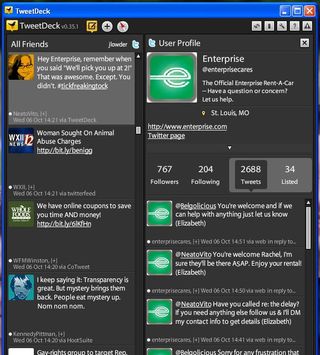
I thought of that today when I observed the interaction between one of my coworkers, Rachel, and Enterprise Rent-A-Car.  Enterprise told Rachel that they'd be at our office to pick her up at 2 p.m.  At 2:15 she called them to see where they were and they indicated that the driver had left on time and knew where he was going so he should be here any time.  Rachel waited a few more minutes and then wrote this on Twitter at 2:21:

Hey Enterprise, remember when you said "We'll pick you up at 2!" That was awesome. Except. You didn't. #tickfreakingtock

Obviously she was being funny, but it's also obvious she's getting a little annoyed. Well, someone at Enterprise is on the ball because within 20 minutes @enterprisecares Tweeted the this:

Have you called re: the delay? If you need anything else follow us & I'll DM my contact info to get details (Elizabeth)

Needless to say Rachel was impressed and is currently a very happy Enterprise customer.  BTW, the driver showed up just a couple of minutes later; he'd gone to the wrong address which is not uncommon for people coming to our office since it's a kind of weird location. 

Here's a screen shot of my Tweetdeck showing the interaction. Very well done Enterprise:

TwitterCustomerCare