I’ll See Your Bible and Raise You a Pagan Spell Book

Last month a public elementary school in Buncombe County, NC was in the news because the school's administrators allowed Bibles to be distributed to students. Here's an excerpt from a story in the Asheville Citizen-Times:

Jackie Byerly, principal at North Windy Ridge, defended the availability of the Bibles. She said they were not handed out, and students had the option to take them. She checked with Superintendent Tony Baldwin and was given permission to make them available.

She said the Bibles arrived Monday morning from a local group of Gideons International, and the box containing the books was opened in the main office. Byerly said the students picked them up during their break time.

“If another group wishes to do the same, I plan on handling that the same way as I have handled this,” she said.

When I read that last quote I said to myself, "Self, I sure hope someone calls her on that." Thankfully my wish has been granted.  From today's news:

Ginger Strivelli delivered on her promise to bring Pagan spell books to North Windy Ridge after the intermediate school made Bibles available in December. She said school officials said they would allow for the availability of her materials, just as they did the Bibles from a local group of Gideons International.

When Strivelli brought the Pagan books to the school Wednesday morning, she said she was told “a new policy is being crafted.”

In all fairness the policy review is a direct result of the backlash from the Bible incident so I don't think this is necessarily an anti-Pagan move by the school system. I'd be seriously worried if they didn't have a policy review.

Having had three kids go through public schools I can tell you that elementary school was an interesting experience – the kids were like sponges soaking up what the adults at school spilled out of their mouths and I can tell you there were a few times I wondered what their teachers were thinking. My favorite example was when my son, who was in 1st grade at the time, asked me who I was voting for in the 2000 election.  I asked him why he wanted to know and he told me he really hoped I'd vote for Bush because his teacher told him Al Gore killed babies in Vietnam.  Seriously.  After several similar experiences through the years I came to the conclusion that elementary school teachers should stick to the same rules we have for polite party conversations: whatever you do don't talk about religion, politics or sex.
Rumor Mill – Trader Joes to Winston-Salem?!

SueMo has shared something on Facebook that I pray is not wishful thinking or a cruel joke: Trader Joe's coming to Winston-Salem in early 2013.  Could it be?

Seriously this is a definition of a rumor – SueMo shared the status of a friend on Facebook who'd received a text from her friend that works at Trader Joe's and who'd told her that Winston-Salem was on the company's "store bulletin."  So don't get too excited yet, but maybe we'll get confirmation from something more official – like Twitter.

BTW, I was just checking out the website and it appears that there's a Trader Joe's on the same road as our oldest son's apartment in Charlotte.  I feel like a total idiot now that I know we've been within a stone's throw of the place and didn't even know it.  Guess we've got another reason to visit him!

The Boring Stuff

At work I'm called the King of BS, which stands for "boring stuff."  My job is to pay attention to things that most people don't want to think about (ordinances, regulatory agencies, market/economic issues, etc.) and I'm such a geek that I even volunteer my time to pay attention to the same kind of stuff on the Lewisville Planning Board.  I'm not going to sit here and tell you I'm doing it for any kind of noble purpose – I get paid for it at work and I don't consider the Planning Board work a sacrifice because I'm truly interested and for the most part I find it enjoyable.

What I've learned is that studying and debating issues like how far apart driveways should be and how to handle stormwater in developments can be incredibly tedious, but if we don't think about these things we could end up with at best an aesthetically unappealing town, and at worst a town with broken infrastructure that's literally a hazard to live in.

That's why I read the Washington Post story on the country's crumbling infrastructure with such interest.  We're literally in deep sh** and I think most people are totally unaware:

And just like roads and bridges, the vast majority of the country’s water systems are in urgent need of repair and replacement. At a Senate hearing last month, it was estimated that, on average, 25 percent of drinking water leaks from water system pipes before reaching the faucet. The same committee was told it will take $335 billion to resurrect water systems and $300 billion to fix sewer systems. 

So we need $635 billion dollars to keep our water and sewer systems going strong. Not so long ago I'd have found that number very daunting, but when you consider we spent $700 billion to bail out a bunch of bankers I think spending $650 billion to make sure we don't all die of dysentary isn't such a bad idea.  Of course it's probably a terrible idea because it would be a, gasp!, public works project and by God we can't have one of those socialist atrocities around here.  I mean why would we want to do something that's literally an investment in our community, would put people to work, and would go a long way towards insuring continued good health for future generations?  I know, I'm just a wild-eyed radical.

The Coming Collapse of the Middle Class

Below is a video of a speech Elizabeth Warren gave at the University of California about the stress on today's middle class families.  She provides lots of interesting data, but what I found most compelling was her comparison of a middle class family of four (two parents, two kids) in 1970 and 2003:

  • In 1970 most families had a single earner, in 2003 the vast majority were two-income families.
  • Average incomes were up in 2003 compared to 1970 due to the second worker, but fixed expenses (mortgage, health care, taxes, child care, cars) were 50% in 1970 and rose to 75% in 2003.
  • Discretionary expenses for items like clothes and food actually went down significantly between 1970 and 2003.  

It's a long video (almost an hour), but it really is worth a look to see how much pressure is on the middle class these days.  Even if you aren't a fan of Warren's it is still worth watching to get a sense of how things have changed in just one generation.

Last point I'll make is that this speech was given in 2007, before the economy tanked. I wonder how some of these numbers would look now.

Big Butt Saddles

When I came across yet another "America's so fat" news stories, this one about dude ranches having to use draft horses and large saddles to accomodate their extra-large clients, it reminded me of a vacation experience from about 10 years ago.  My family and I were lucky enough to spend a week at a dude ranch in Wyoming and when we showed up at the corral the folks working there took one look at me (6'2", 210 lbs) and assigned me to Big John, a rather imposing draft horse that seemed to be almost twice as big as the other horses.  When the wrangler brought him out she mentioned that Big John was used for their bigger clients and then blurted out, "I'm not saying you're fat or anything, but you're just too big for the other horses." I wasn't offended but it had me wondering if I might want to cut back on dessert. That was 20 pounds ago so I'm not sure what they'd put me on these days.

For the record Big John and I got along great, although the fall we took on the last day of riding was a strong reminder of just how tough horseback riding can be.  I was sore for a week and felt lucky to not have shattered any bones.  Maybe my extra padding saved me.

Happy New Year!

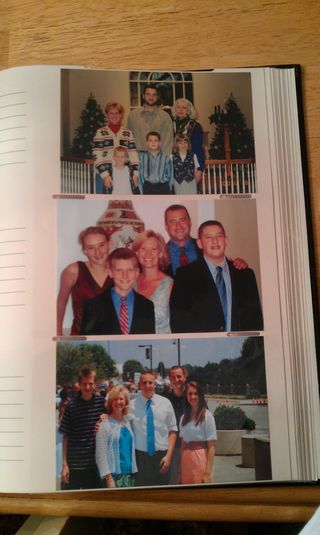
For Christmas this year our daughter put together a photo album called Meet the Lowders. This picture is of one page of the album that features photos of our family through the years. The bottom picture was taken at our son's graduation from West Forsyth HS in June.

Happy New Year from our family to yours!

Imag0735

Why Every Kid Wishes School Schedules Ran Like Congress

As many holidays, teacher work days, snow days, spring breaks and summer breaks as school kids get I think they'd still be thrilled to switch schedules with Congress.  Especially on days like yesterday (Wednesday, Dec. 21, 2011) when Congress said the Pledge of Allegiance and promptly adjourned for three hours. Apparently the Republican leadership didn't want to hear what the Democrats had to say. (Even more interesting, they shut off C-SPAN!):

The incident occurred mere moments after the House went into session. Hoyer made a motion for a vote on the Senate’s payroll tax cut extension, which would extend the lower rates for another two months, but the Republican presiding over the House did not acknowledge the motion. He instead adjourned the House, then got up and walked out.

“As you walk off the floor, Mr. Speaker, you’re walking away, just as so many Republicans have walked away from taxpayers, the unemployed, and very frankly, as well, from those who will be seeking medical assistance from their doctors, 48 million senior citizens,” Hoyer can be heard saying.

“We regret, Mr. Speaker, that you have walked off the platform without addressing the issue of critical importance to this country, and that is the continuation of the middle class tax cut, the continuation of unemployment benefits for those at risk of losing them, and a continuation of the access to doctors for all those 48 million seniors who rely on them daily for help.”

And that’s when the audio cut out. Seconds later, footage faded to a shot of the capitol from outside.

Here's the video:


Krampus

I've unwittingly stumbled upon a goal for 2012: start a Krampus tradition in Lewisville.  What's Krampus?  I just learned about it from the excellent, free, Now I Know newsletter:

A goat-man creature bound to service by the Devil, Krampus’ origins trace back to Germanic traditions from before the advent of Christianity. Per the myth, Krampus goes from home to home (in some places, along with St. Nick), seeking naughty children. Some get off with a stern warning, but for the truly bad children, you better watch out. Krampus throws these children into his sack (or, in some traditions, into a washtub he drags behind him) and carries the child off, to be made into Christmas dinner.

Been rotten this year? No need to get nervous on Christmas Eve; if you’ve made it that far, you are in the clear. Krampus makes the rounds on the night of December 5th, being the eve of the feast of St. Nicholas. As is customary, many people dress up in Krampus costumes that night (as seen above) and take to the streets that night, going home to home “scaring” children. The custom further suggests giving these false Krampuses a drink (schnapps is recommended) to make them go away.

Krampus

Now I just need to figure out how to get myself one of these masks before 12/5/12.


Inside Moves

Did you see the 60 Minutes story on our duly-elected Congresscritters potentially profiting by using information they gleaned from their work on the Hill to inform their investment decisions?  Well, according to this Wall Street Journal story many big-time investors are profiting from information they glean directly from members of Congress and Congressional staffers.

"Hedge funds and other investors have found that Washington can be a gold mine of market-moving information, easily gathered by those who are politically connected," according to Sanford Bragg, CEO and president of Integrity Research Associates, an independent group that analyzes research providers…

Wall Street firms have for years hired lobbyists to scour Congress and the White House for news that could affect stock prices. Now, investors want to hear from decision makers firsthand.

Many turn to William Williams, president of JNK Securities, a firm that brings lawmakers and investors together "to bridge the information gap between Washington and Wall Street," according to a recent news release.

Mr. Williams used to charge clients as much as $10,000 for meetings with lawmakers. That changed last year after a reporter from the publication Inside Higher Ed asked the office of Sen. Tom Harkin (D., Iowa) about an email from JNK showing it was charging to attend a possible meeting with the senator. Mr. Harkin refused to attend.

Now, hedge funds don't pay fees to JNK Securities. If they use information gleaned at these face-to-face meetings they are expected to execute their trades through the brokerage firm, which collects commissions.

There's more, but you get the picture.  I seriously doubt this kind of inside information is restricted to the federal level – I'm willing to bet it goes on at the state and local level as well – and as the reporters point out it's not illegal activity, but I think this is exactly the kind of thing that has escalated the level of mistrust of our public and business institutions to astronomical levels.

If you were to talk to the folks involved in these meetings, both on the government side and industry side, you'd probably get an earful about this dialogue being necessary to make sure the government fully understands the issues so they don't unnecessarily burden industry with misaligned regulation or some such thing.  Sure, it makes perfect sense for government representatives to fully understand the industries they are proposing to regulate, but I'll be darned if I can understand why those discussions can't be publicly broadcast so that everyone is on the same playing field. (Truth be told I can't think of a reason why investors would need to be included in the discussion at all, but for now let's just assume they have a place at the table). Let's put it this way – why shouldn't I, as an individual investor, have access to this information at the same time as a hedge fund investor?  If Congress was a public company and members of Congress were board members of the company then this behavior would be considered insider trading.  It's ironic that because they are essentially board members of USA Inc. their behavior is perfectly legal.

The article goes on to mention some proposed legislation that would prevent this type of inside information trading, but I'm not sure how effective any legislation can be until the entire culture in the halls of power changes. If the people in power can't perceive that it's wrong to play favorites in the public sector, to create a favored class, then there's not a piece of legislation that can be passed that will fix the problem because they'll simply find a way around it to help their friends. 

Long ago some wise people realized that our entire society is constructed on a foundation made up of one element – trust.  Without trust financial markets collapse, bank runs happen (why do you think we even have an FDIC?), government collapses (usually after a bout of totalitarianism) and civil society disappears.  If our leaders don't begin to reestablish trust with the people I fear what my children will inherit.  This probably seems like an over reaction to a relatively minor financial story, but I think this story perfectly highlights what's wrong with our country right now and I very much want to see this fixed before it's too late.

Did a Bear Raid on Citigroup in 2007 Crash the Economy?

A paper (PDF) from a group called New England Complex Systems Institute seems to make the assertion that a "bear raid" on Citigroup in 2007 may have triggered the economic meltdown that led to the Great Recession:

A paper from the New England Complex Systems Institute claims that they have found evidence that traders executed a "bear raid" on Citigroup in 2007, precipitating the financial collapse. A "bear raid" is a market manipulation technique in which short sellers conspire to dump huge quantities of borrowed shares into the market all at once, driving the price down (short selling is a stock-trading technique in which shares are borrowed for sale; the short seller makes money when the value of the borrowed shares declines).

"Bear raids" have been considered a risk to markets since the Great Depression, and a financial regulation called the "uptick rule" was instituted in 1938 to prevent the tactic. The uptick rule was repealed in in July, 2007, and the alleged bear raid took place in November, 2007.

The paper's authors offered these comments about deregulation in their conclusions:

Within the resulting deregulated environment, it is still widely believed that the crisis was caused by mortgage-related financial instruments and credit conditions, and that individual traders did not play a role [32{35]. Our analysis demonstrates that manipulation may have played a key role. Methods for detecting manipulation and its eff ects are necessary to both inform and enforce policy.

When the SEC repealed the uptick rule on July 6, 2007, one of its main claims was that the market was transparent, and that such regulations were not needed to prevent market manipulation [6]. Our results suggest that, not long after the uptick rule was repealed, a bear raid may have occurred and remained undetected and unprosecuted. Our analysis reinforces claims that lax regulation was an integral part of the financial crisis [30].

In response to requests for reinstatement of the uptick rule after the fi nancial crash,the SEC underwent extended deliberations and fi nally implemented an alternative uptick rule, which allows a stock to fall by 10% in a single day before limitations on short selling apply [36]. This weaker rule would not have a ffected trading of Citigroup on November 1, 2007, as its minimum price was just 9% lower than the close on October 31. Subsequent day declines until November 7 were also smaller than 10%.

The authors go on to recommend some policy changes (adopting preventive measures instead of current retroactive penalties, regulatory agencies investigating individual events like this one, improve access to data, etc.) but given our government's reluctance to go after these folks I'm not confident that their advice will be heeded.