Charlotte During DNC Sounds Like the Triad During Furniture Market

In the months before moving with my family to Lewisville, NC in 2004 I decided to take a couple of road trips down from Washington to check out the business environment in the Piedmont Triad. I'd never had trouble getting a room before so I didn't think to make a reservation, which was a huge mistake the time I made the trip the same week that the Furniture Market was in full swing in High Point. Let's just say I ended up staying in a motel where I suspect I was the only person who didn't pay by the hour.

Apparently finding a room in Charlotte during the Democratic National Convention is a similar experience:

All these political reporters have been complaining about the boring staged political conventions for weeks, but when presented with the opportunity to talk to a real live victim of the "Obama economy" — a hooker — they run away screaming. The National Review's John Fund explains that one of their political reporters was forced to request a hotel change after the Democratic National Convention assigned the reporter to a seedy Charlotte hotel that might have had a hooker working in the parking lot. Fund quotes his colleague anonymously:

The Knights Inn was the worst hotel I have ever seen, and I’ve stayed in many bad motels in my life. Two guys were dealing drugs in the room next to me, and a prostitute was working out of the parking lot. And this was in the early afternoon. The room itself was dirty, full of other people’s stuff, etc.

I have never requested a hotel change in 3 years at NR. This was the first time I felt absolutely compelled.
 

We Can’t Handle the Truth

Here's a tasty little tidbit from a post titled Why Fact Checkers Fail:

So here's what we did — what I did — and what others have certainly done as well: I downplayed Republican dishonesty while judging Democratic failings with an unfairly harsh bias. I applied this to assignments, to the tone and presentation of stories, and to the various gimmicks we invented to try to evaluate claims. The results didn't reflect the true scale of the dishonesty gap, but they at least demonstrated that a gap existed. At least, they had the potential to demonstrate the gap, but only to very careful readers with a knack for drawing subtle inference. Because we could never come out and tell you what we all knew in the newsroom: Yes, "all politicians lie" (a cynical dodge if ever there was one), but the modern Republican Party is based on a set of counter-factual and faith-based beliefs, and has been for years. Not only has that foundation consistently put the party on the wrong side of fact-checkers, it has led us to where we stand today, with Mitt Romney running a campaign that has abandoned even the pretense of fact.

There has to be some middle ground between partisan media hacks and spineless media hacks but it seems to be unpopulated at the moment.

Who Pays for Health Care?

An interesting piece at the Atlantic Wire shows the change in who pays for health care services (hospital care, physician and clinical services, prescription drugs, etc.) from 1960 to 2010. In 1960 a far higher percentage of the payments were out-of-pocket and a lower percentage came from private insurance, Medicare and Medicaid. In 2010 a much smaller percentage was paid out-of-pocket and, with the exception of dental services and "other medical products", the vast majority was paid by private insurance, Medicare and Medicaid. 

That's interesting in and of itself, but what's downright unbelievable is the change in the amount spent on health care each year that's shown in the article. In 1960 the total amount spent was $23.4 billion and in 2010 it was $2,186 billion or a 93.4-fold increase. Of course there are more people in America in 2010 so a good question would be, "What's the per-capita increase in health care spending?"

The answer is that in 1960 the per capita spending was $147 and in 2010 it was $8,402 – a 57-fold increase. To give you an idea of how big a jump that is you need only note that the buying power of $1 in 1960 was the same as $7.35 in 2010. In other words health care spending literally exploded; if it had been even roughly analogous to inflation the per capita spending would be more like $1,080 than $8,402.

Some thoughts to ponder as you digest this information:

  • Would spending be lower if end consumers had to pay more out of pocket?
  • Would pricing transparency be greater without insurers playing middle man?
  • How much of the cost is due to the inefficiencies of the health care system? 
  • How much less would the spending be if doctors didn't have to employ multiple people simply to handle billing insurers?
  • If you added in the cost of health insurance that doesn't get directly applied to paying for health care services – many years we pay more in premiums than get spent on health care services – what would the annual spending be? 
  • It's interesting to note that where the money was spent – the percentage spent on hospital care, physician and clinical service, prescription drugs – is almost exactly identical in 2010 to where it was in 1960. Doesn't that seem to indicate that the entire system is screwed up, not just hospitals or pharmaceuticals?

The health care industry is facing some signicant changes thanks to "Obamacare," but it remains to be seen whether or not those changes will rein in costs. It's hard to imagine the health care system getting any less efficient, but then again in 1960 it was hard to imagine a man walking on the moon within a decade. 

The Problem with the Internet

In an interview with Mother Jones author Michael Chabon describes the problem with the internet:

MC: Well, no. It's because I love the internet and it has been incredibly useful and I have made discoveries that have been immeasurably crucial to my work—things I don't know how I ever would have found out otherwise, that are perfect, just what I need for whatever I'm doing. And with that very truth is the pretext for all the bad stuff. Because I have gotten so much out of it that I can always justify or rationalize it to myself. I'll think, "Oh I'm just going to take three minutes to find out who made the spark plugs that were used in Mustang airplanes that they used during World War II." Two hours later, I'm, you know, looking at the Partridge Family fan site or something like that, and listening to "I Think I Love You."

MJ: [Laughs.] It's called procrastination.

MC: It's more insidious, because you're being incited to it. Procrastination is something you doyourself. You know: "I gotta sharpen these pencils before I start. I got 20 pencils, they're looking kinda dull." Well, the pencils aren't calling you and alluring you and inviting you and offering you anything. They're just sitting there. You're the one who's procrastinating. The internet is actively trying to get you to stop working.

Look! Sparkly things!

LiFless

After an extended period of periodic posting Esbee is pulling the plug on Life in Forsyth. (That's an intentionally terrible sentence written specifically in honor of Esbee's impatience with sub-par writing).  I for one am grateful for the free entertainment and information she provided through the years and I'm also thankful she let us go gently over the last year or two.

She's moving on to far more important things and she's going to be fabulous at them all.

Memory

Scott Adams, he of Dilbert fame, writes about his terrible memory and it sounds oh so hauntingly familiar:

In school, I could force myself to remember topics for tests, but it only lasted as long as the test. At home, we have a lot of conversations about what I might have heard or said at some specified time in the past and it almost never sounds vaguely familiar. Sometimes it feels as if someone else lived my life until this very moment and now I'm taking over.

The way I perceive the act of creativity while it happens in me is as a process of forgetting, not a process of creating. The mind is not capable of having zero thoughts, so when you flush whatever is in your head at the moment it creates a sort of vacuum that sucks in a new thought. In my case, that process of forgetting and then sucking in a new thought happens continuously. My memory isn't "sticky," so what comes in slides right back out in a nanosecond. Sometimes a new thought is worth writing down, which I either do right away or lose it forever. Usually the new idea is random garbage and it passes quickly, making room for the next idea. My mind feels like a slot machine that I can't stop pulling. Sometimes the diamonds line up, but not often.

Chicken of the Trees

Apparently squirrel is making it back on the menu in Chicago-of-all-places:

But somewhere along the way, squirrel declined in popularity as a game animal, replaced by bigger quarry, such as deer and turkey, whose numbers had grown in the countryside as the number of humans dwindled. Mainstream views on squirrel eating began to drift toward disdainful—it became something hillbillies and rednecks did. In the late 90s a pair of Kentucky neurologists posited a link between eaters of squirrel brains—a time-honored delicacy among hunters—and the occurrence of a variant of Creutzfeldt-Jakob disease, a theoretical but terrifying new mad squirrel disease. (Peer review later deemed this connection unlikely.) And though noted woodsman and Motor City Madman Ted Nugent devoted a few pages of his wild game cookbook Kill It and Grill It to "Limbrat Etouffee" in 2002—written with a vengeance he typically reserves for sitting Democratic presidents—when the 75th-anniversary edition of Joy of Cooking was published four years later, for the first time in the book's history it didn't include an illustrated how-to for pulling the skin from a squirrel.

Squirrel eating may be making a comeback, however, at least among those with au courant appetites for sustainable, healthy, and locally sourced meats. CNN.com's food blog Eatocracy has encouraged readers to seek out sources of squirrel meat—"more earthy and sumptuous than the darkest turkey." Hunting and foraging authority Hank Shaw has spilled plenty of ink on this "gateway" prey, an abundant animal that hones the hunter's skill for bigger game. It's delicious too, he argues, its pink flesh more dense than a rabbit's, which takes on the nutty flavor of whatever it's been eating.

It's passages like this that might give you pause:

After the heads braised in mirepoix and sherry, a friend demonstrated with a nutcracker the proper technique for extracting a squirrel brain from its cranial cavity, and a half dozen of us popped them into our mouths. They looked like oversize walnuts and tasted slightly creamy, almost like a soft, roasted chestnut. We pulled out the tongues and cheeks, which contained the most concentrated expression of squirreliness. One guest described the meat from the head as "nutty"; others compared it to pork, duck, or lamb. To me this seemed like the very essence of the rodent. If squirrels grew to the size of pigs, you'd really have something.

Yummy. Try getting "tongues and cheeks, which contained the most concentrated expression of squirreliness" out of your head before you eat your next bowl of brunswick stew.

Really you need to go for the article, but stay for the pictures, including the classic photo of a baby sitting in the midst of dead squirrels.

Pile Don’t File

The Department of Veterans Affairs office in Winston-Salem might need some help from an organizational consultant:

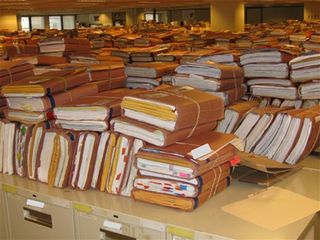
At the VA's Winston-Salem Regional Office in North Carolina, an estimated 37,000 claims folders had been stored on top of file cabinets, according to the Inspector General's report released last week. Those piles had been stacked two feet high and two rows deep. The file cabinets were so close to each other that drawers could not be opened completely. More files had been stored in boxes on the floor and stacked along the wall.

A load-bearing study found that the weight of the files exceeded the floor's capacity by 39 pounds per square foot.

"The excess weight of the stored files has the potential to compromise the structural integrity of the sixth floor of the facility," said the Inspector General report. "We noticed floors bowing under the excess weight to the extent that the tops of file cabinets were noticeably unlevel throughout the storage area."…

In June, after learning that the floor load exceeded capacity, the office removed all folders sitting on file cabinets and placed them on separate floors. The office also intends to purchase a high-density file system for the basement, which will cost an estimated $405,000.

VAFilePile

This looks suspiciously like my desk.