Now That’s an Order Confirmation

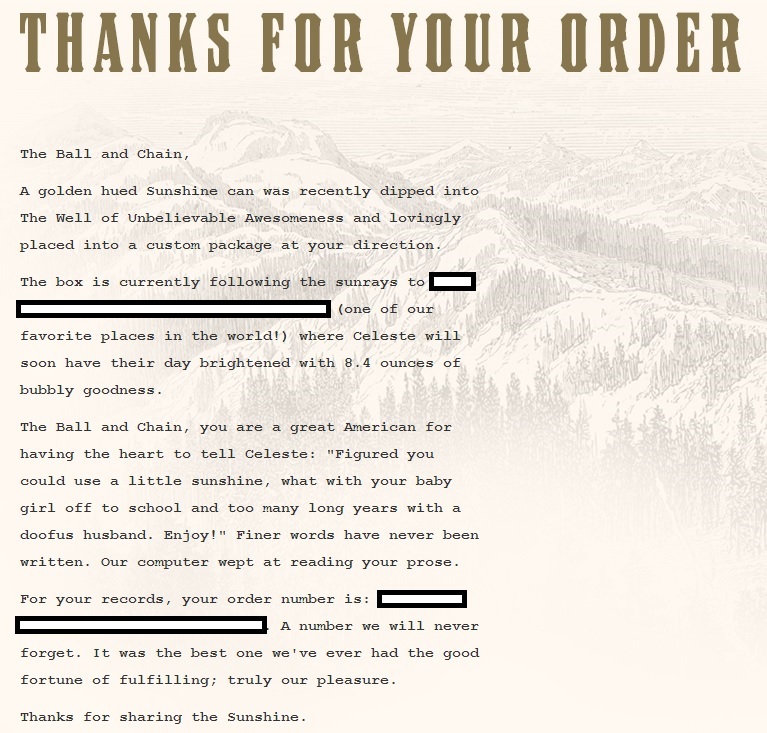
I just ordered an energy drink for my wife that will be delivered to our home with a personalized message. Big deal right? What made it cool was the order confirmation served up by the folks at Drink the Sunshine after I finished paying which you can see below. Very creative, but that shouldn’t be surprising considering the folks behind the product.

Sunshine_OrderConfirmation


FYI, I’m both “The Ball and Chain” and the “doofus husband.”

The Impact of Editing

I get the print version of three daily newspapers, mostly because I’ve been doing it for so long that my morning coffee would feel weird without them, but also because I like the way I read the print version versus online. Something about the ability to skim headlines, the way the layout of the paper causes my eyes to move from item to item, I find to be a better experience than the digital version. That’s why I was reading the print version of the Wall Street Journal this morning and came across an interview with UNC-Chapel Hill’s Chancellor Dr. Carol Folt. In it she came across to me as a little too PR-y, skillfully responding to questions with what I call “mush-mouth” replies. I thought I’d send the article to some journalist/ex-journalist friends to get their reaction, but when I pulled up the online version of the article I noticed some small differences between it and the print version that altered my opinion.

Here’s an example of one Q&A that was edited down for the print version. First the print version:

WSJ: Does the tension between athletics and academics need to be addressed at all schools?

Dr. Folt: People want to know if you can have big-time athletics and education, and if students that participate in athletics can still be considered credible students. That is the broader question.

If you look at the revenue sports [like football and basketball], I think something like 95% of students do not go on to become professional athletes. Even if you go on and play in the NFL, you’re going to spend most of your life not as an active football player. We are preparing students for a lifetime career. 

That’s why the reforms [in academic advising] could help everybody. We could do a better job in our advising, do a better job in helping them be successful in developing throughout their career.

Now the digital version:

WSJ: Does the tension between athletics and academics need to be addressed at all schools?

Dr. Folt: People want to know if you can have big-time athletics and education, and if students that participate in athletics can still be considered credible students. That is the broader question.

If you look at the revenue sports [like football and basketball], I think something like 95% of students do not go on to become professional athletes. Even if you go on and play in the NFL, you’re going to spend most of your life not as an active football player. We are preparing students for a lifetime career. To the student who comes in fencing and wants to go to the Olympics, we can say ‘Great, but what do you want to be [after]?’ That’s the tension.

That’s why the reforms [in academic advising] could help everybody. We could do a better job in our advising, do a better job in helping them be successful in developing throughout their career.

The two sentences that are in bold type were edited out for the print version. To me they didn’t really change the substance of her answer, but they did serve to add some context and that second sentence, “That’s the tension” to me was particularly important because without it she almost seems to be dancing around the question. It’s a minor thing, but boy did it highlight to me the impact that what is, or is not, included in a story can truly change the reader’s perception.
Cupcakes – The Secret to Success for College Football Coaches

Despite the headline, this post is not about whether multi-million dollar football coaches provide a good return on investment, because quite frankly that’s the kind of debate that has all kinds of rabbit holes. No, this post is about how those multi-million dollar coaches’ teams perform on the field against good competition and the Wall Street Journal has a fascinating graphic showing that very few are all that good against non-cupcakes. Here it is:

Source: Wall Street Journal

Source: Wall Street Journal

You’ll notice that only 14% have career winning records and only 9% have winning records with their current teams. For those of us here in ACC country here are the most pertinent numbers:

School (Coach): Career Record/Current School Record

Boston College (Addazio): 0-4/0-2
Clemson (Swinney): 9-13/9-13
Duke (Cutcliffe): 8-25/2-13
Florida St. (Fisher): 9-5/9-5
Georgia Tech (Johnson): 7-20/7-12
Louisville (Petrino): 14-17/4-5
Miami (Golden): 3-11/3-6
UNC (Fedora): 2-8/0-4
NC State (Doeren): 1-3/0-2
Pittsburgh (Chryst): 3-4/3-4
Syracuse (Shafer): 0-3/0-3
Virginia (London): 3-6/3-6
Va. Tech (Beamer): 43-50-1/43-50-1
Wake Forest (Clawson): 1-7/0-0

So one out of 14 coaches (7%) in the ACC has a career or school winning record against top-tier teams. Sounds terrible, but when you compare it to the other conferences it really isn’t all that bad:

SEC – 4 out of 14 (29%)
Big 12 – 2 out 10 (20%) + one coach with a .500 record
PAC 12 – 1 out of 12 (8%) + one coach with a .500 record
Big Ten – 1 out of 14 (7%)

Luckily these guys get to coach against each other a majority of the time so it’s all good.

Getting Lucky

This quote from a blog post about how people get lucky (not what you’re thinking) really hit home:

My research revealed that lucky people generate good fortune via four basic principles. They are skilled at creating and noticing chance opportunities, make lucky decisions by listening to their intuition, create self-fulfilling prophesies via positive expectations, and adopt a resilient attitude that transforms bad luck into good.

Here’s the source piece for the quote. I also like this advice about how to become more lucky:

  • Unlucky people often fail to follow their intuition when making a choice, whereas lucky people tend to respect hunches. Lucky people are interested in how they both think and feel about the various options, rather than simply looking at the rational side of the situation. I think this helps them because gut feelings act as an alarm bell – a reason to consider a decision carefully.
  • Unlucky people tend to be creatures of routine. They tend to take the same route to and from work and talk to the same types of people at parties. In contrast, many lucky people try to introduce variety into their lives. For example, one person described how he thought of a colour before arriving at a party and then introduced himself to people wearing that colour. This kind of behaviour boosts the likelihood of chance opportunities by introducing variety.
  • Lucky people tend to see the positive side of their ill fortune. They imagine how things could have been worse. In one interview, a lucky volunteer arrived with his leg in a plaster cast and described how he had fallen down a flight of stairs. I asked him whether he still felt lucky and he cheerfully explained that he felt luckier than before. As he pointed out, he could have broken his neck.

So I Was Wrong About the Double-Space

Because I learned to type on a manual typewriter back in the dark ages I’ve been doing the period-space thing all wrong for 30 years and didn’t know it:

Every modern typographer agrees on the one-space rule. It’s one of the canonical rules of the profession, in the same way that waiters know that the salad fork goes to the left of the dinner fork and fashion designers know to put men’s shirt buttons on the right and women’s on the left. Every major style guide—including theModern Language Association Style Manual and the Chicago Manual of Style—prescribes a single space after a period. (The Publications Manual of the American Psychological Association, used widely in the social sciences, allows for two spaces in draft manuscripts but recommends one space in published work.) Most ordinary people would know the one-space rule, too, if it weren’t for a quirk of history. In the middle of the last century, a now-outmoded technology—the manual typewriter—invaded the American workplace. To accommodate that machine’s shortcomings, everyone began to type wrong. And even though we no longer use typewriters, we all still type like we do. (Also see the persistence of the dreaded Caps Lock key.)

The problem with typewriters was that they used monospaced type—that is, every character occupied an equal amount of horizontal space. This bucked a long tradition of proportional typesetting, in which skinny characters (like I or 1) were given less space than fat ones (like W or M). Monospaced type gives you text that looks “loose” and uneven; there’s a lot of white space between characters and words, so it’s more difficult to spot the spaces between sentences immediately. Hence the adoption of the two-space rule—on a typewriter, an extra space after a sentence makes text easier to read. Here’s the thing, though: Monospaced fonts went out in the 1970s. First electric typewriters and then computers began to offer people ways to create text using proportional fonts. Today nearly every font on your PC is proportional. (Courier is the one major exception.) Because we’ve all switched to modern fonts, adding two spaces after a period no longer enhances readability, typographers say. It diminishes it.

I hereby officially apologize to every design professional upon whom I’ve inflicted my double-spaced prose.

Hunger in Northwest North Carolina

Through my organization’s annual food drive I’ve become very familiar with the work of Second Harvest Food Bank of NWNC. Unfortunately that familiarity is why the recently released results of a study on food insecurity provides little in the way of surprises, but does serve to help remind me of why we’re so passionate about our efforts on behalf of the organization. If, after reading the following numbers, you feel like helping out you can make a financial contribution at our food drive’s online donation page at  www.helpsecondharvest.com 

Here are just a few of the sobering statistics:

  • Nearly 300,000 different individuals turn to our network of more than 400 partner programs for food assistance annually – or 1 in every 6 people living in our region.
  • Despite Second Harvest Food Bank’s continuing success in sourcing more food for our partner agency network (in the past five years, distribution has more than tripled from 7.9 million pounds to more than 25 million pounds), 44 percent of programs report having less food than needed to meet the needs of those requesting assistance.
  • 32% of those who receive food assistance through our partner agency network are children under the age of 18. Because programs that serve only children were not eligible to be sampled for the Client Survey, for example our BackPack and Kids Cafe programs and summer meal sites, this percentage underestimates the actual number of children being reached by Second Harvest Food Bank.)
  • 10 percent of those who receive food assistance through our partner agency network are seniors age 65 or older. (30 percent are age 50 and older.)
  • 78 percent of those who seek food assistance from Second Harvest Food Bank’s network live in households at or below the poverty level.
  • 57 percent of households have monthly incomes of $1,000 or less.
  • Over the past year, 72 percent of households report choosing between paying for food and paying for medicine/medical care; 31 percent of these households are making this choice every month.
  • 73 percent of households report choosing between paying for food and paying
    for utilities.

    • 30 percent of these households are making the choice every month.
  • 72 percent of households report choosing between paying for food and paying
    for medicine/medical care.

    • 31 percent of these households are making the choice every month.
  • 72 percent of households report choosing between paying for food and paying
    for transportation.

    • 31 percent of these households are making the choice every month.
  • 64 percent of households report choosing between paying for food and paying
    for housing.

    • 24 percent of these households are making the choice every month.
  • 24 percent of households report choosing between paying for food and paying
    for education expenses.

    • 9 percent of these households are making the choice every month.

Remember, there’s an easy way to help at www.helpsecondharvest.com.

Meet the Ultimate Beer Bureaucrat

Who knew? If you want to sell beer in the US you have to get the label approved by one guy:

Any brewery that wants to market its wares in this country needs to get it through Kent “Battle” Martin, giving the federal official extraordinary power. With only vague regulations outlining what is and isn’t permissible, he approves beer bottles and labels for the Tax and Trade Bureau, or TTB, a section of the Treasury Department…

This year, Battle has singlehandedly approved over 29,500 beer labels, the only fact his press handler would provide…

Most government departments are nebulous and anonymous. But because of the sheer volume of his interactions with brewers, Battle has become a symbol for the TTB’s nonsensical rules…

Battle has rejected a beer label for the King of Hearts, which had a playing card image on it, because the heart implied that the beer would have a health benefit.

He rejected a beer label featuring a painting called The Conversion of Paula By Saint Jerome because its name, St. Paula’s Liquid Wisdom, contained a medical claim—that the beer would grant wisdom.

He rejected a beer called Pickled Santa because Santa’s eyes were too “googly” on the label, and labels cannot advertise the physical effects of alcohol. (A less googly-eyed Santa was later approved.)

Information is Power, Sharing it is Trust

“Information is power. When I have it and won’t give it to you, it signals that I don’t trust you to know what to do with it. In turn, it erodes your trust in me.” John Robinson

The quote above is from an excellent blog post by John Robinson that argues for more transparency from our government. It’s not long and it’s worth the couple of minutes it will take you to read it.

Remembering Tanglewood

I’d heard that our little public golf course in western Forsyth County had once hosted a major tournament, but until reading Ed Hardin’s column I didn’t know anything about the 1974 PGA. It’s an interesting read:

Tanglewood comes to life at this time of year, a reminder of golf’s fleeting seasons and cyclical nature. The 1974 PGA Championship played here 40 years ago this week was one of the best tournaments in golf history.

And almost no one knows it.

That’s probably in part because it was a PGA, the least of the four majors in stature and style, a tournament seemingly locked in the ’70s with a great little storyline that gets lost in the strangest of ways…

Yet somehow, the 1974 PGA produced a classic finish. It’s doubtful that you have any idea how good a tournament it was. Almost no one does.

Lee Trevino won by one shot over Jack Nicklaus. Sam Snead, at age 62, finished third. Let that sink in for a second.

Trevino, using a putter found in the attic of a home he was renting that week, held off Nicklaus, who had hired a local heating and air conditioning salesman to be his caddie. Snead, 10 years after becoming the oldest player to win a tour event at the 1965 Greater Greensboro Open at Sedgefield, shot a 68 on Sunday to finish in a four-way tie for third, one stroke ahead of Player.

Here’s the kicker: you can play that same course today for as little as $29 a round. Since I’m not a golfer I don’t take advantage of it, but every time I drive by on my way to the tennis courts (Tanglewood has a very nice public tennis facility) I think about how envious my golfing buddies back in DC would be if they knew I lived 10 minutes from a course that good…and inexpensive.

Dealing With Surprising Social Media Fame

Update 8/2/14 – NPR has a story about this and in it mention that they are checking with the Justice Department to see if the restaurant’s policy is a violation of the prohibition against public businesses like restaurant’s discrimating based on religion. It would seem not since the discount is supposedly at the discretion of each server, but then again stuff like this is often not obvious or all that logical. I wouldn’t blame the restaurant for discontinuing the policy just to play it safe.

Mary’s Gourmet Diner on Trade Street in Winston-Salem just found out what it’s like to have something go viral. From a story on HLNTV:

The tab belonged to Jordan Smith, who had traveled to Winston-Salem for a business trip and stopped for breakfast at Mary’s with two colleagues Wednesday morning.

She tells HLN the group “prayed over our meal and the waitress came over at the end of the meal and said, ‘Just so you know, we gave you a 15% discount for praying,’ which I’d never seen before.”

Impressed, Smith shared a photo of the receipt on her Facebook page. A mutual friend then posted the pic on the page of Orlando Christian radio station Z88.3 and it’s taken off from there, being shared more than 1,700 times as of Thursday afternoon.

Well, apparently things heated up on Facebook thanks to all the attention, causing Mary to post the following on her business’ Facebook page:

MarysFB

Here’s the text in case that’s hard to read:

There’s a lot of craziness going on in regard to the 15% discount. I will not respond to all the posts. I will say that it is not a “policy”, it’s a gift we give at random to customers who take a moment before their meal. This could be prayer or just a moment to breathe & push the busyness of the world away. Who you talk to or meditate on etc. is your business. I have lived in a 3rd world country, there are people starving. We live in a country with an abundance of beautiful food. I NEVER take that for granted. It warms my heart to see people with an attitude of gratitude. Prayer, meditation or just breathing while being grateful opens the heart chakra. It’s good for everyone!!!! Thanks to my local community for your support…you know who I am. As for all the people posting negative comments about me & my restaurant who have never met me or been to the restaurant, thanks for sharing, it’s your right to speak out, just as it is mine. Peace, love & happy eating!!!!

It’s a sign of our times that doing almost anything positive can be turned into a negative. Sheesh.

We were talking about this at work and we all had the same thought before Mary posted on Facebook: if we know they’re giving 15% off just for praying we’d bow our heads in a heartbeat. Of course that kind of defeats the purpose, but I wonder how many people around Winston were thinking the same thing?