Civility and Intelligence

Here’s a quote from a post at the AVC blog on the importance of civil and intelligent debate that hit home when I read it this morning:

I was reminded of that when I read Ruth Bader Ginsburg’s comments on Antonin Scalia, in particular this part:

We disagreed now and then, but when I wrote for the Court and received a Scalia dissent, the opinion ultimately released was notably better than my initial circulation. Justice Scalia nailed all the weak spots—the “applesauce” and “argle bargle”—and gave me just what I needed to strengthen the majority opinion.

and this:

Maybe the most important part of the title to this post is the word civil. Without civility (and respect), it is hard to have intelligent debate. Respecting those with opposing views, working to understand them, and listening closely to them is the key. Even if they don’t change your mind, they can reshape how you discuss and present your views. And that can make all the difference in the world.

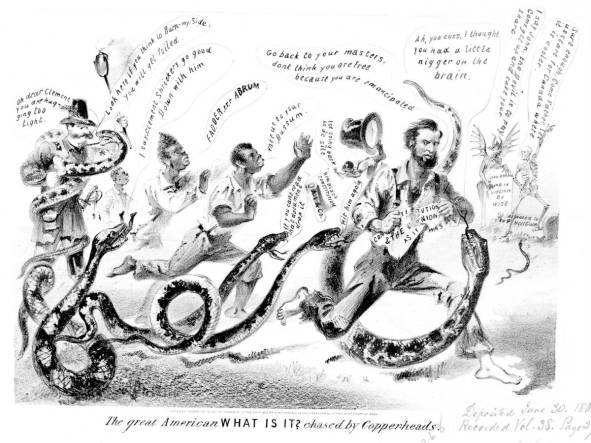
The scary thing about the current state of political discourse in America is the very real lack of civility. As much as we’d like to think this is a modern phenomenon, we actually have a long history of pretty nasty behavior during the political silly season. Check out this political cartoon about Lincoln:

civilityLincoln

Source: HarpWeek

That’s some pretty nasty stuff by any measure. What’s new to our elections these days is the ability of any one person to create or spread nastygrams like this via their social media channels, with nary a thought to whether or not it’s true. With the click of a button they can share personal attacks on candidates, falsehoods about a candidate’s past and beliefs, or launch character assassinations on political candidates or members of a political party faster than you can say “fact check.” It’s truly becoming an overwhelming cacophony of negative, schoolyard name-calling that is drowning out increasingly fruitless attempts at civil discourse.

Lest you think I’m exaggerating, check out these images I found in just five minutes of scrolling through my Facebook feed:

So what commonalities do you find in these images? What I see are personal attacks and name calling with no attention paid to the stated policies of the candidates. How, pray tell, does this advance the cause of the Union in any way?

Now I do understand that much of what people share are things they consider funny. Many of the memes poke fun at the generalizations the sharer has about the folks on the other side of the fence, and normally I wouldn’t be such a stick in the mud about it since I enjoy a good joke as much as the next person. However, when you see people share literally dozens or hundreds of these memes that do nothing but insult people with a different set of beliefs then you have to come to the conclusion that they truly feel that their opposites are stupid, lazy, cruel, etc. When you begin to believe that then you inevitably come to the conclusion that there’s no room for honest debate, and quite frankly you begin to not care what they think because all you see are personal attacks completely divorced from the issues.

So maybe you think I’m overreacting and that I should just ignore what I’m seeing on my social media channels. I might agree except that I think our current crop of political leaders, both liberal and conservative, from the local level to the national level, are exploiting these sentiments and profiting from our separateness. Until we can find a place to have civil and intelligent debate they’re going to play us for the suckers we are.

In other words, folks, we have met the enemy and it is us.

The Poster Child for Electoral Dysfunction

North Carolina’s probably going to be in the news quite a bit over the next week or two. Why? Well, because a federal judge has ruled that the NC Legislature needs to re-do the redistricting it did a few years back and they have until this Friday (Feb. 19, 2016) to get it done. If they don’t then North Carolina’s primary on March 15 is in jeopardy and who knows what that will mean for the contentious 2016 presidential campaigns. With the death of Supreme Court Justice Antonin Scalia this past weekend it is unlikely that the ruling will be overturned, so the Legislature is going to have its hands full.

Add to that the notoriety that the state already enjoys thanks to its voter ID laws (see John Oliver’s video below) and the state is poised to become the poster child for electoral dysfunction.

Camel City’s Own Version of Making a Murderer

The Netflix series Making a Murderer, a documentary ten years in the making about a case in Wisconsin that exhibited some seriously flawed police work and downright shameful behavior by prosecutors, has shed light on some of the flaws of our criminal justice system. Here in Winston-Salem we have the Silk Plant Forest case, which began with a terrible assault in the 90s and resulted in the conviction of a man that many consider innocent, as our own example of a flawed justice system.

The case has been covered extensively by the Winston-Salem Journal over the years, but it’s an article in the Raleigh News & Observer about how the NC State Bar handled a complaint filed against the prosecutors in the case that highlights just how flawed the system can be. From the article:

The path to Coleman’s complaint began in January 2008, 11 years after Smith’s conviction and as Smith’s lawyers were arguing for a hearing to examine evidence not heard at trial. Duke law professor Theresa Newman, who directs the Duke Wrongful Convictions Clinic along with Coleman, received an email from Arnita Miles, who identified herself as a former Winston-Salem police officer.

Miles said she was the first officer to interview Jill Marker at the store after the assault. According to Miles, Marker said her attacker was a black male. She also said Marker dictated a letter that night, as a last message to her husband, and asked Miles to give it to him. Miles said she passed it on that night to the lead detective…

Because of the push for a new hearing, the SBI assigned an agent to assist prosecutors. Following the emails between Newman and Hall, the agent interviewed Miles. The agent turned up problems which he shared in a report to the prosecutors.

Miles did file a report following the attack. In it, she wrote that she was not the first officer at the scene. She wrote that Marker was incoherent and did not describe her attacker. Miles told the SBI she could not explain the discrepancy between what she wrote in 1995 hours after the assault and her 2008 claims…

The Duke lawyers learned of the signed and sworn affidavit in June 2012, following a meeting between District Attorney Jim O’Neill and Swecker, the retired FBI agent with experience auditing criminal investigations, including a critical 2010 audit of the SBI crime lab.

Swecker came to the same conclusion as the Silk Plant Forest Citizens Review Committee: The investigation was deeply flawed and incomplete. Swecker did not conclude that Smith was innocent, but said he deserved a new trial.

At the meeting with Swecker and in a followup email, O’Neill cited the Miles affidavit as proof that Marker had identified her attacker as a black male.

“I am holding in my hand a sworn affidavit by Arnita Miles, who was one of the first officers at the scene and the person who spoke with Jill while she lay on the floor of Silk Plant Forest,” O’Neill wrote. “Despite this evidence, the Duke Innocence Project continued to parade the name of Kenneth Lamoureaux as the person who likely committed this crime, knowing full well that Jill Marker said her attacker was a black man.”

Definitely read the full article and see what you think. Personally this reaffirms my belief that in this case the prosecutors are less interested in truth and justice, and more interested in not losing a case. It’s also reaffirmed my belief that I need to research our current District Attorney Jim O’Neill, who is running for Attorney General, before I consider voting for him.

Trust Us

If you walked down just about any street in America and randomly asked people their opinions of “government” they would almost certainly describe it as bloated, bureaucratic, incompetent, invasive, etc. You would likely be challenged to find someone with something good to say.

Some of these negative assessments are earned – many governments are bloated, bureaucratic and, at times, incompetent – but some of the sentiments are the result of a cacophony of anti-government or small-government advocates. Some of them believe in their heart of hearts that all services, with the exception of public safety, would be most effectively provided by the private sectors. Others believe government is inherently evil and hold an Orwellian world view that just about anything the government does is an assault on individual liberty.

On the flip side of the coin you have people who see the government as the best option for addressing many of society’s ills, but they might see the folks running the show as a lesser light or the systems in place as overly bureaucratic and inefficient.

What all sides have in common, though, is a healthy case of cynicism about the government. Most simply do not trust it, whether from negative personal experiences dealing with the government (DMV lines come to mind), or from stories they’ve heard repeatedly from friends and from the media.

Luckily, for the most part the lack of trust is fed by relatively harmless inconveniences like long lines, higher than expected water bills or slow permitting processes for home improvements. That gives us all some ammunition for running jokes, but since we’re relatively safe and secure in our daily lives it doesn’t give us much cause for doing much more than telling jokes.

That’s why the Flint, MI water story is so important. Multiple governments failed to protect the health and safety of Flint’s residents, and apparently even worked to cover up their failings. This wasn’t a normal hot button issue, like the police shootings and “Black Lives Matter” stories that we heard so much about. While those stories were important and people were hurt, not everyone could identify with them because not everyone has had interactions with the police or could empathize with what it’s like to be black in America.

The Flint water story is about the failure of government to provide a fundamental service that affects everyone, safe drinking water, and then trying to cover it up. EVERYONE can picture themselves in that situation, and they can empathize with the plight of the citizens of Flint. The government violated the public trust and by doing so it weakened the very foundation upon which a civil society is built.

Not to overstate it, because we still do live in an incredibly stable society relative to the rest of the world, but if we don’t start demanding responsible governance from our elected leaders then we are going to see more and more failures like this one. We get enough of those and our society won’t seem so stable anymore.

So, let’s stop with the “all government is bad” rhetoric, along with its “all taxes are bad” cousin, and start having intelligent discussions about how government can best serve our citizens’ needs and take it from there.


Do We Really Want To Be the United Whimps of America?

In the aftermath of the terror attacks in Paris we’re seeing some predictable reactions from a segment of our American crowd. They can be boiled down to the following:

  1. If France didn’t have such strong gun control, in other words was more like American, then there’s no way the terrorists could have killed so many people indiscriminately.
  2. If France and the rest of Europe had closed their borders to refugees then the terrorists couldn’t have gotten into the country to do the damage.
  3. We need to immediately stop taking any refugees lest we let in terrorists.

I’m going to tackle these one at a time:

  1. Terrorists who will wear suicide bomb vests, who aren’t afraid to die, won’t be dissuaded by locals with guns. And it’s not like they wear shirts that say “Terrorist!” on them, so the element of surprise is kind of a given. Basically your average gun-wielding citizenry is likely to die quickly or inadvertently kill innocent bystanders in their efforts to fight the terrorists.
  2. Closing the borders might make it more difficult for the terrorists to get in the country, but since these are extremists who spread their ideology like a virus you will never be able to prevent them from recruiting people who are already in the country. In other words these folks are like an airborne virus and closing the borders would be the equivalent of fighting it with band aids.
  3. This is the big one. As a nation we profess to be a safe harbor for the tired, huddled masses. It’s literally inscribed on one of our greatest symbols. Why then, when the time comes to deal with a huge number of desperate people fleeing their homeland as it goes up in flames thanks to a geopolitical catastrophe that we played a large role in creating, do we endeavor to turn them away?

    Using the logic in #1 above, we of all nations should be the most prepared to accept refugees who may be infiltrated by some terrorists. We are absolutely armed to the teeth here, so if anyone is (literally) armed to deal with this crisis it’s us. Why then does our armed citizenry, many of whom are avowed Christians who should be chomping at the bit to help these desperate souls, seem so eager to turn them away? There’s only one answer I can think of and it’s fear, and that’s what boggles my mind. Many of the very same people who insist that profligate gun ownership makes us safer are also screaming that we need to close our borders. If we leave it up to them we will come to be seen as the United States of Whimps and personally I prefer that not to be the case.

    Don’t get me wrong; I don’t think you just open the gates and let everyone in without doing everything you can to screen out potential terrorists or other threats. What I do believe is that as a nation that is supposed to be a world leader we should show true bravery by welcoming those desperate souls, providing them with a shelter in the storm while we lead the world in doing the hard work necessary to annihilate the cancer that is extremism, Islamic and otherwise.

    Leaders don’t shy away from risk, danger and hard work and America now has a choice to make – lead bravely from the front or bolt our doors, turn off the lights, hug our guns and pray that the bogey man outside tries to get in our neighbors’ houses instead of ours.

A Lifetime of Backing the Wrong Player

Sony Betamax PlayerThis story about Sony ending production of Betamax tapes is a reminder that my family has a long history of buying technology products that seem like a winner but end up being an also-ran or downright lemon. Here’s just a small sample:

  • In the mid-70s we had a Ford Pinto (you know, the rolling bomb)
  • Betamax instead of VHS, but it didn’t take us long to convert to VHS
  • I kept my cassette player for years too long because I didn’t want to buy a CD player because I was convinced they’d only be around a couple of years.
  • A few years back my mom was trying to figure out which e-reader to buy for her kids and grandkids. I sagely advised her to go with the Nook.
  • I used Typepad paid service for this blog for almost 10 years before finally moving over to WordPress. Not that Typepad sucked, but it was the Betamax of blog platforms.

Even when I don’t back a total nag, I rarely go for whatever else everyone else is using. To wit:

  • I’ve never had an iPod and have always had generic MP3 players.
  • I’ve never had an iPhone. First it was some Verizon specific bastardization of a smart phone that barely worked, then a Blackberry that I loved and then a series of Droids. My current phone, the LG G4 is da bomb.
  • I’ve never had an iPad. First it was a Samsung Galaxy tablet that I really liked and now a Fire. I’m looking at a Surface for work.
  • Eschewed the Fitbit and went with Garmin’s Vivofit, which I actually think was a winning choice given it’s durability and the fact it works with a standard watch battery – no recharging!

Dealing With the Loss Of a Child In Today’s World

Ask any parent, at least any non-psychopathic parent, what their worst nightmare is and you can rest assured that it’s losing one of their children. It’s literally impossible to fathom what that feels like or to comprehend how someone deals with it. Recently, the oldest son of a local sports icon was killed in a car accident. That’s tragic in and of itself, but it truly hits close to home for me and my wife because that family just moved into a house a quarter mile from ours and we pass it every day. When we’re together one of us will always say something to the effect of “I feel so bad for them. I truly don’t know that I could deal with what they’re dealing with.”

The father of the boy who was killed truly is a local sports hero by the name of Rusty Larue. He played multiple sports for Wake Forest, went on to play pro basketball and has been coaching here locally for the last couple of years. Just this year he was hired to coach the boys basketball team at the high school my kids attended and the alma mater for current NBA great Chris Paul. In other words he’s exactly the kind of guy I would follow on Twitter and so I did. That’s why I saw this when he Tweeted it this afternoon:

Larue_RT

You’ll notice that it’s a retweet of a Tweet of his son’s from last year. When I saw this it truly had an impact – a mix of once again feeling sadness for the Larue family and a sense of amazement that they have this trove of memories for their son. Yes, most Twitter and other social media accounts are full of silly, fluffy, spontaneous and utterly mundane comments, pictures, links, etc., but they also contain little pieces of personality from the account owner so when someone is no longer with us we have these reminders about them that are quite different from the letters, pictures and other missives that people left in the past.

After thinking about it some more I began to wonder how the experience of seeing these reminders feels to the parents. Does it provide some solace, or is it a painful reminder of their loss? Maybe both? This is something I never want to find out about first hand as a parent.

Of course we will all lose loved ones in our lives, so while it may be a somewhat different experience than losing a child, we will have these types of reminders from the parents, siblings, grandparents, aunts, uncles, cousins and dear friends.

The Larue’s are well known for their faith, strong family and very supported faith community which I’m sure has been tremendously helpful. My sincere hope is that over time these pieces of their son’s online world, which to this generation is a critical component of their lives, can be  stitched together with the unique memories that the parents carry with them, can provide them with a some amount of solace and sustenance.

I have the same hope for all of us who lose a loved one.

<Note> I should be clear that we do not personally know the Larues. They literally just moved into their house a few months ago and we’ve not had the opportunity to meet them, but of course we would love to if and when the time comes. This was written merely as one father, with children the same age, trying to grasp what it must be like to deal with the loss of a child in today’s world.

Traffic

Until 11 years ago I’d lived my entire adult life in Northern Virginia and had spent my time commuting to work in some of the worst traffic the United States has to offer. When we moved to the Winston-Salem area it felt like I’d gone to traffic heaven because rush hour literally didn’t exist. We kind of have a “rush quarter hour” but even that doesn’t feature the gridlock you find in most metro areas. Still, it’s all relative and I would regularly hear locals complain about the busy highways and I’d just shake my head and mutter to myself, “You have no idea how good you have it.”

That’s why I felt vindicated by this article relaying the news that our area has the second-best traffic experience (behind only Phoenix) according to data from Google’s WAZE traffic app. Here’s an excerpt:

You’re not just getting there, Friend. You are having a world-class automotive experience — at least according to a newly released study that suggests Greensboro, Winston-Salem and High Point offer some of the best driving scenarios on the planet.

The metropolitan area finished second, just behind Phoenix, Ariz., in overall driving satisfaction in the study by analysts for Google’s WAZE travel app who compared driving experiences in 32 nations and 167 of the globe’s most mobile communities…

The Triad finished first among the various metros for minimal traffic delays.

Motorists in the region average less than a half hour on the road in a commute that averages about 26 miles, the WAZE study found. A pittance compared to some places in the United States where commuters average more than an hour each way,

Interesting that it ends up my commute is almost exactly the average.