John Daly Passed Out Drunk at the Hooters in Winston-Salem

JohnDalyMugshot
Pro Golfer John Daly, Mr. Grip It and Rip It, got sloshed at the Hooters on Hanes Square Circle and passed out in the restaurant.  The EMTs and police were called and after Daly refused to go to the hospital and the police realized he didn't have a ride they took him to the drunk tank for a 24-hour sober up session.  I have to ask: what was Daly doing in Winston-Salem? It's a great town, but it's not exactly a tourist mecca.  Also, how did he end up at Hooters without transportation?  I'm guessing whoever drove him there ditched him, but who knows.

Really sad.  I remember watching him fight a case of horrible DTs during one tournament and then watching the profile of him on 60 Minutes when he said that he was under control because he'd cut out hard liquor and was a beer-only guy now.  I guess that isn't working so well. 

Bellwether for Newspapers. Anyone Want in On the W-S Journal Dead Pool?

The Christian Science Monitor is leading the way to what is probably going to be the future for most daily newspapers:

'Christian Science Monitor' To Cease Daily Publication
Signaling a fundamental shift in the publishing industry, The Christian Science Monitor
today announced plans to shift from daily to a weekly print publishing
format. In turn, the national newspaper plans to invest heavily in its
Web presence.

"We're the first national paper to
switch to a web first strategy," said John Yemma, editor of the
newspaper, which is more than 100 years old and has won seven Pulitzer
Prizes. "We need to make it first rather than secondary, so we can make
it more of a go-to destination."

Anyone want to start a dead pool for various print dailies?  Not that the whole shebang will die, just the daily printed version.  I'm going to go short on the Winston-Salem Journal and say that they have 18 months before they take similar action.  They may not go to printing once weekly, but I can easily see them down to Wednesday through Sunday by then. 


Cuban: Entrepreneurs are the Future

I'm a fan of Mark Cuban's, and not because I think he's a great sports franchise owner.  I like him because he speaks his mind, and he shares his thoughts with the world via his blog.  Here's a great example:

You can cut taxes for 95pct of Americans and raise taxes for the
rest. You can cut taxes for businesses and retain the Bush Tax Cuts.
You can increase or decrease the capital gains tax 5 or 10pct either
way.  Under both programs the deficit for the country will increase, 
we will borrow and print more money.  5 or 10pct variance either way,
given the big hole  our economy is in wont matter.

The cure for what ails is us the Entrepreneurial Spirit of this
country.  We are a nation of people who encourage , support and invest
in those of any and all age, race and gender who will use their
ingenuity and come up with a new idea.

Its always the new idea that re energizes this country.  Industry,
manufacturing, transportation, technology, digital communications, etc,
each changed how we lived and ignited our economy and standard of
living. Tax policy has never done that.  The American People have.

Entrepreneurs who create something out of nothing don’t care what
tax rates are. Bill Gates didn’t monitor the marginal tax rate when he
dropped out of Harvard and started MicroSoft (btw, it was a ton higher
than it is today). Michael Dell didn’t wonder what the capital gains
tax was when he started PC’s Limited, and then grew it into Dell
Computer.  I doubt that any great business or invention started with a
discussion or even a consideration of what the current or projected
income or capital gains tax was or would be.

It doesn't hurt that I often agree with him, but even when I don't I appreciate his putting it all out there.  It's almost as much fun as watching him get all the other NBA owners' panties in a twist two or three times a season.

Where’s the Bailout for the Policy Holders?

David Hoggard is a small business owner in Greensboro who also happens to be a blogger.  He recently posted his insurance costs for the last year and asked how it is that insurance companies need a bailout.  Here are the numbers:

  • Life insurance -  $7,548.00
  • Personal Disability -  $2,830.00
  • Health policy -  $8,100.00
  • Homeowners – $1,349.00
  • Personal Umbrella – $550.00
  • Personal Auto – $3,098.00
  • Worker’s Comp – business – $31,689.00
  • General Liability – business – $2,687.00
  • Inland Marine Cargo – business – $2,847.00
  • Fire and Casualty – business – $365.00
  • Auto – business – $5,650.00
  • Additional Liability – business – $565.00
  • Unemployment (Fed/state) – business – $2,165.00

All told, that is a whopping $69,443.00 paid to insurance companies by me and my little business within just the past twelve months.  And they are the ones in need of a bail out??????  Puleez.

Now add the amount in bailout money we individual taxpayers are on the hook for and you'll get the true number.  If all were right with the world the people who perpetrated this mess would end up wearing bracelets and eating institutional food for years to come, rather than being allowed to scurry to their 12 bedroom second homes to lament the fact that they're now worth millions instead of billions.  Obviously it ain't gonna happen.

Meanwhile to pay for this fiasco the true business builders in this country, like Hoggard, will be facing premiums and deductibles in the future that will make today's numbers look positively reasonable by comparison.  Happy, happy, joy, joy!

Understanding The Bailout. Correct Me If I’m Wrong

I'm not the sharpest knife in the drawer, especially when it comes to things related to money, so its taken me a while to get my head around this whole credit default swap thing and how it led to the big government bailout.  I began to understand when I was in San Francisco and I heard a speaker describe the market as a game of poker and CDS as everyone who was watching the game betting on the outcome on the side.  The game itself is worth $1,000,000 and the side bets are worth $80,000,000.  That analogy helped, but it didn't quite get me all the way to comprehension and I couldn't quite put my finger on the reason why.

Then yesterday I was watching 60 Minutes and they did a story on CDS, the second story on the subject they'd done just this fall which has to be some sort of sign about how big this mess is.  Anyway, one of the people interviewed used the side bet analogy, but he also pointed out that the bets were made by people who didn't have any money.  AHA!  Now I've got it.

So let's stick with the analogy.  Say you went to play in a poker tournament and you lost early in the night, but instead of going home to get nagged about losing you decide to stick around and see if you can make up some of your losses by betting on the side with the other losers.  You've got $50 in your pocket, but you're so sure you know that your best buddy who's won every basement game you've ever played is going to win the thing that you bet the chump next to you $1,000 that your buddy's gonna win.  The very next hand your buddy goes all in with three of a kind and gets hammered by an inside straight.  He's done and you now owe the guy next to you $1,000 and all you have in your pocket is $50.  You're looking at getting a severe ass-whooping if you don't come up with the other $950.  What do you do?

Well, you could sell your car but you just lost it in a game last week.  You could sell your house, but  you've already used it for collateral on several dozen work-at-home ventures.  You could borrow it from your buddy, but he's tapped out along with every other friend you have.  Besides, you borrowed money from him last week and now he's worried that not only will he not see any money he gives you now, but he has serious reservations about the money he gave you last week. In fact your whole group of friends is in hock to each other but nobody knows who has what, or who owes whom, so no ones lending any money at all.

What's left is your parents.  They've always been good for a bailout, and if you ever needed one now's the time.  So you call up Mom and Pop and they ain't happy.  They're still paying down the second they took on the house to pay for your lousy college education and now you're asking them to go dipping into their home equity one more time.  Luckily they have an open line of credit at the bank that even came with a convenient little check book. So they ask you to come over and sit at the kitchen table while they bitch slap you for 15 minutes, call you all kinds of dirty names and then ask you how much you need.  You think on it for a minute and decide that instead of aiming low and asking for $1,000 you'll see if you can't get them to give you $5,000 so you can pay off your debt and then have some left over for expenses.  They think about it for a while, and they say something about giving it to you if you'll agree to some conditions that they'd like to have their lawyer put into a contract, but you tell them that if you don't get the money tonight the guy you owe is going to kneecap you.  They think a little longer and then say they'll write you a check for $5,000 if you agree to sell them a stake in your house and if you "cross your heart and hope to die" promise that you'll take whatever is left over to help your buddies out.  After all they've always thought your buddies were fine young men, and if you help them out then maybe they'll pay it forward and everyone will start doing better.

Two weeks later you call call your parents from the Caribbean.  You've paid off your debt, filed for bankruptcy protection for your non-gambling creditors and now you're getting a little R&R on your favorite beach in the whole world and you just wanted to thank them.

Glossary:
You and your buddy = Investment Banks
Your house = Mortgage Backed Securities
Your side bet = Credit Default Swaps
Your parents = US Government
Your parents house = US Treasury
Your parents' debt = The US Debt

We Be Stupid

I just read one of those articles that makes me want to pummel the author.  The offending article is titled "Show Biz Demeans Politics" appeared in the Raleigh News & Observer and the headline alone should give you an indication of how dimwitted the article is itself.  After all the politicians haven't needed any help demeaning themselves, and entertainers are merely picking the low hanging fruit that the politicians have handed them.

As for the article itself just take a quick read of this excerpt and see if you can keep from groaning:

A survey by the Pew Center for the People and the Press in 2004
found that 61 percent of people under the age of 30 got some of their
political "news" from late-night comedy shows.

So what is wrong
with this? Plenty, says Russell Peterson, a former stand-up comic and
political cartoonist turned political scientist at the University of
Iowa.

The effect of endless jokes lampooning our political
leaders is "implicitly anti-democratic," Peterson says. It plays to the
deeply ingrained American belief that our political leaders are jokes
and that the democratic system is "an irredeemable sham."

"Election
after election, night after night, joke after joke, they have
reinforced the notion that political participation is pointless,
parties and candidates are interchangeable, and democracy is futile,"
Peterson writes in his new book "Strange Bedfellows: How Late-Night
Comedy Turns Democracy into a Joke" (Rutgers University Press, 2008).

So exercising free speech in the form of humor is implicitly anti-democratic?  Cynicism is suddenly anti-American?  What the authors of the study and the article seem to be blindly ignorant of is that they are the ones engaging in anti-democratic thinking and elitism.  Somehow they can't seem to grasp that the folks who are watching the Daily Show can only find it funny if they happen to be paying attention to the issues.  Political jokes aren't funny if you don't know the politicians, don't know the issues and thus can't put the joke in context.  Did it not occur to the authors that people can think for themselves, that being cynical is not inherently bad, or that people under 30 do have the capacity for critical thinking? 

I hate to tell the esteemed authors but these days the parties and candidates ARE largely interchangeable and we the voters aren't to be blamed for perceiving them that way.  Both parties have raided the treasury for their own purposes and pointed the finger at the other for "pork barrel spending".  Both parties were implicit in running up a staggering deficit, building a monolithic bureaucracy and manufacturing an atmosphere of disdain for the other party.  Late night comedians didn't do it, the parties did.  That's great business for the comedians and a tragedy for the country. 

Commercial Done Right

Let's be honest.  Most commercials on TV, well, suck.  I mean really stink.  That's why I love it when I see one that not only entertains me, but actually informs me about the product.  The E-Trade baby commercials fit the bill perfectly, especially this one:

Real Estate Juxtaposition

When we moved to North Carolina from Northern Virginia four years ago the real estate market here in the Winston-Salem area was one of the few in the U.S. that wasn't experiencing the bubble that the rest of the country was enjoying.  At the same time the real estate market in Northern Virginia was one of the most over-heated markets in the country.  Of course this worked in our favor at the time, but it's been interesting to examine the differences between the two markets during the current mortgage meltdown. 

In general both areas are down, but since Winston-Salem already had depressed real estate prices relative to the rest of the country it didn't have as far to fall as the DC area.  Still, I think in the near future DC has much brighter prospects than we have here in the Piedmont Triad area of North Carolina and two news items I read this week helped mold my thinking.

First, I was reading an article about Obama's surprising success in Virginia and in the article was this paragraph:

In Prince William County, about 25 miles south of Washington, residents
are watching neighbors head into foreclosure at a record pace. Nearly
one in 20 mortgages is in foreclosure there, the highest rate in
Virginia, according to the Virginia Housing Development Authority.

Prince William County is where we lived for the last eight years before we moved to North Carolina, and I can tell you that it's absolutely not surprising that it is experiencing such a bump in mortgage delinquencies.  In the early '00s houses were exploding in value but much of that was due to the fact that money was so cheap; any fool could get a loan with incredibly low ARMs. That made it possible for someone who could only qualify to buy a $200,000 home in the late '90s to qualify for a home in the $350,000 range just a few years later.  Well, guess what happened when those adjustable rates re-set?

On top of the cheap money Prince William also had the distinction of being an ex-urb that was more affordable than the suburbs closer to DC.  Add to that a set of political leaders whose governing philosophy can best be described as "build, baby, build" and you had the recipe for a massive real estate bubble.  Thank God we got out when we did.

Unfortunately for Winston-Salem it's still been a painful year despite not having as far to fall.  Just this morning the Journal reported that foreclosure filings in September were up 55% over September 07.  This area has seen hard times for years so relatively speaking the change in Prince William seems starker than the changes here. Believe me, when we left Northern Virginia that area felt like Northern California must have during the Gold Rush of 1849.  Housing developments sprang up seemingly overnight.  Traffic clogged every highway, and often many neighborhood roads.  People bought houses and flipped them months later for a tidy profit.  Heck it got so crazy that they tore down a prison and built townhouses, houses and a high school in its place. So when prices started to fall, it must have felt like Armageddon.

All that being said, the prospects for Prince William are probably much better than they are here, at least in the near to medium term.  DC's economy is historically insulated from experiencing the worst of economic downturns because of the recession-proof industry known as the federal government and government contracting.  Once the home prices have settled to a normal level there will be buyers because unemployment will likely be lower there than in the rest of the country.  And of course jobs will attract more people and eventually the housing glut will be filled, there will be a shortage of available homes and new homes will need to be built.  It might take a few years but mark my words that unless something truly catastrophic happens the DC area will see home prices rise before much of the rest of the country.

Here in Winston-Salem things will take longer.  Yes our housing prices didn't have as far to fall, but we still saw lots of building that happened thanks primarily to cheap money over the last few years.  Consequently we have a rather large housing inventory.  Unfortunately we're also bleeding jobs, a continuation of the decline of the textile, furniture and tobacco industries that started well over a decade ago and an impending decline in jobs related to the current economic meltdown.  The region is actively pursuing new industries, but it's going to take a while for them to get rooted and growing. In other words even as the housing prices settle we're not going to have a lot of buyers in the near term so the lower housing prices are likely to be with us for a longer period of time than in other parts of the country.

You might think that I regret the move.  Well, that couldn't be further from the truth.  Life is a marathon, not a sprint, and I'd take the environment here over the DC region any day.  Our standard of living is quite high with little traffic, affordable housing (obviously), easy access to the mountains, the beaches only a couple of hours away, a decent education system, easy access to the I-40 and I-85 highways, a leading private university (Wake Forest), two state universities (University of NC School of the Arts and Winston-Salem State University), one of the oldest colleges in the country (Salem College) and a well run local government.  Eventually there will be a lot of companies that will discover the benefits of this area and I'm confident that within the next twenty years this will be a very strong economy.  Honestly you can't lose the majority of your industrial base and expect to replace it overnight, but when you have as many positives as we have it's only a matter of time before you see the positive effects.

The timing should be just about right for us.  We'll be able to make a killing on our house and then I can buy that Winnebago and Celeste and I can see the country in our old age.  I'm sure she can hardly wait.

Holy Crap, Erin’s 15!

A year ago today I was on a business trip to Germany and really not happy about it.  That's because October 23 is our daughter Erin's birthday and for the first time in any of my kids' lives I wasn't going to be there to help celebrate their big day.  As I wrote last year, I had to put food on the table but I didn't have to be happy about it. And since I've written the last few years about how much she's grown up and how she's not my little girl any more I figured this year I'd just highlight where we are at this point in time.

First, let's talk about friends.  Erin has about 5,000 of them and all of them text her every 15 seconds.  Amazingly, her 1 1/4 year old phone still works although I don't think it can take much more punishment.  And honestly the engineers of that thing should win some sort of prize. I figure each of the keys has to have been pressed over 50,000 times at this point and the fact that not one has gone dead is an engineering achievement that rivals the Great Pyramids.

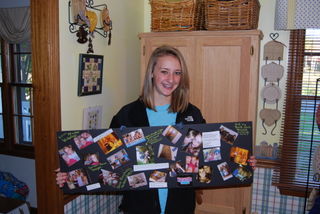
DSC_0503
This morning two of those friends, Jesse and Sarah, showed up at our house about 15 minutes before the school bus was due to arrive.  They were carrying happy birthday signs (Erin's holding one in the picture to the left) and generally made her feel like a million bucks.  They even coordinated with Erin's brother Michael to make sure that she rode the bus and didn't hitch a ride with us and miss all the fun.

Next, let's talk about boys.  Actually in our house it seems like we never stop talking about boys.  Boys, boys, boys.  I guess it's just a sign that she's a healthy and happy 15 year old that Erin finds any boy with a pulse to be "cute."  Recently she's decided to classify one of those boys as a boyfriend and I know this because she changed her profile on Facebook to "In a relationship."  Note to Erin's grandparents: that's how things are done these days.  We don't tell each other anything, we just write about it online for 1,000,000 other people to see and then wait for our family members to hear it through the grapevine.  I asked Erin about it and she blushed and said she wasn't sure Celeste and I would approve so that's why she didn't tell us.  I guess she forgot that I can read and I also have a Facebook account and would eventually find out anyway. 

Ah, well.  I told her that she was right that we wouldn't approve, but that it had nothing to do with the boy himself.  She could be dating the crown prince of England and I wouldn't approve since in my eyes all boys are equally vile and despicable.  Heck I was a boy at one time (Celeste says I still am) and I've told Erin repeatedly that there's not a teenage boy alive that she can trust.  I'm at that point in life where I wish a man could take a stick to any boy that looked cross-eyed at his daughter and he would be met with understanding nods of approval.  But, since we live in a civilized society I'll just have to satisfy myself with treating the little weasels like dog poop on the bottom of my shoe. 

Obviously I'm treading ground that's been well traveled by a gazillion fathers before me, and honestly I have no room to complain. The girl brings home straight A's, excels at everything she tries, and only drives us crazy four times a day.  She also happens to be beautiful, have the world's greatest smile, a laugh that could stop traffic and an uncanny ability to attract people to her like moths to a flame.

Of course I can't end before I tell you that one of our greatest joys is that she's not outgrown her propensity for Erin-isms.  Since she was a child Erin's had the uncanny ability to mutilate words in an often hysterical fashion.  When she was in elementary school she saw a Mitsubishi and called it "mister bushy."  A couple of years ago we were passing a fast food restaurant that had an "Open Late" sign and she blurted out, "Look they have open lattes."  Last year when we asked what some of the activities were scheduled on her class trip to the coast she said they were going to go "wadding." When we gave her a confused look she said, "You know, when you walk in the water but don't swim."  The best part about the Erin-isms is the fact that she just laughs them off.  It's an amazing part of her personality that she just accepts them, and honestly it's one of the most endearing attributes of a truly incredible young lady.

Happy birthday honey.  Tell Will I'm watching.

What is Government?

Well it’s almost over.  In a couple of weeks we’ll have survived what will surely be remembered as one of the crazier election years in memory.  However the election turns out the winners will be dealing with deeper systemic problems than any incoming administration/Congress has had to deal with in at least a generation if not two.  It seems to me that they will be confronted with some hard questions that have not really been addressed in a long time.  Those include:

  • What role should government play in our country?
  • Of the myriad programs that government currently manages, which should remain and which should be jettisoned?
  • How much money should we spend on the programs we decide to keep?
  • How do we get the money to pay for those operations?

Unfortunately we’ve spent decades with people screaming at each other about the role of government, yet in reality we as a society haven’t had an honest conversation about it.  We hear talking heads spouting catch phrases like "government is the problem, free markets are the solution" but never discuss how a free market can exist without government or at least within the governed society. 

Ironically if you start to get down and dirty in a debate with folks from either side of the ideological aisle they almost immediately begin to moderate themselves.  For people who want to trim government to the bone just find the government program that they value and offer to cut it and all of the sudden they’re advocating for "smart government."  For people who want the government to provide for every need simply say that it’s no problem but they will have to use the services as the government dictates and all of the sudden they start arguing for limited government.

The reality is that we need to have a long, painful discussion about what America’s priorities are.  To have a civil society we must have government.  I’d say with the exception of our friendly neighborhood anarchists we can all agree with that.  The differences come in what we ask the government to do.  We need to remember that much of what we take for granted in terms of government hasn’t always existed.  We didn’t start paying income taxes until WWI (well we paid them during the Civil War but then stopped in 1872).  On the other hand we didn’t have Social Security until the 1930s or Medicare until the 1960s.

My point is that there is no reason for us to limit our conversation to making incremental changes to government programs.  Right now we have a unique opportunity to make radical changes because we all know that the system we have now is royally effed up although we can argue all day about the reasons why they are.  So what to do?  Personally I think we should put those four basic questions I listed above to the populace and find out what this country really wants for the future.

So what role should our government play?  My personal preference is that the government limit itself as much as possible to the role of referee.  While certain jobs should always be fulfilled directly by the government (i.e. defense), for most the government should provide a safe environment for private enterprise to fulfill those roles.  A difficult part of this discussion will be deciding which programs fit the bill for government delivery.  Energy? Transportation?  Health care?  Education?  Parks?

For arguments sake who says that public schools are the best answer?  With today’s technology isn’t it possible that distributed education regulated by government might be better and more cost effective?  Isn’t it possible that it would be more effective to take public school funding and have private enterprises compete for the dollars?  I can almost guarantee that if you had a bunch of companies competing for students in Washington, DC the kids would be getting a better product than what they’re getting now.  On the flip side look at the craziness we’ve begot with Medicare.  That’s a program paid for with government dollars and administered by private enterprise and it’s looking like an absolute boondoggle. 

Once we decide on the programs we’re going to keep under the government’s control we’ll have to decide how much to spend on them.  In other words we’ll need to decide how big the military should be, how much money should be provided to state and local law enforcement agencies, how much to spend on building and maintaining roads or if more money should be spent on mass transit, what kind of energy generation projects should we pay for (solar, nuclear, coal, etc.) and the list goes on.

For those industries we decide to regulate we’ll need to determine how far regulations should go. We’ve seen in the financial sector that too much regulation can stifle growth, but not enough regulation can lead to meltdown.  Most likely we’ll only determine the appropriate levels of regulation through trial and error, but it’s crucial that we allow private enterprise to provide as many services as possible in a competitive environment so that we keep the cost of delivery down.    

Finally we need to figure out how to fund the government.  Is an income tax really the best way to go?  Other industrial countries seem to be having success with VATs, so might it be a better way for us to go?  Also, and not insignificantly, we need to remind ourselves that as members of this society it is in our interest to pay taxes.  Those taxes pay for our security and welfare, so the issue isn’t whether or not to pay taxes but determining how much is fair to pay and what those taxes should fund.

These are huge and important issues but we have not been asked to confront them.  Our leaders pay them lip service, but in reality the vested interests debate these issues among themselves and we the people rarely get asked for our take on it.  I’m sure the powers that be think that the average citizen isn’t interested in the details and will only sit still for sound bites, but I think that if we were provided with the information in plain English and allowed to see for ourselves exactly how things have been working lo these many years, they might be fairly well surprised at the response they’d get.  Let’s put it this way: we the people seemed to have pretty good instincts when the Bush administration tried to cram that bailout package down our throats.

Hopefully whoever wins this election, Presidential and Congressional, will engage our country in this kind of fundamental conversation.  If not I truly worry about the country I’ll be living in during my old age, and I don’t even want to think about what my kids and grandkids will be facing.