The World Is Obsessed With Facebook from Alex Trimpe on Vimeo.
Wow…just…wow
Leave a reply
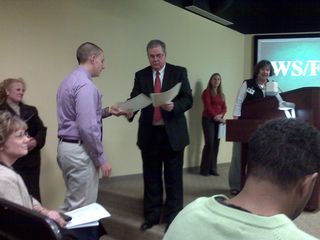
Our oldest is hitting the home stretch of his high school career and last night featured one of what I think will be many landmark events for him over the next few months. In the picture to the left he's receiving a certificate and handshake from the WSFCS Board of Education chair Donny Lambeth. The occassion was the recogntion of Michael and his classmates who participated in the Finance Academy at West Forsyth and East Forsyth High Schools.
At the end of his freshman year Michael attended an orientation session about the Finance Academy and he decided then to commit to a three year program that integrates the principles of finance and business with the students' core curriculum. It also provides the students an opportunity to intern at local businesses the summer after their junior year, and last summer Michael was able to intern downtown with the city government.
As Chairman Lambeth said last night, the news is full of kids doing the wrong thing, so it's nice to see kids being recognized for doing the right thing. It was definitely a proud moment for Michael's parents.
I’m posting this mainly to prove to my friends and family that I did what I did today. You see, if you looked up “car guy” in the thesaurus I’d be the picture next to it’s antonym and my friends and family know this. So I need to document the fact that I spent the day working on my ’87 Dodge pickup with my neighbor. Here’s a sampling of what we did: took off the old two barrel carburetor and intake manifold to replace them with new ones; took off the water pump to replace it; took off the timing chain to replace it and broke the cam shaft in the process; made an unexpected trip to the store to order a new cam shaft; cleaned and painted a bunch of parts so we’ll be ready to put it all together when the cam shaft comes in on Monday.
Big shout out to my neighbor Mark for taking this on. Before we started today I couldn’t have identified anything under the hood that wasn’t the battery.
BTW, nice weather today huh?

Thrush from Gabriel Bisset-Smith on Vimeo.
I hope this NY Times article about my alma mater's men's basketball team doesn't carry the same kind of jinx that appearing on the cover of Sports Illustrated does.
But the Final Four spotlight has gradually faded, and the players from that team have moved on. This season, the Patriots have flourished by reclaiming the program’s preferred role as a midmajor team with major dreams.
Their faces are not on magazine covers or bobblehead dolls, but the Patriots were 22-5, riding a team-record 12-game winning streak entering Saturday’s game at Northern Iowa. George Mason is No. 20 in the Ratings Percentage Index, ahead of teams like Villanova, Louisville and U.C.L.A., and it will probably receive an at-large bid to the N.C.A.A. tournament bid if it does not win the Colonial Athletic Association tournament.
“The Final Four team had their time, and what they did was great,” the junior forward Mike Morrison said, “but now we’re trying to make our mark.”…
“All of a sudden they’ve got a lot of guys on the floor with a great deal of experience and a great deal of confidence,” Virginia CommonwealthCoach Shaka Smart said. “They don’t get rattled.”
And perhaps that is how this team most resembles the one that reached the Final Four. With each win and each day that draws March closer, it becomes more apparent that when the N.C.A.A tournament begins, George Mason could become this year’s George Mason.
A front page article of the Wall Street Journal features a Winston-Salem boxer Jonathan Haggler fighting for the World Boxing Council's Baltic heavyweight title, which covers Poland, Latvia, Estonia, Lithuania and the eastern half of Scandinavia. The fight's in New Jersey. It's boxing so whaddayagonnadoaboutit?
Meanwhile, if Mr. Haggler is successful this weekend, Winston-Salem will boast one of the Baltic region's top heavyweights.
In 26 professional bouts stretching back to 2000, Mr. Haggler has fought only a handful of times outside North Carolina, once at a Radisson hotel in Morgantown, W. Va., another time in a nightclub in Nashville.
He says the opportunity to fight in New Zealand three years ago was his way to fast-track a career. In addition to the pay, he was told the WBO Oriental heavyweight title would vault him into the top 15 of the WBO rankings, and presumably more lucrative paydays…
It wasn't until Mr. Haggler saw the banner for the fight, announcing "WBC Baltic Heavyweight Championship," that he realized he'd be fighting for a foreign title. "That just made it that much more important for me," said Mr. Haggler.
The North Carolina heavyweight, who works with at-risk youth and their families, admits he doesn't know anything about the region other than a few facts about the Baltic Sea that were in a recent email. He admits, too, that fighters like himself are seen as stepping stones. Still, he thinks he can win the fight if he can pace himself.
If he does prevail, he'd like to fight another Pole—two-time world champ Tomasz Adamek, though a trip to the Baltics is unlikely. "I'd be the people's champ from a distance," he said.
I get really tired of hearing intelligent people harp on the taxes paid by the wealthy. Why? Because they usually use this argument: "The wealthiest 1% of Americans pay 40% of all the taxes." They're right, but guess what? The wealthiest 1% also have seen their adjusted gross income increase at a much greater rate than the bottom 99%. Oh, and the wealthiest 400 housholds in the US? Their effective tax rate has plummeted from 30% in 1995 to 16.6% in 2007.
How do the wealthiest peoples' income tax rates compare to the Average Joe? Check out this story comparing the income tax rates of the average resident of the Helmsley Building in New York to the average janitor or security guard.
Why are effective tax rates on the wealthy so much lower than you might expect? It really comes down to how they get their income. From one of the articles linked above:
The low effective tax rate for the top 400 filers is largely due to the fact that capital gains and qualified dividends are taxed at much lower rates than ordinary income. In 2007, the top 400 filers derived 66 percent of their income from capital gains and dividends, compared to 22 percent for filers making between $500,000 and $1 million and just 2 percent for those making under $50,000. It is not surprising that two of the largest reductions in effective tax rates for the top 400 filers occurred in two two-year periods (1996-1998 and 2002-2004) that coincided with the capital gains tax cuts enacted in 1997 and 2003 (and, to a lesser extent, the dividend tax cut enacted in 2003). [2] Additionally, these households benefited from the reduction in the top two marginal income tax rates enacted in 2001.
Currently the top marginal tax rate on capital gains and dividend income is 15 percent, less than half the top rate on wages and salaries. The Obama Administration’s FY2011 budget proposes to raise this rate to 20 percent for high-income households, still well below the 28 percent capital gains tax rate enacted under the Reagan Administration and in effect for most of the 1990s. For dividends, at 20 percent the top rate would be roughly half of what it was during the prosperous 1990s. Under the Administration’s proposal, therefore, the very highest-income filers would continue to pay income tax at very low effective rates.
In a nutshell, when it comes to income taxes, if the vast majority of your income is reflected on the W-2 your employer gives you then your hosed. First off, you most likely are paying a good percentage of your income in payroll taxes which are only applied to the first $106,800 of income. So if you're paid $100,000 then the payroll tax applies to your entire salary, but if you're paid $200,000 then the payroll tax doesn't effect the last $93,200 you make and that brings down your effective income tax rate significantly. Secondly, you can't really fudge the income you report to the IRS since your employer is sending a copy of your W-2 to them stating exactly how much you made. The wealthy, on the other hand, can afford to pay for all kind of tax "shelters" that keep a good chunk of their income from being touched by the IRS. Let's put it this way: I have a feeling that the 16.6% effective tax rate reported above did NOT include income that the IRS knows nothing about. I think it would be a very safe bet that the real tax rate would actually be much lower if you included the "sheltered" income of the wealthy. And last, as the excerpt above made clear the wealthy don't get most of their income in wages which means they don't income tax rates on much of their income and they pay the lower capital gains rate.
So yes it irks me greatly when I hear the wealthy complain about high income taxes. I have no problem with arguments about cutting the size of government in order to keep taxes down, because to me that's a valid philisophical debate about the appropriate role of government. But when I hear these arguments about the wealthy paying more than their fair share in taxes I start to see a little red; does it not occur to anyone that even if they do pay an outsize share in terms of gross dollars, they also enjoy an outsize share of wealth in terms of gross dollars?
Sadly, this kid closely resembles more than a few people I know, but will not name in an effort to keep at least one or two of my friends:
Celeste made me a very special pound cake for Valentines Day.

Winston-Salem is not a large city. Even so it is like every other city in the world, welcoming any number of people who are looking for someplace new or who are simply passing through. Through the wonders of Google I stumbled upon the story of one such person:
Their eyes met and she smiled as she passed Martin Tucker at an intersection in downtown Winston-Salem, North Carolina. The photographer and documentary filmmaker had been downtown setting up a photo exhibit at a local gallery.
"I don't know what it was about her," he said. "She looked dynamic in some way. She looked like she had a story."
Tucker chased down Patulla, who couldn't catch the northbound train until the next day> He wanted to meet up the next day, bring his cameras and audio recorder.
"Well," she replied, "I'm a hobo."
The next day, the two met and talked about religion, politics and relationships. No topic was off limits and she spoke openly, almost too openly, Tucker thought.
In the early evening, Tucker could tell she was antsy to catch her train. She signed a photo release form and was gone, leaving behind only an e-mail address. In hindsight, Tucker wished he had gone with her to the tracks, but he thought he had a complete story…
Tucker produced a 22-minute documentary, "Patty: This is My Normal," based off their afternoon together. The show premiered at a November film festival and will show at another in April.
Tucker read about her death a month later in a Texas newspaper.
He thought he'd told her life's story, but realized then had hadn't.
"I have more questions than I have answers at this point," Tucker said in a recent telephone interview. "This vibrant, 29-year-old woman who seemed like she had everything to live for but decided to check out, was quite a shock. I was crushed. I felt like I had lost a friend."
On any given day you can sit in a car idling at a stoplight on Jonestown Road, Five Corners, Stratford Road or any number of other intersections in Winston-Salem and see them. They are people who sleep outside, who may be passing through or have settled here for whatever reason, and their stories are likely as tragic as Patulla Williams'. We can only pray that theirs don't end as tragically.
 Befuddled