Category Archives: Uncategorized

Mini’s Genius Marketers

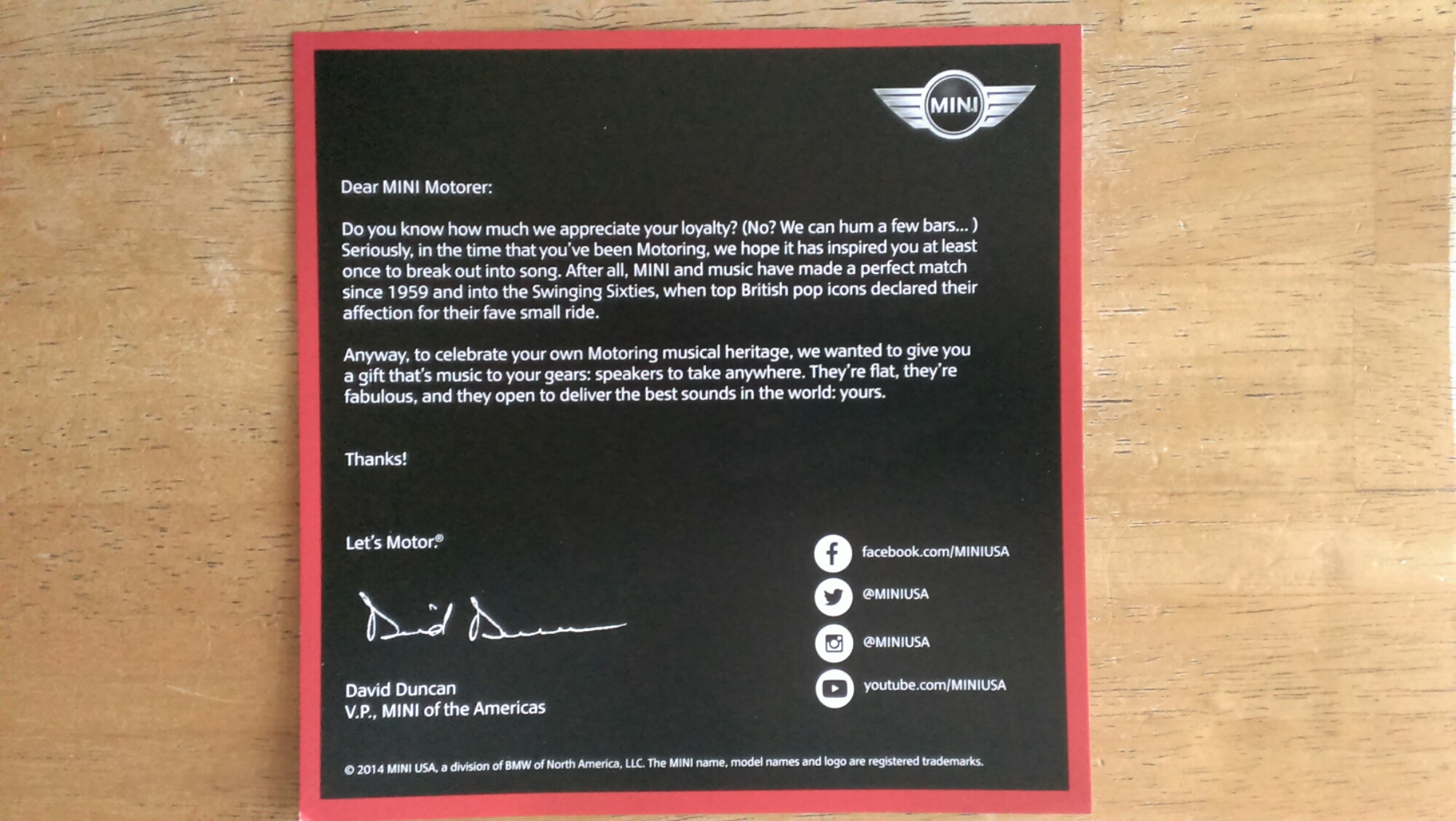
Mini Cooper truly has some smart marketing folks. Yesterday my wife, who’s been driving a Mini for about two years, received a package with what she thought was a free music CD. Instead it was two portable speakers that can be folded flat and are intended to be used to provide “music for your gears” while motoring.

So smart. An unexpected, no strings show of appreciation for their customers.

image

image

image

Getting a Ride for Gaming

We’ve become accustomed to the idea of people getting college scholarships for playing games like basketball, football, soccer, etc. but we’re probably going to have to adjust to the idea of people getting scholarships for playing video games:

Robert Morris University, a small, accredited private school whose main campus is in downtown Chicago, has taken a different tack—boosting the number of athletic scholarships to more than 700, from 150 a decade ago, in a bid to stem declining enrollment…

Kurt Melcher, the Associate Athletic Director at Robert Morris, dreamed up the idea of a videogame scholarship this past spring when he came across a game called “League of Legends,” Mr. Bensema’s specialty. The online game of strategy and teamwork pits teams of five players against one another in a battle for domination that is sort of like a high-speed digital version of capture the flag.

“I just couldn’t believe how elaborate it was,” said Mr. Melcher…

In October, the League of Legends world championships drew 32 million viewers online. An additional 18,000 fans packed the Staples Center in Los Angeles to watch two teams of five skinny young men click away on their mice—as the game played out on huge screens overhead. When a player died, fans screamed as loudly as if Kobe Bryant had just launched himself from the free-throw line and thrown down a two-handed dunk…

In April, Mr. Melcher submitted a one-page proposal to field a League of Legends team. Two weeks later, the president’s council came back and said they wanted to offer 60 scholarships of up to 50% off tuition and room and board.

“We saw this as a chance to reach kids who might not have otherwise considered us,” said Provost Mablene Krueger. For the school, a significant short-term cost of the program is the new esports arena, a retrofitted classroom with 36 gaming stations that will cost the school about $100,000.

The school received a handful of responses when it posted the announcement on its website. Then the owners of Riot Games, which created League of Legends, posted it on the game’s website. Within 48 hours, the school got 2,200 inquiries from as far away as Gambia, in West Africa. Almost all of them were from males.

A few thoughts:

  • Holy crap, it’s still shocking for a guy like me – prototypical middle aged fantasy football dude – to see the numbers involved with video games. Of course it would make sense to create competitive teams to represent the school, for the same reason it makes sense (if it does) to field basketball and football teams.
  • I’d imagine that the demographic this will reach is an attractive one for schools. 
  • I wonder how long before we see this idea spreading to other schools, especially small schools that can’t afford the millions of dollars it takes to field a football team.
  • While we think of gamers as guys, because you know we don’t often think of girls sitting in the basement eating Cheetos while slaying some Russian kids avatar, there’s no real reason that you couldn’t have coed teams which helps alleviate any need for two teams to conform with Title IX requirements.

Totally selfish thought: if this idea takes off our youngest might be able to get a ride somewhere since he has some serious gaming skills.

Paying for Chicago, New York, LA, etc.

We North Carolinians seem to be taking Southern generosity to an extreme:

North Carolina taxpayers could spend more than $10 billion by 2022 to provide medical care for low-income residents of other states while getting nothing in return, a McClatchy Newspapers analysis shows.

Pennsylvania was trying to be just as nice, but then they changed gears:

Pennsylvania, which originally said no, got approval last week to use federal money for its own variation on Medicaid expansion, one that extends subsidies for private insurance to cover up to 600,000 of the state’s poorest adults. Arkansas and Iowa are using a similar approach.

But our fearless leaders in Raleigh seem to be working their way towards a redirection of our redistribution of wealth:
 
Don Taylor, an associate professor of public policy at Duke University, has been quietly pushing his own version of that plan for North Carolina. He says refusing the federal money results in “the redistribution of money from poorer states to richer ones, an outcome imposed by the poorer states upon themselves.”…

In North Carolina, “there will be an opportunity for a political deal,” Taylor says. “State flexibility in the ACA is a feature, not a bug.”

The Locke Foundation, which tends to land close to GOP leaders’ views, wants the federal government to award Medicaid money to states as a block grant, with North Carolina using it to support “a universal, refundable tax credit” to cover premiums, along with government contributions to individual health savings accounts.

You say to-may-to, I say to-mah-to, whatever. Let’s just figure this thing out so we can cover our own butts, not just those wackos up north and out west.
 

Insights from Ira Glass, Host of This American Life

This interview on Lifehacker with Ira Glass about how he does his work ends with a great piece of advice:

I’d just say to aspiring journalists or writers—who I meet a lot of—do it now. Don’t wait for permission to make something that’s interesting or amusing to you. Just do it now. Don’t wait. Find a story idea, start making it, give yourself a deadline, show it to people who’ll give you notes to make it better. Don’t wait till you’re older, or in some better job than you have now. Don’t wait for anything. Don’t wait till some magical story idea drops into your lap. That’s not where ideas come from. Go looking for an idea and it’ll show up. Begin now. Be a fucking soldier about it and be tough.

With some slight editing this could work for almost any line of work.

We Are Sooooo Uber Worthy

Last week I was in Denver on business and needed to get a ride to the convention center from an area that didn’t have a cab within miles. One of the people I was with arranged a ride with Uber after I revealed that I didn’t have the app on my phone because we didn’t have the service where I lived (Piedmont Triad region of North Carolina). For the first time in a long while I felt like a backwoods Luddite.

Guess what? Uber’s coming to the Triad starting today:

The California-based company is expanding to Greensboro, Winston-Sale, Durham, Chapel Hill, Fayetteville and Wilmington, according to the newspaper. The company connects riders and drivers and has mostly been available in larger cities. It is already in use in Charlotte and Raleigh.

The mobile app is linked to a credit card and replaces hailing a cab or arranging for a car service. Customers download the app and the nearest available driver picks them up. A base fee of $2.43 is charged, and the customer is charged $1.46 per mile and 30 cents per minute. Uber gets a 20 percent cut and the driver keeps the remainder.

Does Google Glass + Livestream = Trouble for Event Planners?

There’s an article in the Wall Street Journal about Google offering the Livestream app in its MyGlass store for Google Glass users. The article focuses on some of the privacy and copyright concerns that this raises:

On Tuesday, Google Inc. officially began offering the Livestream video-sharing app in its MyGlass store. The software lets Glass wearers share what they are seeing and hearing with other Livestream account holders free of charge by using the command, “OK Glass, start broadcasting.”

Users who want to broadcast to non-registered Livestream viewers can pay up to $399 a month to stream their video to the Web…

But privacy advocates worry that Google’s Internet-enabled, camera-outfitted glasses already make it too easy for wearers to quietly photograph and film other people…

Livestream’s terms forbid video that is unlawful, obscene or pornographic. The company addresses copyright concerns as it does with footage shot on conventional cameras: A video shared with a few friends might not cause problems, but Livestream would act to take down an illegal broadcast to thousands of viewers.

We could all probably come up with our own unique concerns related to this, but as someone who’s made a living selling professional education services the first thing I thought about was, “What would we do if someone walked into one of our conferences or seminars wearing Google glasses?” I mean, what if they had Livestream loaded and had arranged to have their coworkers watch the live video of the session? We’ve always faced the issue of having one attendee take all the materials back and share with their colleagues, but their colleagues would miss out on the interaction with the instructor and other attendees, not have the opportunities to ask questions, etc. With this technology one person could attend and provide a live video stream to colleagues who could then text their own questions to the attendee and get a truly “almost good as live” experience.

Of course my knee jerk reaction was that we’d simply ban the things from our sessions. But is that the right thing to do? As with most things the answer is “it depends.” There are lots of factors at play here: whether or not the instructor is okay with it, the nature of the material, the purpose of the class, etc. For example I currently work with a trade association and one of our primary functions is to provide education to our members. We have to balance the cost of providing the education with the budgetary constraints of our members – in other words we need to be careful that we don’t price our members out of the very classes their employees need, but we still need to cover our costs. In that scenario would we be hurt by a member sending one person rather than ten and thus paying $100 for the seminar versus the $1,000 they would have sent otherwise? Actually I think there could be opportunity there.

What do I mean by opportunity? Well, we could have a situation here where our members would be saving us the expense of creating our own streaming video service, which I think is going to become the norm in professional education. I think people will become comfortable with experiencing education sessions that aren’t professionally produced, that they’ll be satisfied with less than perfect video, and might actually prefer the experience since it will be more like sitting in the back row of a class than watching a professional webinar. So, how do we make sure it doesn’t cut our education revenue to the point that we can’t afford to put on these classes?

Here are a couple of ideas:

  • Create an upcharge for allowing wearable devices. If an attendee wants to wear Google Glass then they pay x% more to do so. If they don’t pay the fee then they can’t wear it in. We’re assuming they’ll share it with colleagues which means we could be losing out on additional revenue, but on the flip side we could pitch it as a member service – “Sure we’re charging you to wear your Google Glass, but we’re saving you money and your employees’ time away from the office.”
  • Because we aren’t having to provide seats to ten people from one company we could have seats opened up to more attendees from other companies. In the long run we might be able to reduce our overhead because we could downsize our training space and embrace a blend of in-person and remote learning.
  • We might be able to create sponsorships that take into account the increased exposure from the live streams and help offset the lost attendee revenue.
  • We could sell education by subscription. Companies can pay a flat fee to allow all of their people to attend any session. That removes the incentive to try and game the system and might even create a more predictable revenue stream for the organization.

That’s just a few ideas. Would love to hear from others how they see this type of technology will affect their businesses, whether or not they have anything to do with training. The possibilities in all businesses seem staggering to me.

Dear Lewisvillians, Roundabouts Work

When I was on Lewisville’s planning board we had a couple of recurring debates, one about roundabouts and the other about cyclists. I always fell on the pro side of the roundabout debate and I’m happy to see that the MythBusters have shown they are indeed superior to four way stops.

BTW, Lewisville is slated to get more roundabouts in the future so we might as well get used to them.

http://seven.of.nine.wimp.com/loadvideo/d7fe763b17ae760fef524c658c476d20/53932a13/mobile-videos/9c609c887ee3f1c5991919a4bb979641_test.flv.hq.mp4

The Week That Spanned a Year: 12/29/13 – 1/4/14

Current Events – Everything you need to know about Obamacare in one place – Probably the best, most easily understood piece about Obamacare and what it means for you…with video!

Oh Shit! Issue of the Week Retirement crisis being brought on by aging boomers who didn’t save squat and fewer young workers to fund the retirement system.

Cutest Video of the Week – A dad, his daughter and a pink plastic ukulele.

Stupid Person of the Week – The man who didn’t bring home the beer.

Technology – Year of the Glasshole – Excerpt – “An anecdote: I wanted to wear Google Glass during the birth of our second child. My wife was extremely unreceptive to this idea when I suggested it. Angry, even. But as we got a bit closer to the date, she began to warm to it and eventually landed somewhere in the neighborhood of bemused hostility.”

History – Nattering Nabobs of Negativism Through the Ages From the printing press to the internet and how pundits of their times thought they’d ruin society.

Marketing – How to make things go viral A must read for anyone in the business of getting attention, whether for themselves or their business.

Small Business – 10 Bold Predictions for 2014 – #9, that Obamacare will be very popular with super-small businesses, is spot on.

Oy of the Week – Meet the people who think the US is 2014 years old

Quote of the Week – “Everybody is a genius. But if you judge a fish by its ability to climb a tree, it will live its whole life believing that it is stupid.” – Albert Einstein

Health Insurance – Caveat Emptor

One of the problems with buying health insurance is that it's one of the most complicated purchase any one of us will make in any given year. With the advent of Obamacare scores of people will be buying insurance on an open market for the first time – versus opting from a limited set of options from an employer – and that means the complexity of the process will have an ever greater impact in the coming years. That's what makes this story on Planet Money so scary:

Any day now — assuming the government manages to fix HealthCare.gov — millions of people will start shopping for health insurance.

Will those shoppers know what they're doing? More to the point, if you're one of those shoppers, will you know what you're doing?

Here's a quick quiz, courtesy of economists George Loewenstein and Saurabh Bhargava, who study what people know (and what they think they know) about health insurance. The economists have used longer versions of these quizzes in their research…

While the share of people who answered each question correctly varied, the vast majority of people who took the quizzes got at least something wrong.

And this isn't just some academic artifact: Bhargava and Loewenstein are leading an ongoing study of some 50,000 real-world choices that people make when shopping for insurance — and found that 65 percent of the time, people choose plans that are more expensive than other options but don't provide more benefits.

You should go take the quiz. You might be surprises at how much you think you know that you really don't.

Amendment One Advocate Taking on Tillis for Republican Senatorial Nomination

There's an interesting article at Atlantic.com about the Rev. Mark Harris' run for the Republican nomination for the Senate seat currently held by Democratic Sen. Kay Hagan.  Rev. Harris was instrumental in getting Amendment One passed and is looking to use the same grassroots organization he used in that fight to boost his Senate run:

Now Harris is attempting to unseat Hagan in the Senate, vying to win the Republican nomination with assistance from his band of grassroots allies. He announced his Senate candidacy this month, and has the potential to give state Senate House Speaker Thom Tillis a serious challenge in the Republican primary.

Harris has sent early signals that he'll build his Senate campaign infrastructure out of that same grassroots organization that fought against gay marriage. He has already brought on Republican activist Mary Frances Forrester, who spearheaded the Amendment One campaign, and Rachel Lee Brady, who worked for the pro-Amendment One group Vote Marriage NC. That could be helpful in injecting cash into the relatively unknown first-time candidate's campaign and could help propel Harris to the Republican nomination…

The article goes to point out why the state-wide fight for Hagan's seat might not be as easy as the Amendment One results would seem to indicate:

Amendment One was on the ballot during last year's May primary, when there were no competitive statewide contests, not the general election when the presidential campaign and a heated gubernatorial race boosted turnout. As is typical of primary elections, the electorate was much older and much more conservative than in a typical general election, but the excitement around Amendment One exacerbated those differences. Over three-quarters of voters in the primary election were over the age of 50, according to Lake Research Partners, a Democratic polling organization that worked with same-sex marriage proponents during the primary. That electorate was "enormously" helpful in getting Amendment One passed, pollster Celinda Lake said, and could be a boon to Harris in getting through the Republican primary.

The Democrats are going to be in a dogfight to retain control of the Senate so you can expect to see lots of national money injected into this campaign since Sen. Hagan's seat is seen as one of the most closely contested in the country. Things are gonna get interesting around here in the very near future.