Category Archives: Uncategorized

Making the Media His Biotches

This article about how Donald Trump is controlling the media came to my attention via a friend on Facebook as you can see below:

TrumpMedia

I particularly like David Boyd’s comment that it  “Helps that they’re such willing bitches.” It’s understandable that the media want to cover Trump – after all he is the phenomenon of this political season – and I understand that they are competing for ‘share of mind’ of an increasingly diminished audience of news watchers, but when do they finally say, “You know what, this a-hole’s been able to run an incredibly inexpensive campaign because we give him so much free air time” and then cut HIM off. He truly needs them far more than they need him, so why keep feeding the troll?

Could it be that they’re desperate to prove they’re still needed, still the Fourth Estate, still an essential part of the democratic process? Maybe they’re finally realizing that what they thought was simply a nightmare they would wake up is reality – that most people don’t read, watch or listen to them anymore. They’ve got Facebook and so does Trump, so no one thinks they need the media anymore. Sadly, they’re probably right and wrong at the same time.

Is BMI Worse Than Worthless?

The statistical gurus at FiveThirtyEight have looked at the ubiquitous body mass index (BMI) and come to a conclusion that many of us suspected: it stinks as a measure of health. In fact I’d argue that it might be worse than useless, in fact might even be harmful, because it misleads people into thinking they are not at risk of negative health effects because they have a BMI in the “normal” range.

Taken alone as an indicator of health, the BMI is misleading. A study by researchers at UCLA published this month in the International Journal of Obesity looked at 40,420 adults in the most recent U.S. National Health and Nutrition Examination Survey and assessed their health as measured by six accepted metrics, including blood pressure, cholesterol and C-reactive protein (a gauge of inflammation). It found that 47 percent of people classified as overweight by BMI and 29 percent of those who qualified as obese were healthy as measured by at least five of those other metrics. Meanwhile, 31 percent of normal-weight people were unhealthy by two or more of the same measures.2 Using BMI alone as a measure of health would misclassify almost 75 million adults in the U.S., the authors concluded…

The researchers analyzed the health data for 15,184 adults who were part of the National Health and Nutrition Examination Survey. Their results,published in the Annals of Internal Medicine, were pretty surprising: They showed that midsection obesity was a killer, even among people with normal BMIs. For example, a man with a BMI of 22 (putting him firmly in the normal range) but too much belly fat according to his waist-to-hip ratio had an 87 percent higher mortality risk than a guy with the same BMI and a healthy waist-to-hip ratio.

What’s more, a man with a normal BMI and disproportionately big belly had more than twice the mortality risk of a man who was overweight or obese by BMI but not by waistline. Among women, those who were normal weight by BMI but had a high waist-to-hip ratio had a 48 percent higher mortality risk than those with a similar BMI but a healthy waist-to-hip ratio, and a 32 percent higher risk compared with those who were obese according to BMI only.

This is the kind of thing that leads me to think BMI has more in common with phrenology than mainstream health care practices.

Civility and Intelligence

Here’s a quote from a post at the AVC blog on the importance of civil and intelligent debate that hit home when I read it this morning:

I was reminded of that when I read Ruth Bader Ginsburg’s comments on Antonin Scalia, in particular this part:

We disagreed now and then, but when I wrote for the Court and received a Scalia dissent, the opinion ultimately released was notably better than my initial circulation. Justice Scalia nailed all the weak spots—the “applesauce” and “argle bargle”—and gave me just what I needed to strengthen the majority opinion.

and this:

Maybe the most important part of the title to this post is the word civil. Without civility (and respect), it is hard to have intelligent debate. Respecting those with opposing views, working to understand them, and listening closely to them is the key. Even if they don’t change your mind, they can reshape how you discuss and present your views. And that can make all the difference in the world.

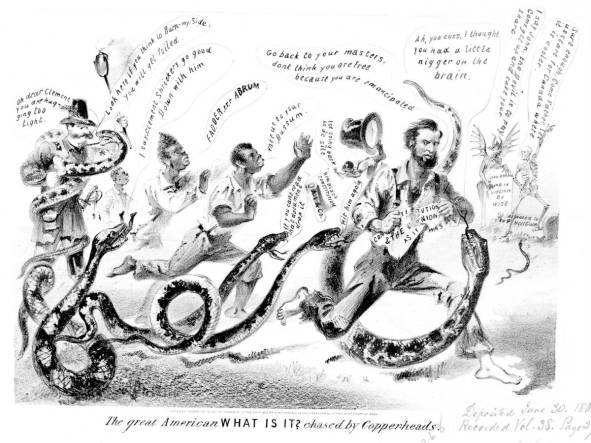
The scary thing about the current state of political discourse in America is the very real lack of civility. As much as we’d like to think this is a modern phenomenon, we actually have a long history of pretty nasty behavior during the political silly season. Check out this political cartoon about Lincoln:

civilityLincoln

Source: HarpWeek

That’s some pretty nasty stuff by any measure. What’s new to our elections these days is the ability of any one person to create or spread nastygrams like this via their social media channels, with nary a thought to whether or not it’s true. With the click of a button they can share personal attacks on candidates, falsehoods about a candidate’s past and beliefs, or launch character assassinations on political candidates or members of a political party faster than you can say “fact check.” It’s truly becoming an overwhelming cacophony of negative, schoolyard name-calling that is drowning out increasingly fruitless attempts at civil discourse.

Lest you think I’m exaggerating, check out these images I found in just five minutes of scrolling through my Facebook feed:

So what commonalities do you find in these images? What I see are personal attacks and name calling with no attention paid to the stated policies of the candidates. How, pray tell, does this advance the cause of the Union in any way?

Now I do understand that much of what people share are things they consider funny. Many of the memes poke fun at the generalizations the sharer has about the folks on the other side of the fence, and normally I wouldn’t be such a stick in the mud about it since I enjoy a good joke as much as the next person. However, when you see people share literally dozens or hundreds of these memes that do nothing but insult people with a different set of beliefs then you have to come to the conclusion that they truly feel that their opposites are stupid, lazy, cruel, etc. When you begin to believe that then you inevitably come to the conclusion that there’s no room for honest debate, and quite frankly you begin to not care what they think because all you see are personal attacks completely divorced from the issues.

So maybe you think I’m overreacting and that I should just ignore what I’m seeing on my social media channels. I might agree except that I think our current crop of political leaders, both liberal and conservative, from the local level to the national level, are exploiting these sentiments and profiting from our separateness. Until we can find a place to have civil and intelligent debate they’re going to play us for the suckers we are.

In other words, folks, we have met the enemy and it is us.

The Poster Child for Electoral Dysfunction

North Carolina’s probably going to be in the news quite a bit over the next week or two. Why? Well, because a federal judge has ruled that the NC Legislature needs to re-do the redistricting it did a few years back and they have until this Friday (Feb. 19, 2016) to get it done. If they don’t then North Carolina’s primary on March 15 is in jeopardy and who knows what that will mean for the contentious 2016 presidential campaigns. With the death of Supreme Court Justice Antonin Scalia this past weekend it is unlikely that the ruling will be overturned, so the Legislature is going to have its hands full.

Add to that the notoriety that the state already enjoys thanks to its voter ID laws (see John Oliver’s video below) and the state is poised to become the poster child for electoral dysfunction.

Trust Us

If you walked down just about any street in America and randomly asked people their opinions of “government” they would almost certainly describe it as bloated, bureaucratic, incompetent, invasive, etc. You would likely be challenged to find someone with something good to say.

Some of these negative assessments are earned – many governments are bloated, bureaucratic and, at times, incompetent – but some of the sentiments are the result of a cacophony of anti-government or small-government advocates. Some of them believe in their heart of hearts that all services, with the exception of public safety, would be most effectively provided by the private sectors. Others believe government is inherently evil and hold an Orwellian world view that just about anything the government does is an assault on individual liberty.

On the flip side of the coin you have people who see the government as the best option for addressing many of society’s ills, but they might see the folks running the show as a lesser light or the systems in place as overly bureaucratic and inefficient.

What all sides have in common, though, is a healthy case of cynicism about the government. Most simply do not trust it, whether from negative personal experiences dealing with the government (DMV lines come to mind), or from stories they’ve heard repeatedly from friends and from the media.

Luckily, for the most part the lack of trust is fed by relatively harmless inconveniences like long lines, higher than expected water bills or slow permitting processes for home improvements. That gives us all some ammunition for running jokes, but since we’re relatively safe and secure in our daily lives it doesn’t give us much cause for doing much more than telling jokes.

That’s why the Flint, MI water story is so important. Multiple governments failed to protect the health and safety of Flint’s residents, and apparently even worked to cover up their failings. This wasn’t a normal hot button issue, like the police shootings and “Black Lives Matter” stories that we heard so much about. While those stories were important and people were hurt, not everyone could identify with them because not everyone has had interactions with the police or could empathize with what it’s like to be black in America.

The Flint water story is about the failure of government to provide a fundamental service that affects everyone, safe drinking water, and then trying to cover it up. EVERYONE can picture themselves in that situation, and they can empathize with the plight of the citizens of Flint. The government violated the public trust and by doing so it weakened the very foundation upon which a civil society is built.

Not to overstate it, because we still do live in an incredibly stable society relative to the rest of the world, but if we don’t start demanding responsible governance from our elected leaders then we are going to see more and more failures like this one. We get enough of those and our society won’t seem so stable anymore.

So, let’s stop with the “all government is bad” rhetoric, along with its “all taxes are bad” cousin, and start having intelligent discussions about how government can best serve our citizens’ needs and take it from there.


Don’t Fly the Rainbow at Carolina Beach

Boing Boing has a post about a lifeguard at Carolina Beach catching hell for flying a rainbow flag:

On July 4, Zach Hupp, a lifeguard on Carolina Beach, NC, flew a rainbow flag from his post. Hupp says someone immediately complained to another lifeguard, concerned “that they thought because I was flying that flag that I would only rescue gay people,” and someone else posted on the town’s Facebook page that she “didn’t know how to explain this one to the tourists who asked us about it.”

Hupp received a formal warning, and the town officials made a new policy that only flags authorized by the town or the US Lifesaving Association can be displayed on the lifeguard stands.

It seems that if you’re going to North Carolina’s beaches this year you have two things to worry about: being attacked by sharks and being overrun by numbskulls.

Time Travelers

The old blog has been neglected of late because yours truly has been preparing for, and then participating in, a week-long vacation in England. That meant we started living five hours ahead of our friends and family back home in North Carolina, at least for the first few days we were there.

At 2 a.m. this past Sunday morning the folks back in NC “sprang forward” for daylight savings time, but in England they don’t make the leap until the end of the month. That means for the last couple of days we have only been four hours ahead of everyone back home,  so we time traveled while we slept on Sunday, which is kinda cool when you think about it.

Oh and here’s some random pics of our time travels.

image

image

image