Category Archives: Sports

Class Act

The first time I saw CJ Harris play was in the Frank Spencer Holiday Classic his senior year at Mt. Tabor High School. He was easily the best player on the court and it was encouraging to know that he was staying in town to play at Wake Forest. Unfortunately (for him) his tenure coincided with one of the most challenging times in the history of Wake Forest basketball. Fortunately (for us) he stuck it out and didn't transfer to another more stable program. He, along with Travis McKie, have been the players who have been most responsible for keeping the program from totally flaming out. They've shown tremendous character in fulfilling their roles for the Wake hoops program so it should not come as a surpise that Harris would write this thank you letter to the Wake Forest community. Here's an excerpt:

Thank you so much for the kind words and love that you have shown me and my family over the past four years. That is more precious to me than any victory on the court, as your words have truly help define who I am today.

While I am sad that my career at Wake Forest has come to an end, I see nothing but a bright future for the Deacs. I know that I have helped lay the foundation for this program to achieve the success we can all be proud of. My teammates and the coaching staff are working hard to get there, and they deserve your continued support and enthusiasm. 

Thank you again for making these past four years truly special.

Always a Deac!

CJ
“The time has come for us all to act like we’ve got some sense.”

Winston-Salem Journal sports reporter Dan Collins, who covers the Wake Forest beat, wrote the sentence that is the headline for this post. He wrote it as part of a piece on what he thinks we need to see from Wake fans who are at odds over the direction the school's basketball program is heading. He also wrote:

What does rankle me, however, is to see the utter lack of respect some have for opinions other than their own. And it rankles me to see what lengths some go to discredit and even vilify those who decline to walk lockstep in any direction they feel the argument should — no, must — go. 

It's very important here that I repeat, I'm talking about voices from both sides of the divide…

The worst moments, though, have come with the ridicule and vilest of rhetoric that has been tossed back and forth. Such hate and vitriol should be denounced by any fair-minded individual.

The unfortunate incident at the end of the Wake-Maryland game left a bitter taste I've yet to get out of my mouth. I've heard some say that what the person did was unacceptable, but they understand his frustration.

No, that's wrong. Unacceptable is unacceptable. To qualify it with the word but is to mitigate how wrong it was.

Collins is being very politic in his choice of words. There's a phrase that could be used to describe the fans' behavior and would be both succinct and accurate if not politic: Many Wake fans have been showing their butts and they need to just stop.

True Football

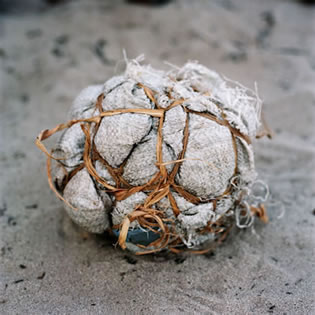
Unlike American football, which has very little to do with the foot meeting the ball, soccer, a.ka. football as the rest of the world knows it, is a simple game played by children all over the world. Even in the poorest corners of the earth children find a way to play, and this group of photos of homemade footballs in Africa shows you how.

Amen_balls_01

(Photo by Jessica Hilltout)

Remember the Carolina Cougars?

Folks of a certain age from around these parts (Piedmont Triad of North Carolina) might remember the Carolina Cougars of the old American Basketball Association. The Cougars were based in Greensboro until 1974 when they were purchased by Ozzie and Daniel Silna, moved to St. Louis and renamed the Spirit. That's when this story starts to get really interesting:

Four of the A.B.A.’s seven teams merged with the N.B.A. in 1976, but the Virginia Squires were a financial wreck and the Kentucky Colonels were placated with a $3.3 million payment. But if the Spirits couldn’t join the N.B.A., the Silna brothers wanted to share in what the A.B.A. didn’t have: national TV revenue. They settled with one-seventh of the television money generated annually by each of the four surviving A.B.A. teams — the Nets, the San Antonio Spurs, the Indiana Pacers and the Denver Nuggets…

In 1980-81, the first year the Silnas were eligible to get their share of TV money, they received $521,749, according to court documents filed by the N.B.A. For the 2010-11 season, they received $17,450,000. The N.B.A.’s latest TV deal, with ESPN and TNT, is worth $7.4 billion over eight years. Soon, the Silnas’ total take will hit $300 million.

That's what you might call a heckuva deal, but the brothers are looking to maximize it:

In Manhattan federal court on Thursday, lawyers for the Silna brothers and the league argued over whether the men are owed money beyond what they get from the N.B.A.’s national broadcast and cable television contracts. They want to tap into the money the league gets from international broadcasts, NBA TV, the league’s cable network, and other lucrative deals that could not have been imagined in the three network television universe of 1976.

If Federal District Judge Loretta A. Preska agrees, the Silna brothers — Ozzie, 79, and living in Malibu, Calif., and Daniel, 68, and living in Saddle River, N.J. — stand to receive millions more, all without having assembled a team or used an arena for more than three decades.

As the article pointed out the brothers' original investment in a struggling team in a struggling league was quite risky, but it's hard to imagine that they imagined it would pay off to this extent.

The Sanctimonious NCAA

There have been innumerable stories and opinion pieces written about the scanctions the NCAA dropped on the Penn State football program, but two of the strongest paragraphs come from Joe Nocera's opinion piece in the New York Times:

What was most galling about Emmert’s news conference (Note: Emmert is the current president of the NCAA) was its sanctimony. He kept talking about the “values” that athletics was supposed to embody, about how college sports is supposed to be an integral part of academic life, and how it should never overwhelm the mission of the university. “Football will never again be placed ahead of educating, nurturing and protecting young people,” he said.

But at big-time sports schools, football is always placed ahead of everything else. The essential hypocrisy of college sports is that too many athletes are not real students — and no one cares. Coaches make millions and lose their jobs if they fail to win. Universities reap millions by filling stadiums and making attractive television deals. They serve as the minor leagues for the pros. Everybody knows this — including the N.C.A.A. The notion that the Penn State case is going to change all of college sports is absurd. College football almost can’t help but corrode academic values. Nothing that happened on Monday is going to change any of that.


Blind Tennis

Tennis, like golf, is one of those sports that's hard for non-players to appreciate how difficult it is to master. On the other hand, it would be hard for anyone to underestitmate the difficulty of mastering blind tennis:

Like tennis for sighted people, the game requires speedy court coverage and precise shot-making. Blind players rely on their ears to follow a foam ball filled with ball bearings that rattles when it bounces or is struck…

Other adaptations include a smaller court with a badminton net lowered to the ground, string taped along the lines and junior rackets with oversize heads. Players with some sight get two bounces, the completely blind three. Only one set is played, and an umpire calls the lines.

The first sound-adapted tennis ball was designed in 1984 by Miyoshi Takei, a blind high school student in Japan. Now, about 300 players compete in tournaments there; blind tennis is also played in China, South Korea, Taiwan, Britain and Russia…

And for a local angle, here's a quote from a dean at UNCG:

An expert on orientation and mobility for the blind, William R. Wiener, dean of graduate studies at the University of North Carolina, Greensboro, said that sound localization “is so important when blind people navigate the world,” and added, “Listening to the ball, locating where it is and swinging at it probably helps you with the sport and also with your mobility.”

Be sure to check out the video that accompanies the article

Sharing the Road in Lewisville

Anyone who lives in Lewisville, NC knows that our town is a pretty popular destination for cyclists. I'll often hear grumbling about the inconvenience of having to wait behind large packs of riders, aka pelotons, on some of the beautiful country roads that make the town such an inviting place to live and bike. I don't hear many complaints about individual riders, or groups of two or three, but that's because they're relatively easy to pass even on our two lane roads with no shoulders.

All that being said I've also seen some crazy decisions made by impatient drivers. Passing just before a blind curve, passing on a rise with oncoming traffic too close for comfort, passing too close to the actual cyclist, etc. Part of me understands the frustration – most of us aren't cyclists and thus don't understand the draw of riding on roads when you could just toddle on down to Salem Lake or Muddy Creek and ride on trails without inconveniencing drivers – and I especially feel the frustration myself when I'm running late for something and am stuck behind a bunch of cyclists. But you know what? We need to get over it.

Here's the deal: just because most of us aren't cyclists and don't understand the draw of riding on our roads, there are obviously people who love it and that's their right. And "right" is the correct word because unless the laws change cyclists have as much of a right to the road as drivers of cars and motorcycles. Sure they need to follow the rules just like we drivers do, and I'm sure that some of them roll through red lights or do rolling stops at stop signs, but I'm also pretty sure that the same percentage or more of drivers do the same thing, and I'm absolutely positive that almost every driver in Lewisville has pulled a (technically) illegal passing maneuver on a cyclist.

Why am I bringing this up now? Because I just read this article about a Winston-Salem cyclist killed in an accident in Greensboro, and although it sounds like there might have been mitigating circumstances (blinding sun) it still reminded me that I'm in constant fear of seeing this kind of story in Lewisville. Whether we see our visiting cyclists as a blessing or a curse we need to respect their right to the road, and do everything we can to make sure we all share the road safely.

On a related, but different note: I think a nice little entrepreneurial venture would be opening a temporary refreshment stand near Shallowford Square. (Think hotdog stand with healthy stuff instead of hotdogs, chips and sodas).  The cyclists tend to park downtown and launch their rides from there so I'd imagine they'd be willing customers once they're rides are done. There are also lots of folks who walk and jog downtown these days so I'd imagine they'd be a good market too. That's assuming you can get a permit from the town to do it, but it might be worth a try.

Why I Should Have a Cold One BEFORE I Play Tennis

Just about every Tuesday evening I play tennis with a group of guys for a couple of hours before we head to a local bar for a couple of beers. After reading this item on Freakonomics I'm thinking we should reverse that order:

The key finding of the new research is that the intoxicated participants solved more items on the Remote Associates Test compared with the control participants (they solved 58 per cent of 15 items on average vs. 42 per cent average success achieved by controls), and they tended to solve the items more quickly (11.54 seconds per item vs. 15.24 seconds). Moreover, the intoxicated participants tended to rate their experience of problem solving as more insightful, like an Aha! moment, and less analytic. They also performed worse on a working memory test, as you might expect. 

In the past I've found that if I happened to have a drink before playing – say on a Saturday after mowing the lawn I had a cold beer and then headed out to play a couple of sets of tennis – I'm generally much more relaxed and play much better. As a good friend once told me, my brain is my worst enemy on the tennis court, so maybe there's something to this concept. I'll run a little experiment and let you know how it goes.


Linxplained

The folks at Freakonomics explain why Jeremy Lin's success was actually predictable:

An average point guard selected in the NBA draft from 1995 to 2009 posted a 5.8 Win Score per 40 minutes (WS40) in his last year in college.  In 2009-10, Lin posted a 8.0 WS40, which meant he was an above average prospect.

Lin’s above average Win Score was driven by his ability to excel at shooting efficiency from two-point range, his ability to get rebounds, and his ability to get steals. When we look at which college factors predict an NBA player’s productivity, we find that it is these very same factors that matter: shooting efficiency from two-point range, rebounds, and steals.

Now what factors don’t matter? We found that a player’s height, age, and other box score numbers are not associated with more NBA production later on. In addition, appearing in the Final Four – a factor that clearly impacts draft position – doesn’t suggest higher production in the future.  In sum, what Lin didn’t have in 2010 wasn’t related to his future NBA prospects.  Consequently – contrary to what people in the NBA thought back in 2010 — people outside the NBA argued (again, back in 2010) that Lin might be worth a look.  

I smell a Moneyball moment for the NBA.