Category Archives: Social Media

Who To Trust

One of the real problems we have in the Information Era is that so much information is just, well, wrong. Back in the pre-Internet dark ages we used to be able to easily identify the folks who distributed craziness as news, and just as importantly, the people who accepted that craziness at face value. We simply looked around us while in line at the grocery store and if we saw someone reading the National Enquirer, or one of the other tabloids, and he wasn’t laughing then we knew that was someone who shouldn’t be trusted to walk and chew gum simultaneously. Now things have gotten a little more complicated.

Case in point is how a blogger/nut-job could post a completely unfounded story related to the Ferguson, MO protests and in short order it morphed into a story on a national “news” network (Fox):

In short order Hoft’s story spread throughout the right-wing blogosphere. The right-wing media machine was cranking up. Early in the afternoon of Aug. 19, the right-wing libertarian site Before It’s News cited Mark Dice’s YouTube report, which in turn cited Hoft’s story…

Soon the story had been picked up by pretty much all of the right-wing noise machine, including Matt Drudge, Breitbart, Right Wing News, the Washington Times and the New York Post.

Now that the story had broken into the wild and had been reported by numerous sources — all citing Jim Hoft’s original report as well as each other — Fox News decided it had enough cover to report on Hoft’s bogus story.

They ran the story every half-hour with a flashing “ALERT ALERT” image at the bottom of the screen and cited , yep, Jim Hoft’s report.

Say what you will about the “mainstream media” at least back in the day there was an effort made to be a reputable news source and to prove to readers/viewers/listeners that the news being reported was accurate and had been confirmed by multiple primary sources. There was actually angst about using unnamed sources, and it was done only when absolutely necessary. Were the news outlets perfect? No, but for the most part you could expect that behind whatever editorial slant an outlet might have they were at least supported by verifiable facts. Unfortunately those days seem to be gone.

This is not just a national story. Right here in the Piedmont Triad there’s an increasing level of concern about one local newspaper’s lack of diligence in policing its Letters to the Editor for at least a modicum of accuracy, and quite frankly the quickening demise of local newspapers is more frightening than anything because they have traditionally been the only source of coverage of local governments. Without them who’s going to be the Fourth Estate?

All this brings to mind something my kids learned when they were doing research projects in school. Times had changed from when I was in school. In my day we had to go to the library to review books, encyclopedias, magazines and articles on microfiche (if you’re under the age of 35 look that up and be amazed) for our research. You could be pretty confident your sources were solid because a librarian had vetted those materials, but still we were taught to use multiple sources to support our thesis. Then the internet happened and all of the sudden kids had the ability to do research from the comfort of their own homes, but without the protection of a librarian vetting their sources. So guess what? A big part of their lesson was in learning how to identify good sources of information, and subsequent to that, verifying that information by finding multiple sources. I’m thinking that should become a required course of study in our society, because without it our populace will be led around by its noses by a bunch of charlatans. It’s already happening and it will only get worse.

 

Dealing With Surprising Social Media Fame

Update 8/2/14 – NPR has a story about this and in it mention that they are checking with the Justice Department to see if the restaurant’s policy is a violation of the prohibition against public businesses like restaurant’s discrimating based on religion. It would seem not since the discount is supposedly at the discretion of each server, but then again stuff like this is often not obvious or all that logical. I wouldn’t blame the restaurant for discontinuing the policy just to play it safe.

Mary’s Gourmet Diner on Trade Street in Winston-Salem just found out what it’s like to have something go viral. From a story on HLNTV:

The tab belonged to Jordan Smith, who had traveled to Winston-Salem for a business trip and stopped for breakfast at Mary’s with two colleagues Wednesday morning.

She tells HLN the group “prayed over our meal and the waitress came over at the end of the meal and said, ‘Just so you know, we gave you a 15% discount for praying,’ which I’d never seen before.”

Impressed, Smith shared a photo of the receipt on her Facebook page. A mutual friend then posted the pic on the page of Orlando Christian radio station Z88.3 and it’s taken off from there, being shared more than 1,700 times as of Thursday afternoon.

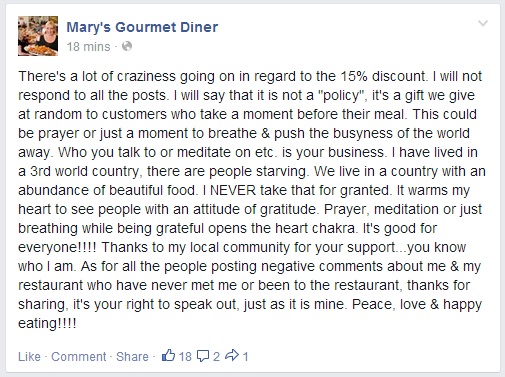
Well, apparently things heated up on Facebook thanks to all the attention, causing Mary to post the following on her business’ Facebook page:

MarysFB

Here’s the text in case that’s hard to read:

There’s a lot of craziness going on in regard to the 15% discount. I will not respond to all the posts. I will say that it is not a “policy”, it’s a gift we give at random to customers who take a moment before their meal. This could be prayer or just a moment to breathe & push the busyness of the world away. Who you talk to or meditate on etc. is your business. I have lived in a 3rd world country, there are people starving. We live in a country with an abundance of beautiful food. I NEVER take that for granted. It warms my heart to see people with an attitude of gratitude. Prayer, meditation or just breathing while being grateful opens the heart chakra. It’s good for everyone!!!! Thanks to my local community for your support…you know who I am. As for all the people posting negative comments about me & my restaurant who have never met me or been to the restaurant, thanks for sharing, it’s your right to speak out, just as it is mine. Peace, love & happy eating!!!!

It’s a sign of our times that doing almost anything positive can be turned into a negative. Sheesh.

We were talking about this at work and we all had the same thought before Mary posted on Facebook: if we know they’re giving 15% off just for praying we’d bow our heads in a heartbeat. Of course that kind of defeats the purpose, but I wonder how many people around Winston were thinking the same thing?

New Etiquette for the Always On Observers

Two recent articles highlight the side effect of "wearable computing" – personal cameras that automatically capture the world around us. First is this piece from a Wired writer describing his year as a Google Glass user:

My Glass experiences have left me a little wary of wearables because I’m never sure where they’re welcome. I’m not wearing my $1,500 face computer on public transit where there’s a good chance it might be yanked from my face. I won’t wear it out to dinner, because it seems as rude as holding a phone in my hand during a meal. I won’t wear it to a bar. I won’t wear it to a movie. I can’t wear it to the playground or my kid’s school because sometimes it scares children.

Next up is a piece in The Wall Street Journal about cameras you can clip to your shirt so they can take pictures automatically throughout the day:

But there's a cost to amassing so much photographic evidence. The tiny cameras made others uncomfortable when they found out they were being recorded. Some friends wouldn't hug me; gossiping colleagues kept asking, "Is that thing on?" These devices upset a fundamental (though arguably flawed) assumption that even in public, you aren't being recorded.

Makes you squirm, doesn't it? One reason I wanted to review these cameras is that this kind of technology isn't going away. "Always on" cameras are becoming popular in home electronics like the Xbox One and a new wave of streaming video security systems. Now you can buy cameras that attach to your wrist, ear, bike helmet and eyeglasses. They're also fast becoming part of the uniforms of cops, soldiers and doctors.

Both articles explore the positive utilities of these devices, but the authors also highlighted the discomfort that these things caused in people around them. It's not surprising when you think about how uncomfortable you'd be if someone were to just start snapping pictures of you with a traditional camera while you're out and about, but it's even more discomfiting when you realize that people can do it without you even knowing it. What this means is that in the very near future we're going to go through a societal learning stage about what will be the appropriate (polite?) way to use these new devices.

What's scary is that we still haven't mastered the etiquette for proper mobile phone usage and those things have been with us for 20 years! Hell, someone was shot and killed in Tampa this month because of dispute over texting in a movie theater, so it's a bit scary to think what we'll be seeing with these always-on cameras. Of course we'll figure it out eventually but there are going to be many uncomfortable moments until we do.

Today’s Teens’ Tepid Take on Transport

My kids, all three of them, have had an extraordinarily luke-warm attitude towards getting their driver's licenses and based on conversations I've had with some of their friends' parents they aren't the only ones. Sure there are still plenty of kids chomping at the bit to get their licenses the day they turn 16, but the percentage of kids who don't seem too excited about it seems much higher these days than when their parents were that age. Why is that? Netscape founder and venture capitalist Marc Andreessen might provide a clue in his answer to the question of why he's so excited about the potential of car-sharing services:

Ask a kid. Take teenagers 20 years ago and ask them would they rather have a car or a computer? And the answer would have been 100% of the time they'd rather have a car, because a car represents freedom, right?

Today, ask kids if they'd rather have a smartphone or a car if they had to pick and 100% would say smartphones. Because smartphones represent freedom. There's a huge social behavior reorientation that's already happening. And you can see it through that. And I'm not saying nobody can own cars. If people want to own cars, they can own cars. But there is a new generation coming where freedom is defined by "I can do anything I want, whenever I want. If I want a ride, I get a ride, but I don't have to worry. I don't have to make car payments. I don't have to worry about insurance. I have complete flexibility." That is freedom too.

While Andreessen is talking about the future of car sharing services (which by the way seem much more likely to succeed in dense urban environments than in small urban/sprawl environments like where my family lives) he's stumbled on an important influence on our kids today – they don't need cars to connect with their friends because they have smartphones, computers and game consoles to connect.  Sure their parents had phones, but with the exception of the lucky few who had their own phone lines in their bedrooms they had to share the phone with the rest of their families and had zero expectation of privacy. Today's kids don't just have private phone conversations they have the ability to have private video chats which their parents could only dream about 30 years ago.

In the case of our youngest, who is well into his 17th year of life and has no desire to get his license, he doesn't even have to leave the living room to play games with his friends. Thanks to Xbox Live he plays games with/against them all the time. His dad had to use that shared family phone to call his friends to coordinate a time to meet at the arcade to watch each other play Galactica. Once that beautiful day in the early 80s rolled around when he got his first Atari system he called his friends over so that could play Atari football head-to-head!

The point is that teens are decreasingly equating a driver's license with freedom. In fact our youngest has flat out said that he's dreading getting his license because he doesn't want the responsibility. On the other hand his dad is pushing him hard to get the damn license so he doesn't have to keep getting out of bed an hour earlier than normal in order to get the kid to school in time to catch the bus to the career center!

But I digress. There truly is a large behavioral shift going on with the younger members of our society. Thanks to the mortgage meltdown many young adults no longer assume that homeownership is all that their parents thought it was cracked up to be, and now that people have mobile networks at their disposal they're no longer socializing in the same way either. Of course kids will still want to get together to party and act like the fools they are, but how often they get together and how they get there is changing very quickly and those habits and patterns will last into their adult years. It'll be interesting to see how it all shakes out.

Playing Foursquare

Finally I'm seeing a payoff for the ridicule I've endured for continuing to use Foursquare.  I'm not really a hardcore user because I probably forget to check into places I visit about 50% of the time, but when I do check in I get one of two reactions if I'm with someone: if they're an "online" person they say "Are you still using that goofy service?" and if they're a Luddite they say "Is that another one of those stupid social media things you're into?" My reply is usually a shrug or I'll say, "Well sometimes I can get a discount." But all this time what I've really been hoping for is a way to track where I go and the kinds of places I prefer and finally Foursquare has come through with Time Machine.

FourSquareMap
This screenshot below is a map that shows my 1200+ checkins over the last few years and some graphs that show the kind of places I like visit. It won't surprise anyone who knows me that I really like coffee shops.

Here's what's really smart about it though: the time machine then asks if I want to see the future and then takes the opportunity to recommend places to visit based on my history. What I like about this is it highlights parts of Foursquare that I haven't used, didn't really realize I could use, and will now probably utilize. Basically they've helped me understand that this could be much more than just a gimicky, fun, service as Fred Wilson pointed out in his post about Time Machine:

I've been using Foursquare for about four years and have checked in almost 5,000 times. That's an average of 3.4x a day. No wonder Foursquare is so good at making recommendations for me when I am in places I don't know much about.

I plan on testing Foursquare's recommendations on my next trip. As I use the recommendations I'll probably realize that if I were to check in more often I would get even better recommendations, which will lead to more check ins, which will lead to better recommendations, etc.

Importance of Being an Information Omnivore

How much time do you spend at work looking at information that would be classified as outside the realm of your expertise or not part of your core job description? If your answer is "very little" then you could be setting yourself up for eventual failure or at a minimum unnecessarily limiting your ability to succeed. Why? Because you need to understand not just your world, but the universe in which your world exists.

If you need an example you need look no further than what has happened to many people in the newspaper industry. 15 years ago many newspapers were riding high, boasting fat profit margins and enjoying monopolies in their markets. Then they were blindsided by what the internet represented – a distributed network of information sharing that pushed them from the center of the daily information ecosystem. Should the folks working in the newspaper industry have seen it coming? In retrospect it's easy to say yes, but at the time the vast majority of them had not an inkling of what the internet/web was about and so could not conceive how they might be able to utilize it to beat their competition, much less prevent it from decimating their entire business.

But what if some of the senior newspaper execs had spent the late '80s or early '90s looking at the larger universe of information distribution, looking at their circulation operations as one form of information distribution and figuring out how these new forms of distribution could change their business? It's quite likely that some did, and surely there are publishers out there who can point back to efforts at starting fax-based updates, email alerts, etc. But how many truly took the time to understand the underlying shift in information flow, to grasp how the new technology would be adopted by their customers and how they might shift to meet those changing consumption patterns? It's pretty plain by the state of the industry today that not many succeeded if they tried.

Over the last few years the big shift for many industries has been the rapidly expanding adoption of smartphones (over 50% of the US market now uses smartphones), but anyone who's been paying attention has seen it coming and hopefully has been adjusting to address this new reality. But what's next? What's the next big shift in how we do business going to be? It could be something related to Bitcoin, and the why is explained by venture capitalist Fred Wilson in a blog post he wrote to explain his firm's investment in a company called Coinbase:

We believe that Bitcoin represents something fundamental and powerful, an open and distributed Internet peer to peer protocol for transferring purchasing power. It reminds us of SMTP, HTTP, RSS, and BitTorrent in its architecture and openness. Like what happened with those other low level protocols, entrepreneurs and developers are now building technology on top of Bitcoin to make it more useful, more accessible, and more secure.

This has the smell of something important because it could potentially change how companies exchange services for compensation. What's more fundamental to a business than that? More importantly, how much could something like that change your business? Well, how much did the wide adoption of credit cards change business 30+ years ago? But that only offers part of the answer since this feels like something that eases transactions like credit cards did, but expands the market like the web did.  And who could this new development threaten? The banks are a good bet.

So who thinks that bankers truly understand what this could represent? Sure, they see it and they think about it, but how many truly understand the tectonic shift going on beneath the surface. Probably not many, because you can bet there probably aren't many bankers who have stopped counting their money long enough to try and understand this "Bitcoin World" and they could suffer the fate that many newspapers have over the last ten years.

That's where the title of this post comes into play. It is vitally important for all of us to be information omnivores, because you must understand the larger context in which you're working and living. While you don't need to understand all the technology that underlies what we do, just like you don't have to know how an internal combustion engine works to understand the affect of cars, you do need to understand how their application and adoption will affect your business or your life. How do you do this? Simply by being curious. Watch TED talks, read articles in trade magazines from industries that aren't your own, read the blogs of experts in other fields, take a class at a local community college or take a free class from one of the online programs like Coursera. The possibilities are almost endless and even if you never apply the information you glean to your day job you'll know something you wouldn't have otherwise. Worst case scenario you'll probably get better at Trivial Pursuit and you'll be able to wow people at dinner parties with your amazing grasp of (seemingly) worthless knowledge. More likely you'll find that your newfound knowledge will come in handy in ways you never anticipated.

Who Owns Your Friends?

Here's an interesting tidbit from JimRomenesko.com about a reporter who had built a following on her Facebook and Twitter accounts, and what happened when the new owner of her station put in place a social media policy:

At this juncture, I am retaining ownership of my existingFacebook and Twitter pages. Therefore, the company has started new social media accounts in my name for me to use during work hours when I am covering stories. The company has administrative control over these accounts.

It would be easy to think this kind of thing only applies to businesses with "talents" like news organizations, theaters, etc., but that would be wrong. As social media in its varying forms becomes  ingrained in the way we do business, the question of who "owns" friends/followers will be as fundamental as who "owns" a salesperson's contact list.  Many companies avoid this problem by having only one official company Facebook page, Twitter account, LinkedIn page, etc. so there's no question about who "owns" those followers, but for those companies that decide to allow their employees to develop distinct social media presences as company representatives this is a vital consideration.

 You might wonder why any company would allow an employee to develop a distinct social media presence. After all, you'd think that would distract from the company's core social media property. That's a valid concern, but when you stop to consider what you pay people to do in the "real world" – attend industry conferences, develop sales channels, develop relationships with the trade media, etc. – why wouldn't you want them to do the same things via social media? If you're willing to embrace the messiness and chaos that this brings to your social media portfolio then you're likely to generate plenty of business through these efforts, but you also better be ready to protect your business by making it clear who "owns" those channels and the related followers/fans/friends.

Don’t Be a Grammar Goon

Tempted to make fun of someone on Facebook because he doesn't know the difference between lose and loose? Probably not a good idea, and it might actually mean you're a bit of a whank:

There was a time that it gave me a blush of pride to be referred to as “the Spelling Sergeant” or “the Punctuation Police”. I would gleefully tear a syntactic strip out of anybody who fell victim to the perils of poor parallelism or the menace of misplaced modifiers. I railed against atrostrophes and took a red pen to signs posted in staff rooms, bulletin boards and public washrooms. I was, to put it bluntly, really, really annoying…

So if I crap on Jonny’s spelling, I’m either reinforcing an oppressive status quo, or picking on a person with a disability, or both. And taking part in these kinds of insults, even when they’re directed at an Internet troll, encourages other people to participate in this kind of shaming. It’s frankly also pretty ineffective as a debate tactic. I’m not going to change Jonny’s mind, nor help him improve his writing abilities, by making fun of him. He may be a jerk because he’s never learned how to express himself in a healthy way, and I’m not doing much to help him. And reducing my arguments to the level of ad homonym attacks debases my own credibility – because if I have a valid point to make, I should be able to make it without resorting to pettiness. Furthermore, it is guaranteed that somewhere out there on the Interwebs, there is someone I agree with whose reasoned arguments are disparaged, dismissed or ignored because they come wrapped in a package of nonstandard language.

This is no trifling issue, either. I like to shock the new tutors I train by quoting statistics from theInternational Adult Literacy Survey. I ask them to estimate, in a developed country like Canada or the U.S., what percentage of the population has literacy skills below the very basic level needed to function well in our society. People usually guess ten percent, fifteen percent, maybe as much as twenty-five. Then I pull out the sad, stunning facts: nearly half of all North American adults cannot cope with complex written material of the sort that the other half of us take completely for granted. HALF, you guys. This should be considered anational crisis. Not fodder for sport.

The blog post that's the source of these opinions is titled Literacy Privilege: How I Learned to Check Mine Instead of Making Fun of People's Grammar on the Internet and it's well worth the read, if for no other reason than absorb the list of privileges we literate members of society enjoy. Here's a sample:

  • I can easily and safely navigate my way around the city I live in because I understand all of the posted signs, warnings and notifications.
  • I can make healthy and informed choices about the products I purchase because I can accurately read their labels and price tags.
  • I can safely use pharmaceuticals prescribed to me without having to remember the doctor’s or pharmacist’s instructions because I can accurately read their labels.
  • When required to visit doctors, hospitals, government agencies, banks, or legal offices, I do not have to invent excuses to bring paperwork home so that someone else can read it to me. If I live alone, I do not have to expose myself to judgement and ridicule by asking the doctor, nurse, agent, clerk, lawyer or other employee to read it to me.
  • I can independently make informed medical, legal, political and financial decisions about myself and my family because I can read and understand important documents.

The companion pieces to this post are also well worth the read. You can find them here and there.

The Ultimate Water Cooler

An interesting quote from the editor of Details in an interview about what he reads:

Once I get into the office and turn on my computer, I actually go to Twitter first thing. I'm not terribly prolific, but I like to see what’s trending. If you go to CNN.com, or any news outlet, they’re controlling what you’re seeing. On Twitter, it’s a worldwide list of what’s trending, and that’s interesting. I hunt and peck by subject—I don’t follow that many people—you can do it sort of mindlessly. If I see a name or subject, I'm curious as to why it's trending, and it’s a guessing game I play with myself before I click through to see what it is. It represents the ultimate water cooler: anything from a sports figure to a political figure to a celebrity to a cause to "I’m a Belieber," whatever it is. That's my first conversation of the day, eavesdropping on this great global discussion.

Social Media Political Derangement Syndrome

Every four years we have to suffer through a Presidential campaign, but in the era of social media the agony has truly been heightened to an almost unbearable level. Not only do we have to listen to candidates and pundits, now we have to bear our (supposed) friends sharing their own, often wharped, views about the various candidates and their supporters. I have to admit I kind of snapped this morning and wrote this on Facebook:

An interpretation of modern American politics based on extensive reading of my friends' Facebook and Twitter posts – in four paragraphs:

Give a man a fish and you feed him for a day. Teach a man to fish and you feed him for a lifetime.

Teach a Republican to fish and he hires all the non-union fishermen, pays them minimum wage, decimates the fishery, ships the entire catch to the Cayman Islands and has them stored in a secret freezer. He keeps a small portion in the states to live off of day-to-day and pays capital gains on it. Fires all the fishermen and figures out a way to get more fish in China. Blame the lack of fish in American waters on the Godless Democrats' turning us into a non-Christian nation and hope that no one has actually read the Bill of Rights.

Teach a Democrat to fish and he establishes a Department of Fishing, writes 3,425 pages of regulations, hires all the fishermen, pays them so-so wages but gives them killer pensions, accidentally decimates the fishery and taxes the cattlemen to help pay for the clean up. When they get mad he starts talking about rising tides lifting all boats, but gets distracted and starts blaming the Republicans for global warming. 

The Green Party candidate doesn't eat fish so he fries up some tofu and calls the Democrat and Republican mean names.

Admittedly it's not very witty, nor very inciteful, but it made me feel better. Sure, I could turn off social media, but then I'd lose out on this unprecedented opportunity to learn exactly how wharped many of my "friends" are.