Category Archives: Education

Importance of Being an Information Omnivore

How much time do you spend at work looking at information that would be classified as outside the realm of your expertise or not part of your core job description? If your answer is "very little" then you could be setting yourself up for eventual failure or at a minimum unnecessarily limiting your ability to succeed. Why? Because you need to understand not just your world, but the universe in which your world exists.

If you need an example you need look no further than what has happened to many people in the newspaper industry. 15 years ago many newspapers were riding high, boasting fat profit margins and enjoying monopolies in their markets. Then they were blindsided by what the internet represented – a distributed network of information sharing that pushed them from the center of the daily information ecosystem. Should the folks working in the newspaper industry have seen it coming? In retrospect it's easy to say yes, but at the time the vast majority of them had not an inkling of what the internet/web was about and so could not conceive how they might be able to utilize it to beat their competition, much less prevent it from decimating their entire business.

But what if some of the senior newspaper execs had spent the late '80s or early '90s looking at the larger universe of information distribution, looking at their circulation operations as one form of information distribution and figuring out how these new forms of distribution could change their business? It's quite likely that some did, and surely there are publishers out there who can point back to efforts at starting fax-based updates, email alerts, etc. But how many truly took the time to understand the underlying shift in information flow, to grasp how the new technology would be adopted by their customers and how they might shift to meet those changing consumption patterns? It's pretty plain by the state of the industry today that not many succeeded if they tried.

Over the last few years the big shift for many industries has been the rapidly expanding adoption of smartphones (over 50% of the US market now uses smartphones), but anyone who's been paying attention has seen it coming and hopefully has been adjusting to address this new reality. But what's next? What's the next big shift in how we do business going to be? It could be something related to Bitcoin, and the why is explained by venture capitalist Fred Wilson in a blog post he wrote to explain his firm's investment in a company called Coinbase:

We believe that Bitcoin represents something fundamental and powerful, an open and distributed Internet peer to peer protocol for transferring purchasing power. It reminds us of SMTP, HTTP, RSS, and BitTorrent in its architecture and openness. Like what happened with those other low level protocols, entrepreneurs and developers are now building technology on top of Bitcoin to make it more useful, more accessible, and more secure.

This has the smell of something important because it could potentially change how companies exchange services for compensation. What's more fundamental to a business than that? More importantly, how much could something like that change your business? Well, how much did the wide adoption of credit cards change business 30+ years ago? But that only offers part of the answer since this feels like something that eases transactions like credit cards did, but expands the market like the web did.  And who could this new development threaten? The banks are a good bet.

So who thinks that bankers truly understand what this could represent? Sure, they see it and they think about it, but how many truly understand the tectonic shift going on beneath the surface. Probably not many, because you can bet there probably aren't many bankers who have stopped counting their money long enough to try and understand this "Bitcoin World" and they could suffer the fate that many newspapers have over the last ten years.

That's where the title of this post comes into play. It is vitally important for all of us to be information omnivores, because you must understand the larger context in which you're working and living. While you don't need to understand all the technology that underlies what we do, just like you don't have to know how an internal combustion engine works to understand the affect of cars, you do need to understand how their application and adoption will affect your business or your life. How do you do this? Simply by being curious. Watch TED talks, read articles in trade magazines from industries that aren't your own, read the blogs of experts in other fields, take a class at a local community college or take a free class from one of the online programs like Coursera. The possibilities are almost endless and even if you never apply the information you glean to your day job you'll know something you wouldn't have otherwise. Worst case scenario you'll probably get better at Trivial Pursuit and you'll be able to wow people at dinner parties with your amazing grasp of (seemingly) worthless knowledge. More likely you'll find that your newfound knowledge will come in handy in ways you never anticipated.

Student Privacy Concerns Raised for Tech Project Tied to Guilford County Schools

inBloom is a tech project funded largely by the Bill & Melinda Gates foundation that is seeking to improve education through data.  One of the school districts participating in the project is Guilford County Schools.  The inBloom initiative was announced about two months ago by what was then called the Social Learning Collaborative. Now that inBloom has been out there a while it's starting to get some attention from parents and advocates, and they aren't real keen on what they're finding as it relates to their children's privacy. There's some noise being made by some folks in New York (more about that below), but so far it doesn't seem to be of concern to anyone in Guilford County. 

Before we get to the privacy issue let's look at what inBloom is trying to do. Here's what you find on the inBloom "Vision" page of its website:

inBloom is dedicated to bringing together the data, content and tools educators need to make personalized learning a reality for every student. To achieve this vision, inBloom:

  • Offers states and districts a secure technology infrastructure to integrate data, services and applications that work together to support personalized learning.
  • Partners with education technology companies, content providers and developers to support the creation of products compatible with this infrastructure.
  • Works with states and districts to help them use this infrastructure to support educators and students.

Seems like a worthy pursuit and they go on to stress on the same webpage that "We recognize the sensitivity of storing student data and place the utmost importance on the privacy and security of that data." They have a full page dedicated to their privacy commitment.

Well as mentioned above some folks in New York aren't satisfied with inBlooms assurances. From the Village Voice:

Parents and advocates opposed to the new initiative believe it will put sensitive student information at risk and allow companies to capitalize on data that parents never consented to release.

The New York State Education Department says that districts have been sharing this kind of information for nearly a decade, and that the new initiative simply enables that data to be shared in a safer, more efficient fashion…

Disciplinary records, attendance records, special-needs records, testing records, addresses, phones numbers, email-addresses and birth-dates are among some of the data that can be shared with the third-party vendors contracting with state and city districts.

Opponents of inBloom are outraged by the prospect of corporations profiting from student information that parents never consented to release…

NYSED has a different take.
 
"I'm not sure there's consent involved. This is regular student information that when parents register a child for school. They give up," Tom Dunn, spokesman for NYSED tells the Voice.  

New things are always scary, especially to parents. Most parents understand that to a degree their childrens' information is "public" as soon as they enter the school system, but they also are accustomed to getting those release forms from school that say it's okay to use their childrens' images from a school event on the website, or if a reporter is going to be at the school for an event the parents get a form asking for permission for their child's name to be used. Thus it is entirely reasonable for parents to be upset if they find out after the fact that their childrens' personal info is being used without them proactively giving their permission.

It's also reasonable for parents to be worried because there are private, third-party vendors involved. Given the raft of data breaches at credit card companies, banks, governmental agencies and other entities entrusted with our personal info you can understand how parents might feel their children are being made vulnerable by this kind of program.

Even if the goal of the program is noble, and the intent pure, it would behoove the participating school districts to aggressively inform the parents and public of what they're doing with the students' information even if they aren't required to by law. That would go a long way towards a successful implementation of the program, and quite frankly it might be critical to the success of the program. If parents don't buy in, or actively try to opt out on behalf of their children, then the program's doomed to failure anyway so the schools might as well get buy in from the get-go.

I’ll See Your Bible and Raise You a Torah

There's a proposed bill in the NC senate (SB 138) that would allow local school boards to offer elective courses in Bible study at their high schools.  This would probably cause some consternation with folks who see this kind of thing as violating the separation of church and state, but quite honestly if it's an elective that seems to be a bit of a stretch. On the other hand it does seem to put the state in the position of favoring one religion over others since it doesn't include other religious texts like the Torah or the Koran.

If the intent of the course is not to indoctrinate students but to study how the the Bible has influenced society then it could be seen as a legitimate educational effort rather than an effort to indoctrinate non-religious or non-Christian students.  And if that's the case then why not write the bill so that school's could offer similar courses to study the Torah, the Koran or other religious texts that have obviously had a tremendous impact on our world? 

Perhaps it would be helpful to look at the text of the bill to see if we can discern the intent. Here it is:

A BILL TO BE ENTITLED
2 AN ACT TO PROVIDE FOR LOCAL BOARDS OF EDUCATION TO OFFER TO
3 STUDENTS IN GRADES NINE THROUGH TWELVE AN ELECTIVE COURSE IN
4 BIBLE STUDY.
5 The General Assembly of North Carolina enacts:
6 SECTION 1. G.S. 115C-81 is amended by adding a new subsection to read:
7 "(g4) Bible Study Elective. – Local boards of education may offer to students in grades
8 nine through 12 elective courses for credit on the Hebrew scriptures (Old Testament), the New
9 Testament, or a combination of the two subject matters. A student shall not be required to use a
10 specific translation as the sole text of the Hebrew scriptures or New Testament and may use as
11 the basic textbook a different translation of the Hebrew scriptures or New Testament approved
12 by the local board of education or the principal of the student's school. A course offered by a
13 local board of education in accordance with this subsection shall (i) follow federal and State
14 law in maintaining religious neutrality and accommodating the diverse religious views,
15 traditions, and perspectives of the students of the local school administrative unit and (ii) not
16 endorse, favor or promote, or disfavor or show hostility toward any particular religion,
17 nonreligious faith, or religious perspective. Courses may include the following instruction:
18 (1) Knowledge of biblical content, characters, poetry, and narratives that are
19 prerequisites to understanding contemporary society and culture, including
20 literature, art, music, mores, oratories, and public policies.
21 (2) Familiarity with the contents, history, style, structure, and societal influence
22 of the Hebrew scriptures or the New Testament."
23 SECTION 2. This act is effective when it becomes law and applies beginning with
24 the 2013-2014 school year.

At first blush it seems innocuous enough, but you still have to ask why other prominent religious texts aren't included.  By not including them it's easy to see how people would assume the underlying intent is to introduce Christianity to the public schools, and as mentioned before it definitely seems to put the state in the position of favoring one religion over another.

Let's end with a fun scenario game:

  1. Bill becomes law.
  2. School district decides to offer Bible elective at its high schools.
  3. Two-thirds of the way through the course a teacher, who's a Baptist, goes out on maternity leave and the replacement teacher is a Mormon.
  4. Parents of several students demand either a different teacher be assigned to the course or that their children be allowed to transfer out of the class without penalty. Their argument is that they don't want their children being fed "lies" by that "cultist."

Wouldn't it be fun to be a fly on the wall of the principal's office that day.
Related articles

Bill would create Bible study elective for high schools

Class Participation is Overrated

For those who hated "class participation" in school and didn't understand why tests couldn't be 100% of their grade, this story in the Wall Street Journal is wonderful news:

David Lando plans to start working toward a diploma from the University of Wisconsin this fall, but he doesn't intend to set foot on campus or even take a single online course offered by the school's well-regarded faculty.

Instead, he will sit through hours of testing at his home computer in Milwaukee under a new program that promises to award a bachelor's degree based on knowledge—not just class time or credits…

Wisconsin officials tout the UW Flexible Option as the first to offer multiple, competency-based bachelor's degrees from a public university system. Officials encourage students to complete their education independently through online courses, which have grown in popularity through efforts by companies such as Coursera, edX and Udacity.


No classroom time is required under the Wisconsin program except for clinical or practicum work for certain degrees.


Reading, Writing, ‘Rithmetic…and Coding

Last week I sent my mom a link to the registration page for TEDxWakeForestU (she's a Wake Forest alumnus) and she and I were discussing it during a visit this past weekend. Others in our group asked what TEDx was, so I tried to describe the TED concept and the TEDx extension of it, but really failed quite miserably. That's one reason I was ecstatic to stumble across this video from TEDxBeaconStreet; it provides a great example of the TEDx format that I can send my mom so she can share it. The other reason is that the presentation is about the intersection of technology and education – something my mom's passionate about and thus I'm guaranteed she'll find the presentation fascinating.

Hopefully you will too:

What’s Your School Spending?

The Triangle Business Journal has a nice slideshow that highlights how much each school in the NC university system spends per degree conferred in 2011-12. Here's a handy-dandy list, by school, of the amount spent per degree and the number of degrees conferred:

  1. UNC School of the Arts – $115,840 (300)
  2. UNC-Chapel Hill – $115,376 (7,630)
  3. Elizabeth City State – $114,652 (429)
  4. NC Central – $82,547 (1,521)
  5. NC A&T – $78,160 (1,665)
  6. UNC-Asheville – $66,898 (723)
  7. Winston-Salem State – $61,797 (1,472)
  8. UNC-Pembroke – $61,475 (1,119)
  9. East Carolina – $61,024 (6,009)
  10. NC State – $59,408 (8,347)
  11. Fayetteville State – $59,370 (1,151)
  12. UNC-Greensboro – $55,593 (3,977)
  13. UNC-Charlotte – $50,609 (5,294)
  14. Appalachian State – $45,630 (4,246)
  15. UNC-Wilmington – $44,854 (3,189)
  16. Western Carolina – $44,383 (2,375)

FYI, the system average was $66,540 per degree and the number of degrees conferred system-wide was 49,447.

So I Just Enrolled in a Course at Cal-Berkeley (Kind Of)

With two kids in college I'm offered many, many opportunities to recall my own years in school. One of my biggest regrets about how I approached my education is that I saw it as something I needed to do in order to not disappoint my parents, to set myself up for a decent job/career, and to have lots of fun partying in the process. I didn't approach it the way I would now – as an opportunity to learn about interesting topics from people who have spent their lives becoming experts on those topics. 

Luckily for me there's a relatively new development in the world of higher education – massive open online courses (MOOCs).  From a story in the Wall Street Journal:  

Professor Jeremy Adelman has taught a world-history class at Princeton University for several years, but as he led about 60 students through 700 years of history on the ivy-covered campus this past fall, one thing was different: Another 89,000 students tuned into his lectures free of charge via Coursera, an online platform.

Those kinds of numbers, and their potential for remaking higher education, have generated plenty of excitement about massive open online courses—dubbed MOOCs. They've also lured venture investors and universities, who have put millions of dollars into companies like Udacity, Coursera and edX, which partner with schools or instructors to offer these courses.

So here I am in my middle years, 25 years removed from my last fling with higher education, and I have the change to learn at the (digital) knees of some of the finest professors from the finest universities in the land. I'm sticking my toe in the water by taking the "Introduction to Statistics" course offered by University of California-Berkeley on edX. Why stats? It and Finance are the two courses I actively avoided taking in school because they were "hard" and I've regretted it on oh-so-many occassions during my career.  Later on I'm hoping to dabble in some courses in various other areas that strike my fancy, and to be honest I'm as excited about this as I've been about anything in a long time.

If you're interested here are the four MOOC resources listed in the Journal story:

Don’t Be a Grammar Goon

Tempted to make fun of someone on Facebook because he doesn't know the difference between lose and loose? Probably not a good idea, and it might actually mean you're a bit of a whank:

There was a time that it gave me a blush of pride to be referred to as “the Spelling Sergeant” or “the Punctuation Police”. I would gleefully tear a syntactic strip out of anybody who fell victim to the perils of poor parallelism or the menace of misplaced modifiers. I railed against atrostrophes and took a red pen to signs posted in staff rooms, bulletin boards and public washrooms. I was, to put it bluntly, really, really annoying…

So if I crap on Jonny’s spelling, I’m either reinforcing an oppressive status quo, or picking on a person with a disability, or both. And taking part in these kinds of insults, even when they’re directed at an Internet troll, encourages other people to participate in this kind of shaming. It’s frankly also pretty ineffective as a debate tactic. I’m not going to change Jonny’s mind, nor help him improve his writing abilities, by making fun of him. He may be a jerk because he’s never learned how to express himself in a healthy way, and I’m not doing much to help him. And reducing my arguments to the level of ad homonym attacks debases my own credibility – because if I have a valid point to make, I should be able to make it without resorting to pettiness. Furthermore, it is guaranteed that somewhere out there on the Interwebs, there is someone I agree with whose reasoned arguments are disparaged, dismissed or ignored because they come wrapped in a package of nonstandard language.

This is no trifling issue, either. I like to shock the new tutors I train by quoting statistics from theInternational Adult Literacy Survey. I ask them to estimate, in a developed country like Canada or the U.S., what percentage of the population has literacy skills below the very basic level needed to function well in our society. People usually guess ten percent, fifteen percent, maybe as much as twenty-five. Then I pull out the sad, stunning facts: nearly half of all North American adults cannot cope with complex written material of the sort that the other half of us take completely for granted. HALF, you guys. This should be considered anational crisis. Not fodder for sport.

The blog post that's the source of these opinions is titled Literacy Privilege: How I Learned to Check Mine Instead of Making Fun of People's Grammar on the Internet and it's well worth the read, if for no other reason than absorb the list of privileges we literate members of society enjoy. Here's a sample:

  • I can easily and safely navigate my way around the city I live in because I understand all of the posted signs, warnings and notifications.
  • I can make healthy and informed choices about the products I purchase because I can accurately read their labels and price tags.
  • I can safely use pharmaceuticals prescribed to me without having to remember the doctor’s or pharmacist’s instructions because I can accurately read their labels.
  • When required to visit doctors, hospitals, government agencies, banks, or legal offices, I do not have to invent excuses to bring paperwork home so that someone else can read it to me. If I live alone, I do not have to expose myself to judgement and ridicule by asking the doctor, nurse, agent, clerk, lawyer or other employee to read it to me.
  • I can independently make informed medical, legal, political and financial decisions about myself and my family because I can read and understand important documents.

The companion pieces to this post are also well worth the read. You can find them here and there.

US Student Loan Debt Up 814% Since 2001

GrowthOfDebt

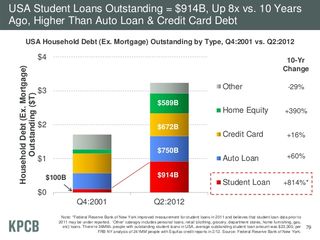
Mary Meeker of Kleiner Perkins Caufield & Byers, does an annual "Internet Trends" presentation, and this year's slide deck can be found here. Included in her presentation is an amazing graphic (slide 79 of 88) that you can see above; it shows how the share of US consumer debt has changed from the 4th quarter of 2001 to the 2nd quarter of 2012.

It is absolutely stunning how much – and how quickly – student debt has grown in this country. From $100 billion in 2001 to $914 billion in 2012 is an 814% increase in just a decade. The next fastest growth category is "home equity" at 390% and it wouldn't be a stretch to say that at least some of that is attributable to parents taking out home equity to pay for the kids' college tuition, so it's conceivable that education is responsible for even more debt than is being reflected by this graph.

One has to wonder – has higher education delivered a return that can possibly justify such massive debt?