Category Archives: Economics

US Student Loan Debt Up 814% Since 2001

GrowthOfDebt

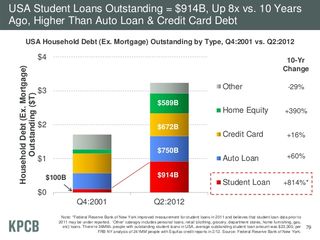
Mary Meeker of Kleiner Perkins Caufield & Byers, does an annual "Internet Trends" presentation, and this year's slide deck can be found here. Included in her presentation is an amazing graphic (slide 79 of 88) that you can see above; it shows how the share of US consumer debt has changed from the 4th quarter of 2001 to the 2nd quarter of 2012.

It is absolutely stunning how much – and how quickly – student debt has grown in this country. From $100 billion in 2001 to $914 billion in 2012 is an 814% increase in just a decade. The next fastest growth category is "home equity" at 390% and it wouldn't be a stretch to say that at least some of that is attributable to parents taking out home equity to pay for the kids' college tuition, so it's conceivable that education is responsible for even more debt than is being reflected by this graph.

One has to wonder – has higher education delivered a return that can possibly justify such massive debt?

I Don’t Remember

Those of us with children have had countless conversations with them that went something like this:

Parent: Why did you <insert some inexplicably stupid act>?

Child: I don't know.

Parent: What were you thinking?

Child: I don't remember.

Apparently the CEO of Bank of America is very much like a child:

In the case of Bank of America, MBIA has long wanted to depose Moynihan because it was precisely Moynihan who went public with comments about how B of A was going to make good on the errors made by its bad-seed acquisition, Countrywide. "At the end of the day, we'll pay for the things Countrywide did," was one such comment Moynihan made, in November of 2010.

As it turns out, Moynihan was deposed last May 2. But the deposition was only made public this week, when it was filed as an exhibit in a motion for summary judgment. In the deposition, attorney Peter Calamari of Quinn Emmanuel, representing MBIA, attempts to ask Moynihan a series of questions about what exactly Bank of America knew about Countrywide's operations at various points in time…

Early on, he asks Moynihan if he remembers the B of A audit committee discussing Countrywide. Moynihan says he "doesn't recall any specific discussion of it."

He's asked again: In the broadest conceivable sense, do you recall ever attending an audit committee meeting where the word Countrywide or any aspect of the Countrywide transaction was ever discussed? Moynihan: I don't recall.

Calamari counters: It's a multi-billion dollar acquisition, was it not? 
Moynihan: Yes, it was. Well, isn't that the kind of thing you would talk about? 
Moynihan: not necessarily . . .

The exasperated MBIA lawyer tries again: If it's true that Moynihan somehow managed to not know anything about the bank's most important and most problematic subsidiary when he became CEO, well, did he ever make an effort to correct that ignorance?  "Do you ever come to learn what CFC was doing?" is how the question is posed.

"I'm not sure that I recall exactly what CFC was doing versus other parts," Moynihan sagely concludes.

The deposition rolls on like this for 223 agonizing pages. The entire time, the Bank of America CEO presents himself as a Being There-esque cipher who was placed in charge of a Too-Big-To-Fail global banking giant by some kind of historical accident beyond his control, and appears to know little to nothing at all about the business he is running.

In the end, Moynihan even doubles back on his "we'll pay for the things Countrywide did" quote. Asked if he said that to a Bloomberg reporter, Moynihan says he doesn't remember that either, though he guesses the reporter got it right.

Well, he's asked, assuming he did say it, does the quote accurately reflect Moynihan's opinion?

"It is what it is," Moynihan says philosophically.

(H/T to Lex for linking to this).


Credit Where Credit is Due

Remember "It's the economy stupid?" The first President Bush certainly does, because that phrase famously summed up the soon-to-be President Clinton's campaign focus in beating him. Here's the thing – Clinton ended up getting too much credit for the economic recovery that occurred during his first term, and Bush-the-first didn't get enough credit for making the tough and politically disastrous policy decisions that kick started the recovery in the first place.

Why bring that up now? Because it's interesting to see how President Obama is blamed for things that he literally has no control over, like high gas prices, but gets no credit for things he had a direct hand in, like an improving economy. He is also being criticized for budget deficits that were largely made necessary by the policy decisions of his predecessor, President Bush-the-second. Could Obama have made policy choices that kept the deficit from growing as much as it did in his first term? Sure, but many economists think that would have been much worse for the economic recovery we're seeing. In fact some argue that his policies weren't aggressive enough – that larger short-term deficits might have led to a faster, steeper economic recovery. 

What further complicates the issue in this election cycle is that President Obama came into office as the US economy was in an unprecedented-in-our-lifetime freefall. In the same way that it's difficult to prove a negative, it's also difficult for a sitting President prove that the economy could have been in worse shape if his policies had been different. Quite frankly it's easier for a challenger to say that things could/should have been much better and that it's the President's fault that they aren't; he literally doesn't have to prove it since it's a matter of opinion.  That's how Clinton took out Bush Sr. and that's how Romney is trying to take out Obama. 

It remains to be seen if the recent economic improvement will be enough to convince voters that Obama is worth keeping around. If it's not, Romney will inheret a growing economy and unless he really screws up he'll be given far more credit for it than he deserves.

Where Efficiency Goes to Die

"Baumol's disease" provides an interesting explanation for why service businesses like health care can only be so efficient. Can they be more efficient than they currently are? Absolutely, but any improvements made will not bring delivery costs down to the levels found on the product side of our economy. From Steven Pearlstein's column in the Washington Post:

No matter how innovative people were in coming up with new technology and new ways of organizing their work, Baumol and Bowen reasoned, it would still take a pianist the same 23 minutes to play a Mozart sonata, a barber 20 minutes to cut the hair of the average customer and a first-grade teacher 12 minutes to read her class “Green Eggs and Ham.” Based on this observation, the duo predicted that the cost of education and health care would inevitably outstrip the price of almost everything else.

Now, 50 years later, Baumol has updated and expanded his observation with a new book,“The Cost Disease,” which sheds some useful light on our current economic debate.

The basic facts are well-known to most Americans: Over the past 30 years, overall prices have risen 110 percent, median income has risen 150 percent, medical costs have risen 250 percent and college tuitions have risen 440 percent.

To hear the politicians talk, you’d think the rise in tuitions and medical costs was an American phenomenon. But as Baumol points out, the growth rates are pretty consistent across all developed countries.

The whole column is an interesting read, and I would be remiss if I didn't point out that Pearlstein's the Robinson Professor of Political and International affairs at my alma mater, George Mason University

Drunken Gas

Has anyone else seen all those social media posts blaming the high price of gas on President Obama? Experts have pointed out that the causes for the rise and fall of gas prices are complex and have little to do with the President, but that doesn't seem to deter people from believing what they want to believe. Here's an interesting story that might help persuade some folks that the President, or anyone else for that matter, is really in control of the oil industry:

On June 30, 2009, oil mysteriously jumped by more than $1.50 a barrel during the night, to reach its highest price in eight months, the kind of swing that is caused by a major geopolitical event…

Although not authorized to invest company cash in trades, Steve Perkins, a long standing, senior broker at PVM Oil Futures, had managed to spend $520 million on oil futures contracts throughout the night, the FSA said.

On the morning of the 30th, an admin clerk called Perkins to ask why he had bought 7 million barrels of crude during the night. Perkins had no recollection of the transactions, and it turned out that he had made the trades during a “drunken blackout," according to the FSA.

By the time PVM realized the transactions had not been authorized by a client, they had incurred losses of $9,763,252.

Between the hours of 1:22 a.m. and 3:41 a.m., Perkins gradually bought 69 percent of the global market, while driving prices up from $71.40 to $73.05, by bidding higher each time.

Here's the crazy thing: the authorities only suspended this guy's trading license for five years and said they might give it back if he can prove he's conquered his drinking problem. If this is how the world works how can any one leader be held responsible for the outcome? The inmates are truly running the asylum.

Foreclosure Blossom

Check out this interesting animated map showing how foreclosures exploded in the United States on a county-by-county basis. Interesting, but not surprising to folks in the Piedmont Triad, is the fact that the number of foreclosures in the area was already depressingly high in January '07, before the housing crisis hit most of the rest of the country. For instance in Forsyth County 1 in 837 homes was in foreclosure in January '07, and 1 in 549 in July '12. As you'll see when you look at the map, many other regions started out in better shape than the Triad, but quickly caught up as the economy tanked.

This Ain’t Your Dad’s Wall Street

Mark Cuban does a great job explaining why Wall Street is no longer the economic engine it once was:

Over just the past 5 years, the market has changed. It is getting increasingly difficult to just invest in companies you believe in. Discussion in the market place is not about the performance of specific companies and their returns. Discussion is about macro issues that impact all stocks. And those macro issues impact automated trading decisions, which impact any and every stock that is part of any and every index or ETF.  Combine that with the leverage of derivatives tracking companies,  indexes and other packages or the leveraged ETFs, and individual stocks become pawns in a much bigger game than I feel increasingly less  comfortable playing. It is a game fraught with ever increasing risk.

So back to the original question. What business is Wall Street in ?

Its primary business is no longer creating capital for business. Creating capital for business has to be less than 1pct of the volume on Wall Street in any given period. (I would be curious if anyone out there knows what percentage of transactions actually return money to a company for any reason). It wouldn’t shock me that even in this environment that more money flows from companies to the market in the form of buybacks (which i think are always a mistake), than flows into companies in the form of equity.

He then offers up some ideas about how to return Wall Street to its original role:

My 2 cents is that it is important for this country to push Wall Street back to the business of creating capital for business.  Whether its through a use of taxes on trades(hit every trade on a stock held less than 1 hour with a 10c tax and all these problems go away), or changing the capital gains tax structure so that there is no capital gains tax on any shares of stock (private or public company) held for 1 year or more, and no tax on dividends paid to shareholders who have held stock in the company for more than 5 years.  However we need to do it, we need to get the smart money on Wall Street back to thinking about ways to use their capital to help start and grow companies. That is what will create jobs. That is where we will find the next big thing that will accelerate the world economy.  It won’t come from traders trying to hack the financial system for a few pennies per trade.

The Incredible Shrinking Middle

One of the underexplored aspects of the current unemployment situation in North Carolina is the movement of people from adequate paying jobs to under paying jobs. A study by the NC Justice Center makes it vividly clear:

The nonprofit group determined there were 356,000 more working-age adults employed in the state in 2001 than in 2010, with manufacturing taking the brunt of the job decline.

The state lost 380,000 jobs in that period, with about 75 percent concentrated in industries with average hourly wages that enabled individuals and families to stay above the living income standard. A family of four needed to earn at least $23.47 an hour in 2010 to have enough money to meet basic expenses, according to N.C. state government standards.

The state's manufacturing workforce, which paid an average of $25.30 an hour, fell by 38 percent during the 10-year period. Manufacturing accounted for 72 percent of the state's job losses…

Where North Carolina did have job growth, it mostly came in low-wage industry sectors, the group said. About 83 percent of the job growth came with average wages of less than the $23.47-an-hour living income standard for a family of four.

For example, 15 percent of the state's job growth from 2001 to 2010 came in the food-services and accommodation sectors, which paid $7.15 an hour.

The state's median household income dropped 9.4 percent during the decade, or from $47,823 in 2001 to $43,326 in 2010.

The center found the number of North Carolinians living in poverty – $22,314 annual income for a family of four – rose by 24.1 percent during the decade.

In a nutshell the middle class is shrinking, and not from upward mobility. You would think that would lead to an outcry against the "corporate class," but outside of a little wrist-slapping at the height of the economic meltdown it just hasn't happened. That's what makes this interview of Mike Lofgren by Bill Moyers so easy to believe (h/t Fec for the link). For those of you expecting an anti-Republican screed you'll be disappointed – he basically argues that both parties have been captured by the corporate class. Enjoy:

Slow Money

Responding to a piece in the New York Times about bypassing Wall Street with investment dollars,  AVC's Fred Wilson describes how he and his wife have abandoned Wall Street and have concentrated on investing in businesses they can feel, touch and understand:

We are in cash, real estate, venture capital, and private investments centered around our neighborhood and city (retail, restaurants, etc). Other than cash, we are invested in things we can touch and/or impact and understand.

As Ron talks about at the start of his piece, the never ending blowups on wall street are eroding confidence in that system. It certainly has eroded our confidence in that system. So we are staying out of it for the most part.

And he describes a movement he calls Slow Money described in this way:

“Let’s just take some of our money and invest it near where we live in things we understand, starting with food,” as the movement’s founder, Woody Tasch, puts it. He describes returns as being in the “lowish single digits,” ranging from roughly 3 percent to a few percentage points higher…

As one system seems to be failing on a regular basis, it makes sense that there are new systems that operate differently that are emerging. 

Wouldn't it be sweet justice if the titans of Wall Street were put in their place not by the toothless-so-far government regulators, but by the free market they so stridently defend but seem to only believe in if it's rigged in their favor? 

Fleecing the Financiers

How bad are the reputations of bankers and financiers these days? Bad enough that when you see news stories about bad things happening to them you experience a level of schadenfreude that almost can't be described. To wit:

Case 1: Banks desperate for money falling for scams that used to only work on people who believed a prince in Africa would reach out to them for help.

Case 2: A large trading firm almost bankrupting itself in one day thanks to some faulty computer code.

Here's a fun game: see if you can find one person who actually sympathizes with these folks.