Author Archives: Jon Lowder

Addressing Homelessness

At the day job I work for a trade association that represents the apartment industry, thus the companies I work with are on the front lines of our nation’s housing situation. You may not be aware of it, but we do indeed have a housing situation that can be best summed up as this: we have too many people who don’t make enough money to pay for the housing that’s available, and/or we don’t have enough housing units that are affordable for people at the bottom of the income scale. Even worse, we have a LOT of people who, thanks to any number of life events, lose their housing and thus end up living in flop houses, cars, tents or under a bridge.

Because apartment owners and managers provide over a third of the housing in the U.S, and a majority of the rental housing, they are often looked to for a solution to the problem of affordability and homelessness. It would be great if they could snap their fingers and solve the problem, but due to the complexity of the issue (static income, increases in the costs of everything from health care to food, lack of housing inventory in general, etc.) this is not something housing providers can solve on their own. That’s not to say that people in the industry aren’t trying, and a perfect example is a woman named Lori Trainer who has been working for years down in Florida to address homelessness in her community. (Here’s a link to a video about some of her work, and I’ll embed it below as well). She just wrote an article for Multifamily Insiders titled The Story Behind the Sign that helps put homelessness in perspective. Here’s an excerpt:

We’ve all seen the homeless person with the sign on the side of the road and when we do, many people think these thoughts.    What the people offering these judgments don’t realize is that the overwhelming majority of people don’t “choose” to be homeless.  In fact, nearly 50% of the homeless in America are working.  Why are they homeless then?  Well, that is the “564,788 person question” (the number of homeless on the street each night according to the National Alliance to End Homelessness).

The causes of homelessness range from sad to tragic.  Job loss, foreclosures, divorce and natural disasters such as the tragedies we are seeing in the Midwest and in Canada are a few examples.  These storm victims certainly didn’t choose to be homeless or do anything wrong but they are indeed homeless now.  If their insurance isn’t perfect, takes a year to work out the details or worse yet, doesn’t pay, what do those families do?  They have lost everything; their homes, belongings and jobs.  They are now homeless…

Another very prevalent and sad demographic in the homeless arena are families.  Approximately 206,268 were identified in the last count. Divorce, domestic violence, death, single parents and low wage workers are all in this category.  Children are resilient but often suffer irreparable damage when forced to live in vehicles, shelters or motels for weeks or months on end.  60 Minutes did a great job highlighting this epidemic:https://youtu.be/L2hzRPLVSm4   (Be sure to have tissues handy!)

Then Lori goes on to point out that there are many, many more people who are just a misstep away from becoming homeless themselves.

Many people think it could never happen to them.  But the truth is that one out of three people are two paychecks away from being homeless.  There are 12 million renters pay more than 50% of their annual income for housing and 37 million people living in poverty in America.  Simple fact, a minimum wage worker cannot support a household and pay rent.  There is a critical shortage of affordable housing in the US and, according to the National Low Income Housing Coalition; approximately 200,000 units are destroyed annually.  That combined with the “aging out” tax credit population and the mile long waiting lists for section 8 vouchers, we have the perfect storm.

One of the initiatives we are working on at the national level in the industry is to identify the programs that industry groups are participating in at the local level around the country. For instance, my employer is working with Partners Ending Homelessness to help match their clients with available apartment units in Guilford County. What we’ve found is that like many things in life, the concept is simple but the implementation is complex. Still, we’ve seen progress and we will continue working because this is an issue that will be with us for the foreseeable future.

That’s just one initiative in one community, but that’s the kind of effort we’re going to need in every community around the country to address homelessness, because quite frankly this is not an issue that can be solved from Washington. What our national leadership CAN do is address the big picture issues that underlie homelessness, including:

  • An economy that is not providing adequate income for average workers
  • A health care “system” that bankrupts some, and financially cripples many
  • A crumbling infrastructure that threatens all of us
  • A byzantine regulatory structure (think HUD & EPA) that makes affordable housing development a challenge

Another chief culprit is an under-performing, and some would say under-valued, education system, but that’s not just a Washington issue so let’s not throw it entirely on them. The point is that homelessness is the most severe symptom of an ailing nation. If we are truly measured by how we treat the least of us, then as a nation and a community we have a lot we need to do to heal ourselves.

Here’s the video about the effort in Florida that Lori’s been a big part of:
Proactivism

Unless you’ve lived under a rock for the last couple of months you’ve heard about a small issue we’ve had here in North Carolina. It’s a piece of state legislation called HB2, aka “The Bathroom Bill”, and it has actually grown into a national issue thanks to the combination of national media attention, acts of protest by well known companies and entertainers and the recognition by many politicians that it is a perfect “wedge issue” for this monumental election year. From amidst the increasingly nasty din that surrounds the issue has emerged a fleetingly rare voice of sanity, and it came to my attention from, of all places, an issue of a trade newsletter I receive called Associations Now, that has a piece about a group that is encouraging musicians to use their shows to protest HB2 instead of cancelling their shows outright in protest:

As an alternative, a pair of activists launched North Carolina Needs You, which encourages musicians to hold shows in the state and use them as platforms to speak out against the measure, known as HB2.

The initiative was born when Grayson Haver Currin, a prominent North Carolina music journalist and onetime codirector of the state’s Hopscotch Music Festival, came up with the strategy after Springsteen canceled. Currin and his wife, Tina, created the campaign out of concern that, in the long run, artist boycotts would do more harm than good.

Almost immediately, the band Duran Duran, which had struggled with whether to cancel its show, collaborated on Currin’s initiative and decided to perform, using the show to draw attention to the cause by bringing critics of the law onstage and by donating money to political nonprofits working to fight the law.

The website also found quick support from those nonprofits, including Equality NC, Progress NC Action, and the state chapters of the NAACP and the ACLU…

The artists choosing to stay have received positive notices from music-industry peers who are directly affected by the law.

The band Against Me!—whose lead singer, Laura Jane Grace, publicly came out as transgender in 2012—announced that it would keep its May 15 show in Durham on the schedule specifically to protest the law. The band is encouraging attendees to use gender-neutral bathrooms at the concert venue.

While it’s easy to understand where acts like Bruce Springsteen are coming from when they cancel shows, this approach seems much more productive. Hopefully more voices like the Currins’ will emerge here in North Carolina and we can get back to some level of sanity.

This Day in History

History.com tells me that on this day in 1564 William Shakespeare was born. What it does not tell me, and this is an unforgivable oversight, is that 402 years later on April 23, 1966 a remarkable person named Celeste Marie Rogers was born. The oldest child of Patty and Phil Rogers, she would go on to graduate from George Mason University and then make the questionable decision of marrying yours truly (Jon Lowder). The result is a 24 year (and counting) marriage that produced three incredible children -Michael, Erin and Justin – and lots of laughs.

In case you haven’t done the math yet let me make plain why today is important – it marks exactlyCelesteGlamourCropped 50 years that Celeste has spent on this Earth and that is an occasion worth celebrating. So here it is: Happy Birthday to a wonderful, wonderful woman!
 

Perception IS Reality

In the ongoing North Carolina saga that is the aftermath of the state legislature’s passage of HB2, it has become clear people are still people. Essentially, people who support the bill focus on the parts they agree with – namely the “bathroom bill” portion – and seem perfectly willing to ignore or minimize the parts that they may or may not agree with if they bothered to look past the headlines related to the bathroom-related stuff. On the other hand opponents of the bill focus on the discriminatory aspects of the bill and the egregious rollback of employees’ rights to sue for wrongful termination -rightly so in my opinion – yet they also minimize the feelings of people confronted with the confusing spectrum of human sexuality and gender and belittle as “ignorant” those who don’t know the difference. In other words, our state legislature has drawn a big red line on either side of which the citizens of the state are lining up.

One real rub here is that there are many people who hate the bill, but don’t want to admit that sharing a restroom with a transgender person gives them pause. Given enough time to think about it they probably realize that they already have and just didn’t know it, but the fear of the unknown and different is something that must be addressed and it does no good to belittle those who have those fears.

Another issue is that a certain percentage of the backlash against the bill is coming from people and institutions from outside the state, so people who support it are able to fall back on the old “we’re not going to let those California liberals (or Yankee, or whatever other pejorative) tell us how to live our lives, so they can take their business elsewhere” argument or, even better, the “those people are hypocrites because they still do business in <fill in the blank place with some hot-button issue>” tack. When these people hear that yet another performer is cancelling a North Carolina gig, or another conference is cancelling and moving to another state, or another company is halting expansion plans for the state, they shrug it off as inconsequential or hypocritical. Yet, you can be dead certain that if Charlotte’s bathroom ordinance that was supposedly the justification for HB2 was in place and a Christian rock band cancelled a show there, then they would instantly invoke the right of the band not to violate its principles and decry the lost economic impact due to the ordinance. Hypocrisy, meet thyself.

So here’s the deal – both sides have their perceptions of the issue and so each has its own version of reality. What the supporters of the bill will have to reconcile themselves with is the reality that their perception, and thus their version of reality, is out of step with much of the rest of the country. You know what? That’s their right, but when some of them wake up one day and are unemployed because the state has lost so much business because it is out of step with the rest of the country then they will have a whole new reality to face and that might change their perception of what IS important to worry about and what’s maybe a red herring of an issue that’s been used to screw them over.

Making the Media His Biotches

This article about how Donald Trump is controlling the media came to my attention via a friend on Facebook as you can see below:

TrumpMedia

I particularly like David Boyd’s comment that it  “Helps that they’re such willing bitches.” It’s understandable that the media want to cover Trump – after all he is the phenomenon of this political season – and I understand that they are competing for ‘share of mind’ of an increasingly diminished audience of news watchers, but when do they finally say, “You know what, this a-hole’s been able to run an incredibly inexpensive campaign because we give him so much free air time” and then cut HIM off. He truly needs them far more than they need him, so why keep feeding the troll?

Could it be that they’re desperate to prove they’re still needed, still the Fourth Estate, still an essential part of the democratic process? Maybe they’re finally realizing that what they thought was simply a nightmare they would wake up is reality – that most people don’t read, watch or listen to them anymore. They’ve got Facebook and so does Trump, so no one thinks they need the media anymore. Sadly, they’re probably right and wrong at the same time.

Is BMI Worse Than Worthless?

The statistical gurus at FiveThirtyEight have looked at the ubiquitous body mass index (BMI) and come to a conclusion that many of us suspected: it stinks as a measure of health. In fact I’d argue that it might be worse than useless, in fact might even be harmful, because it misleads people into thinking they are not at risk of negative health effects because they have a BMI in the “normal” range.

Taken alone as an indicator of health, the BMI is misleading. A study by researchers at UCLA published this month in the International Journal of Obesity looked at 40,420 adults in the most recent U.S. National Health and Nutrition Examination Survey and assessed their health as measured by six accepted metrics, including blood pressure, cholesterol and C-reactive protein (a gauge of inflammation). It found that 47 percent of people classified as overweight by BMI and 29 percent of those who qualified as obese were healthy as measured by at least five of those other metrics. Meanwhile, 31 percent of normal-weight people were unhealthy by two or more of the same measures.2 Using BMI alone as a measure of health would misclassify almost 75 million adults in the U.S., the authors concluded…

The researchers analyzed the health data for 15,184 adults who were part of the National Health and Nutrition Examination Survey. Their results,published in the Annals of Internal Medicine, were pretty surprising: They showed that midsection obesity was a killer, even among people with normal BMIs. For example, a man with a BMI of 22 (putting him firmly in the normal range) but too much belly fat according to his waist-to-hip ratio had an 87 percent higher mortality risk than a guy with the same BMI and a healthy waist-to-hip ratio.

What’s more, a man with a normal BMI and disproportionately big belly had more than twice the mortality risk of a man who was overweight or obese by BMI but not by waistline. Among women, those who were normal weight by BMI but had a high waist-to-hip ratio had a 48 percent higher mortality risk than those with a similar BMI but a healthy waist-to-hip ratio, and a 32 percent higher risk compared with those who were obese according to BMI only.

This is the kind of thing that leads me to think BMI has more in common with phrenology than mainstream health care practices.

Civility and Intelligence

Here’s a quote from a post at the AVC blog on the importance of civil and intelligent debate that hit home when I read it this morning:

I was reminded of that when I read Ruth Bader Ginsburg’s comments on Antonin Scalia, in particular this part:

We disagreed now and then, but when I wrote for the Court and received a Scalia dissent, the opinion ultimately released was notably better than my initial circulation. Justice Scalia nailed all the weak spots—the “applesauce” and “argle bargle”—and gave me just what I needed to strengthen the majority opinion.

and this:

Maybe the most important part of the title to this post is the word civil. Without civility (and respect), it is hard to have intelligent debate. Respecting those with opposing views, working to understand them, and listening closely to them is the key. Even if they don’t change your mind, they can reshape how you discuss and present your views. And that can make all the difference in the world.

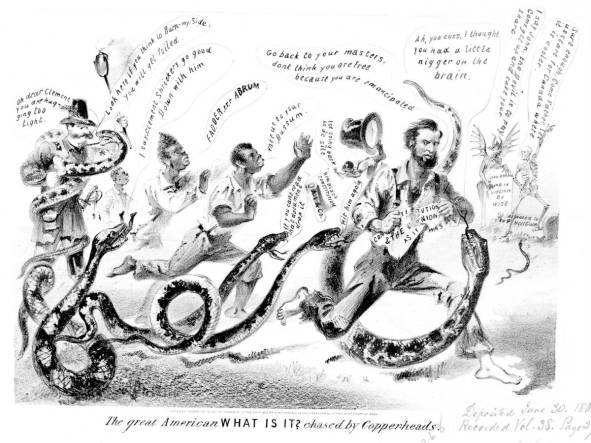
The scary thing about the current state of political discourse in America is the very real lack of civility. As much as we’d like to think this is a modern phenomenon, we actually have a long history of pretty nasty behavior during the political silly season. Check out this political cartoon about Lincoln:

civilityLincoln

Source: HarpWeek

That’s some pretty nasty stuff by any measure. What’s new to our elections these days is the ability of any one person to create or spread nastygrams like this via their social media channels, with nary a thought to whether or not it’s true. With the click of a button they can share personal attacks on candidates, falsehoods about a candidate’s past and beliefs, or launch character assassinations on political candidates or members of a political party faster than you can say “fact check.” It’s truly becoming an overwhelming cacophony of negative, schoolyard name-calling that is drowning out increasingly fruitless attempts at civil discourse.

Lest you think I’m exaggerating, check out these images I found in just five minutes of scrolling through my Facebook feed:

So what commonalities do you find in these images? What I see are personal attacks and name calling with no attention paid to the stated policies of the candidates. How, pray tell, does this advance the cause of the Union in any way?

Now I do understand that much of what people share are things they consider funny. Many of the memes poke fun at the generalizations the sharer has about the folks on the other side of the fence, and normally I wouldn’t be such a stick in the mud about it since I enjoy a good joke as much as the next person. However, when you see people share literally dozens or hundreds of these memes that do nothing but insult people with a different set of beliefs then you have to come to the conclusion that they truly feel that their opposites are stupid, lazy, cruel, etc. When you begin to believe that then you inevitably come to the conclusion that there’s no room for honest debate, and quite frankly you begin to not care what they think because all you see are personal attacks completely divorced from the issues.

So maybe you think I’m overreacting and that I should just ignore what I’m seeing on my social media channels. I might agree except that I think our current crop of political leaders, both liberal and conservative, from the local level to the national level, are exploiting these sentiments and profiting from our separateness. Until we can find a place to have civil and intelligent debate they’re going to play us for the suckers we are.

In other words, folks, we have met the enemy and it is us.