IRS Should Just Hire a Bunch of Direct Marketers and Listen to My Mom

During a show about how much tax revenue the IRS doesn't collect – 17% or $450 billion a year – the folks at Freakonomics talk about how a little-known unit of the British government called the Behavioral Insights Unit gooses the UK's tax collection efforts:

One of my favorite examples of this comes from a small unit in the British government called the Behavioral Insights Team.  What they do is experiment with all kinds of cheap and simple nudges.  For instance, sending out letters that appeal to the herd mentality in all of us. Here is the unit’s director, David Halpern:

David HALPERN: So what we do is we simply tell people something, which is true, which is 9 out of 10 people in Britain pay their tax on time. And by putting that single bit of information into the top of a letter, it makes people much more likely themselves to pay the tax on time.

GARDNER: So it’s peer pressure?

DUBNER: That’s exactly right — we like to run with the herd.  They also tried another super simple trick, which was just handwriting a message on the outside of the tax envelope.  This message would just say simply that the contents are important, but it’s written in hand.

HALPERN: Of course people are like ‘oh my God, but how can that possibly be practical?’ Well we’ve now just got the results in. It turns out that for every pound or every dollar that you spend on getting, you know, someone to write on the envelope, you get $2,000 return.  A one to 2,000 return. So it’s a nice simple illustration of these small things and how consequential they are.

Anyone who's spent even a week working as a direct marketer could have told you this would work. The IRS should just hire a bunch of laid off direct marketing folks and they'd pay for themselves in no time.

Later in the podcast they talk about an idea from a behavioral psychiatrist at Duke:

Dan Ariely, a behavioral psychologist at Duke, has a nice idea: to let taxpayers direct a small portion of their tax money to the parts of the government that they most care about:

Dan ARIELY: So I’m not sure what’s the right percent — five percent or ten percent.  But what if we got people to have a say about where some of the taxes go? All of a sudden you’re not looking at it as you against the government.  You’d have to look carefully at all that the government is doing for us — building libraries and roads, and education and military and so on and so forth and say, what do I care about?

My mother made this same argument when I was a kid. Her argument was that if she could earmark even one or two percent for any program/department of her choosing she'd feel better about paying her taxes in general. She also made another interesting point: taxpayers would be able to indicate with their dollars which programs they felt were most important. In essence we'd be able to tell which programs were truly valued by us, the taxpayers, and not have to trust politicians to divine what we wanted. That's why I figured it would never come to pass, and I haven't been wrong yet.

They’ve Got B.O. and Heartburn and Gas

Former Republican US Senator Alan Simpson, quoted in an interview by the LA Times in reference to "tea party-inspired Republicans":

He reserved his greatest contempt for the tea party-inspired Republicans who equate compromise with capitulation and view obstruction as progress. "Some of them," he said, "are as rigid as a fireplace poker, but without the occasional warmth."

He leaned forward, stabbing a bony finger into a wood conference table. "Let me tell you something, pal: If you are a legislator and you can't learn to compromise an issue without compromising yourself, get out of the business. In fact, don't ever get married, either. You don't want any part of that."

Compromise is the only way anything has ever gotten done, he went on, going back to the Declaration of Independence and the Constitution, both of which amounted to more give than take. "They don't like that," he said of the tea partyers’ unwillingness to bargain. "They get nasty. They smell bad. They've got b.o. and heartburn and gas. They're seethers."

HT to Fec for the link.

No Holding and No Folding

In poker knowing when to hold or fold is a critical skill. In North Carolina the legislature has decided that some people can't be trusted with knowing whom to hold (that would be a reference to the ban on same-sex marriage) or when to fold (that would be a reference to a proposed law that would require a two year waiting period and compulsory counseling for any married couples pursuing a no-fault divorce). Combine that two year waiting period with loosened gun regs and you have yourself a recipe for some interesting situations don't you?

Public Art or Not

Some folks see grafitti and think "Now that's art" and others see it as the defacement of property. Personally I find even grafitti I like to be a defacement of someone's property unless of course the property owner invited the artist to work his magic. That's why in the realm of "unapproved" art I prefer something that's creative, easily removable and inherently temporary. Here's a great example:

Then there's the stuff that's approved and is anything but art. Like cell towers disguised as trees.

CellularTree

The Blogfather

Ed Cone was blogging before "blogger" became a pejorative. The Greensboro dead tree product carries a story about his decision to quit the blogging scene.

From his office three floors above South Elm Street — where he has an action figure perched on his window and a framed handwritten response from gonzo journalist Hunter S. Thompson on his wall — Ed wrote about it on Word Up.

Will it return? Who knows? Ed doesn’t. But there is this story I heard once about Ed’s great-grandfather, about how he used to row out to the middle of a lake in Maine and sit.

I ask Ed about it. He tells me he understands it now. It’s that need for quiet, for some contemplation. That’s what Ed is doing. For now.


Class Act

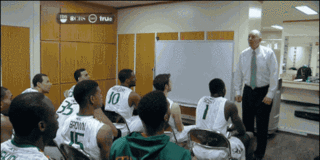
The first time I saw CJ Harris play was in the Frank Spencer Holiday Classic his senior year at Mt. Tabor High School. He was easily the best player on the court and it was encouraging to know that he was staying in town to play at Wake Forest. Unfortunately (for him) his tenure coincided with one of the most challenging times in the history of Wake Forest basketball. Fortunately (for us) he stuck it out and didn't transfer to another more stable program. He, along with Travis McKie, have been the players who have been most responsible for keeping the program from totally flaming out. They've shown tremendous character in fulfilling their roles for the Wake hoops program so it should not come as a surpise that Harris would write this thank you letter to the Wake Forest community. Here's an excerpt:

Thank you so much for the kind words and love that you have shown me and my family over the past four years. That is more precious to me than any victory on the court, as your words have truly help define who I am today.

While I am sad that my career at Wake Forest has come to an end, I see nothing but a bright future for the Deacs. I know that I have helped lay the foundation for this program to achieve the success we can all be proud of. My teammates and the coaching staff are working hard to get there, and they deserve your continued support and enthusiasm. 

Thank you again for making these past four years truly special.

Always a Deac!

CJ