Another Day in the Neighborhood

Day 8 of Virtual Walk Around the Triad to Benefit Second Harvest

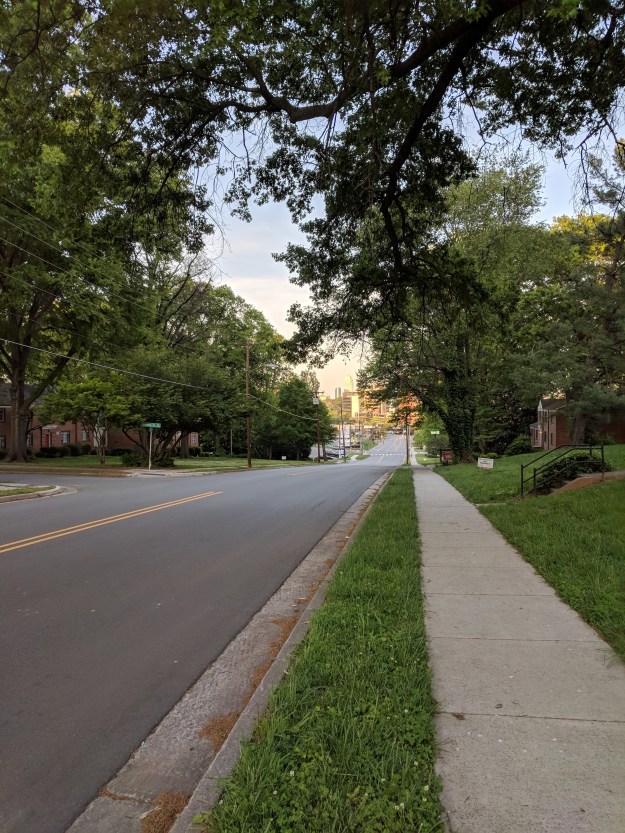
Activity Day 8: Squeezed in a late night walk around the neighborhood. It ain’t exotic, but it’s effective.

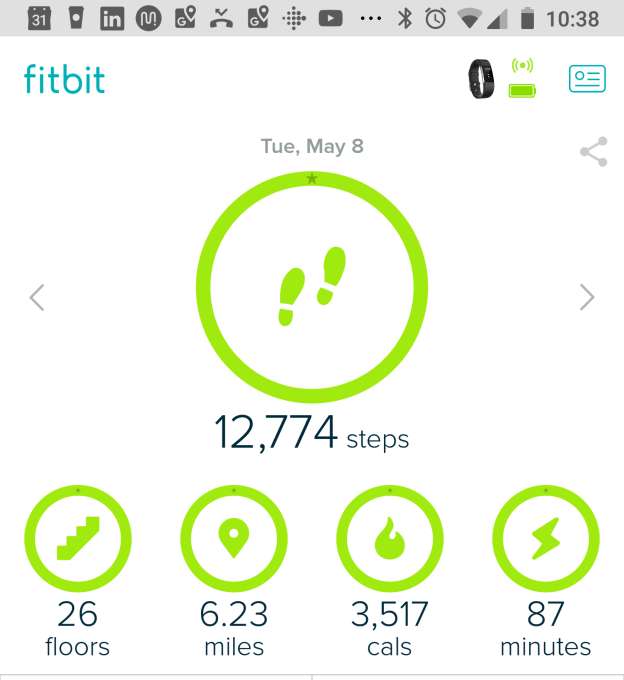
Miles walked/run: 6.23 miles. Here’s the screenshot from my FitBit:
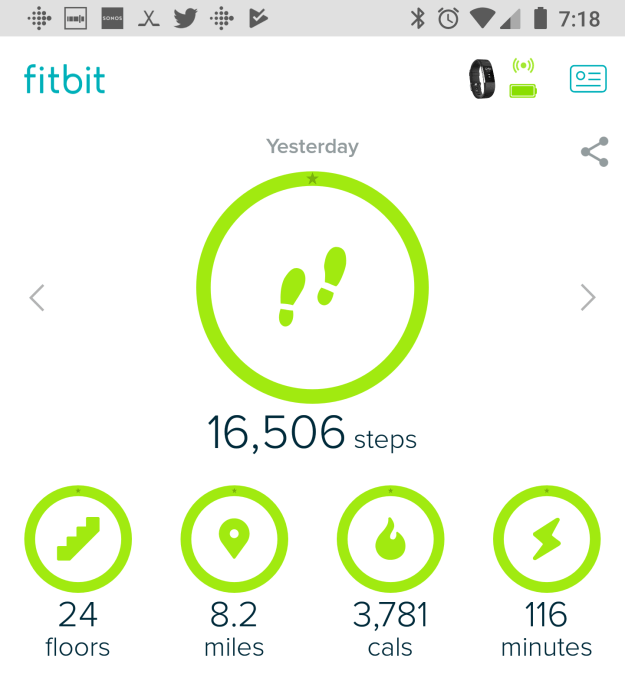
Screenshot_20180510-103854_2

Miles remaining in challenge: 323.90. Made a good start to the second week of the challenge, especially since I fell just short of the daily average of 5.4 miles I needed during Week 1.

Today’s sponsor: Piedmont Triad Apartment Association Food Drive. I’m very proud to work for an organization that has dedicated itself to helping address fundamental issues like food insecurity in our community.

Movin’ on Up

Days 7 of Virtual Walk Around the Triad to Benefit Second Harvest

Activity Day 7: So that weekend house-move in Florida that I missed came to me. Spent last evening moving boxes, furniture, etc. and running around in general.

Miles walked/run: 4.22 miles. Here’s the screenshot from my FitBit:

Screenshot_20180508-104640_2

Miles remaining in challenge: 330.13. My first week I averaged 5.26 miles/day, which is a little behind the pace I need to make my goal. Time to ramp it up!

Today’s sponsor: Crescent Rotary Club (via my contribution. The members of this club do a tremendous amount of good for our community.

Recovery and Usefulness

Days 6 of Virtual Walk Around the Triad to Benefit Second Harvest

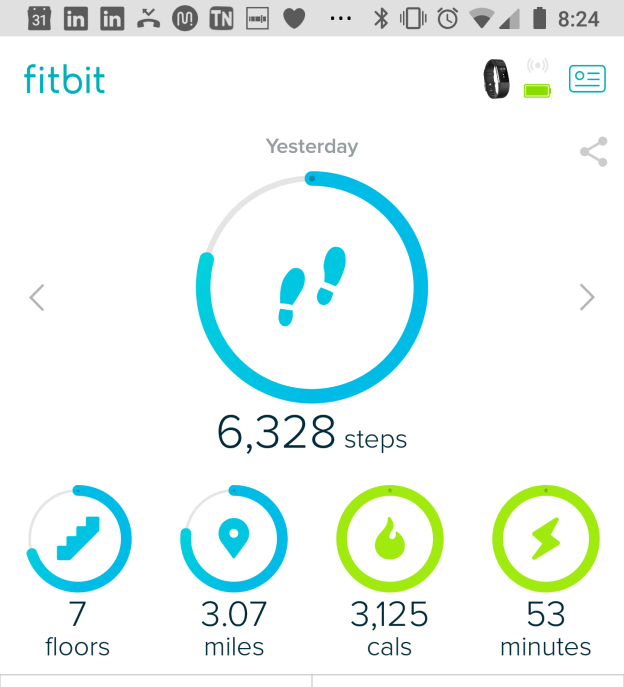
Activity Day 6: After the 12+ miles on Day 5 the old legs needed a day to recover, so I spent it working around the house and yard. Just doing that I still managed to get a few miles in.

Miles walked/run: 3.07 miles. Here’s the screenshot from my FitBit:

Miles remaining in challenge: 334.35

Today’s sponsor: Crescent Rotary Club (via my contribution). The members of this club do a tremendous amount of good for our community.

When Life Throws a Curve, Head to the Lake

Days 4&5 of Virtual Walk Around the Triad to Benefit Second Harvest

Activity Day 4: When your better half has an unexpected and kinda scary medical event you don’t do anything but take care of her, so that’s what I did.
Activity Day 5: I was supposed to be in Florida helping my mom pack up her house, but due to the events of Day 4 she recruited someone else. So I made sure my better half was in solid shape and headed to Salem Lake for a walk/run.

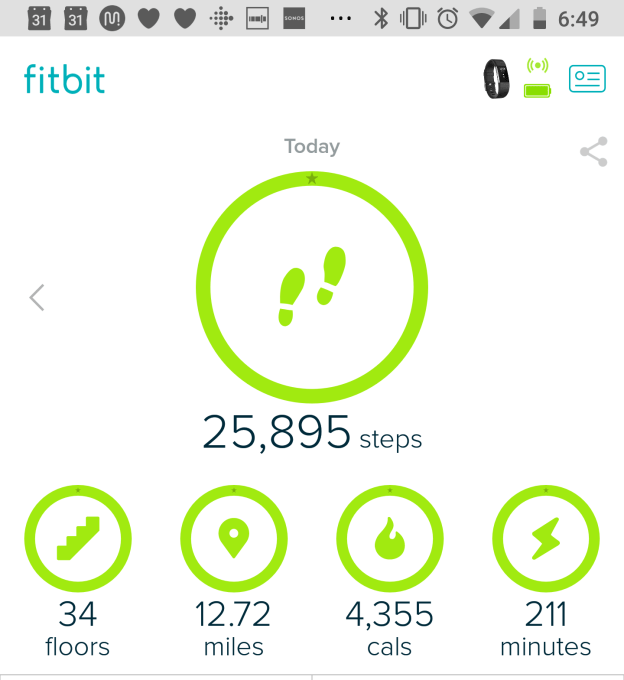
Miles walked/run: 12.72 miles. Here’s the screenshot from my FitBit:

Miles remaining in challenge: 337.42

Today’s sponsor: Crescent Rotary Club (via my contribution. The members of this club do a tremendous amount of good for our community.

Mr. Lowder’s Neighborhood

Day 3 of Virtual Walk Around the Triad to Benefit Second Harvest

Activity: Morning dog walk and evening walk around Williamsburg Square Neighborhood with my much better half, Celeste Lowder (3 laps)

Miles walked/run: 5.43 miles. Here’s the screenshot from my FitBit:

screenshot_20180504-064659.png

Miles remaining in challenge: 350.14

Today’s sponsor: The PTAA Food Drive which began today and runs through July 7.

To Ardmore and Beyond!

Day 2 of Virtual Walk Around the Triad to Benefit Second Harvest

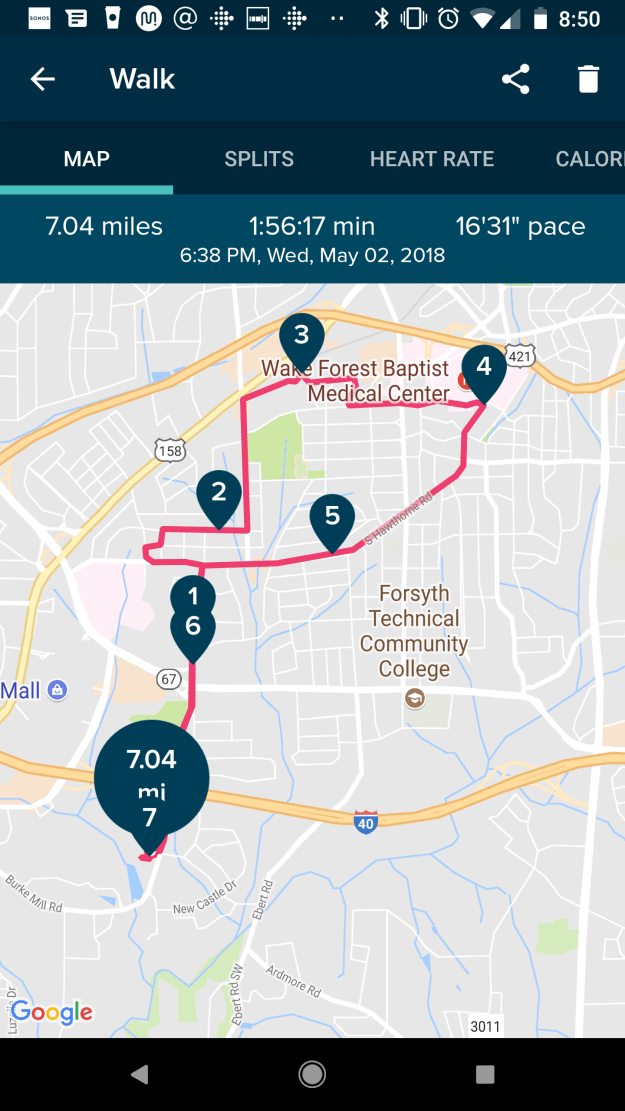
Activity: Walked from Williamsburg Square to Stratford Road and around

Miles walked/run: 7.04 miles. Here’s the screenshot from my FitBit:

Miles remaining in challenge: 355.57

Today’s sponsor: The PTAA Food Drive which began today and runs through July 7.

Day 1 of Virtual Walk Around the Triad to Benefit Second Harvest

Today was the first day of my 68-day challenge to walk a cumulative 367 miles, the same distance that I would have to walk to reach the farthest-apart apartment communities that are members of my organization, the Piedmont Triad Apartment Association. The goal is to raise at least $1,000 for the Second Harvest Food Bank of NWNC. If you want to make a donation you can do so here.

Each day I will post the results of what I did to reach my goal, and I won’t count the regular day-to-day “getting around steps.” Here are today’s results:

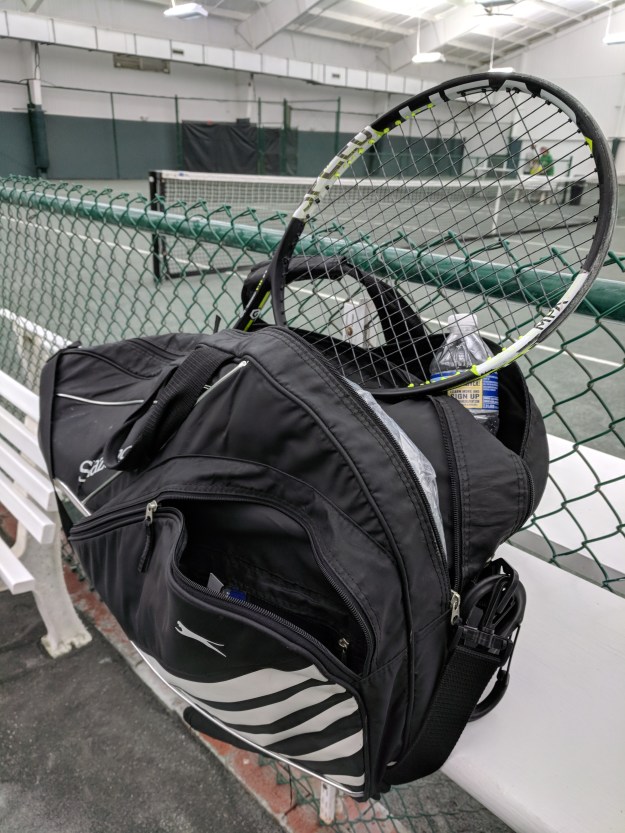
Activity: Tennis

Miles walked/run: 4.39 miles (mostly sprinting so I’m wiped out). Here’s the screenshot from my FitBit:

Miles remaining in challenge: 362.61

Today’s sponsor: The PTAA Food Drive which began today and runs through July.

Framing the Issue

Guns are the issue du jour right now, thanks to yet another school shooting (Stoneman Douglas High School in Florida) that resulted in multiple deaths. We’ve had lots of mass shootings in America in recent years, and we’ve also had a well-documented cycle of reactions that lead, eventually, to…nothing. No matter the number of innocent people killed, or the circumstances in which they’ve been killed, the cycle has been the same: outrage, intense scrutiny in the media for a week or less, calls for gun control, calls for mental health reform, lots of grandstanding and then…nothing. Until the next time, usually within a month or two, when the cycle starts anew and we all get a little number, shrug our shoulders and say, “Well, there’s nothing I can do about it. Is there a good comedy on Netflix to lighten the mood?”

The most recent shooting seems to have a slightly different feel. Mainly that’s due to teenagers. It ends up that some of the kids in the high school that was the scene of the shooting are actually quite articulate, and they’re impassioned, and they’re inspiring a lot of people to speak out for gun control. They’re so effective that the Fox News and NRA crowd are accusing them of being “crisis actors” (whatever the hell that is), which is an amazingly extreme form of victim blaming, not to mention picking on kids, which can only backfire on them in the long run.

When you think about it, this is an amazing turn of events. The pro-gun folks, led by the NRA and their media arm at Fox News, have been amazingly effective at framing the gun control debate for the last generation. No matter how serious the shooting, they always have a plan for framing the debate so that it moves away from gun control and ends up at promoting gun rights and identifying mental health reform as the only viable solution for ending mass shootings. The debate quickly devolves into a bunch of shouting, everyone becomes entrenched in their familiar positions, and within days we have a society that’s lost interest/given up. These kids seem to have at least ensured we’ll be paying attention longer, and that’s obviously a good thing and I’m heartened by their activism, but I’ve been around long enough that I’m highly skeptical their efforts will lead to a radically different conclusion.

My skepticism stems from the gun lobby’s skill in framing the debate. Of late their primary tack has been to say that in addition to mental health reform, the only way to stop a bad guy with a gun is to have a good guy(s) with a gun around. Because the current focus is on schools and the latest tweak to their scheme is to propose arming a certain number of teachers as the best line of defense against an armed attacker. It’s no surprise that this “solution,” which President Trump has endorsed, has generated a heated backlash and unfortunately, I think this reaction is the turning point that could lead us closer to where we always end up – doing nothing – than to see any substantive change in terms of alleviating gun violence.

I seriously doubt the gun lobby, Fox News pundits, and President Trump, ever truly believed that arming teachers was a proposal that would see the light of day. What they did believe was that it would frame the debate; it would signify the worst possible idea from the perspective of gun control advocates, and stake out a negotiating position for the gun lobby that would allow them to compromise and accept a proposal that would calm the gun control people and still be acceptable to gun proponents. I don’t know what that is, and obviously, it’s better than nothing, but I expect that if you see anything happen at all, it will be closer to nothing than to a solution.

It sucks being pessimistic, and I truly am glad to see these kids getting engaged, but I think we’d seriously be mistaken if we thought this was going to lead to revolutionary change. I guess a more positive outlook would be this: maybe we’re seeing the first step in evolutionary change.

For the sake of innocent bystanders everywhere, I hope that’s the case.

No Hugging Zone

Bill Clinton, George HW Bush, Donald Trump, Al Franken, Roy Moore, Kevin Spacey, Harvey Weinstein, Louis C.K., Mark Halperin. That’s an off-the-top-of-my-head list of powerful and influential men accused of sexual harassment or inappropriate behavior (like pinching butts during photo ops). Sadly, the list of men who have abused their positions of power in this way would be pages long if I were to do the research, and it will undoubtedly keep growing because men in power will continue to behave this way.

What is changing, hopefully, is that their victims are refusing to stay silent. If that causes men to pause and worry about their every interaction with the people over whom they have some power or influence, then so be it.
For as long as I can remember the places I’ve worked have had a no-closed-door policy for one-on-one meetings between members of the opposite sex unless there’s a large window that allows others to see into the room. The reasons for that are easy enough to understand, and most people I’ve met who manage other people follow that rule pretty closely.
There is, however, one custom that is not ubiquitous but is widespread enough, that I think we need to address it in the context of sexual harassment or inappropriate behavior: hugging in a business environment. While hugging is not my preferred mode of greeting anyone to whom I’m not related or very good (personal) friends with, I’m often confronted with offered hugs at business meetings. It could be at a conference, or a lunch meeting, or even a regular meeting: there’s often someone who wants to hug and I’m put in the no-win position of offending them if I refuse to hug, or giving a hug that makes me feel awkward.
Now, this is nothing new for me. I didn’t grow up in a huggy family, so when I went to college and suddenly had girls I barely new offering up hugs I wasn’t sure what to do about it. That feeling has continued throughout my career, and now I’ve come to believe that some people sense it because they shake hands with me while hugging the person standing next to me, which I’m totally good with. So, not hugging is actually my default preference.
There are, however, plenty of people who insist on the hug and I’m becoming firmer in my belief that hugging has no place in a business setting for the same reason that I don’t think it’s a good idea to have closed-door, one-on-one meetings with a member of the opposite sex. Simply put, if I give 100 hugs there’s a very high likelihood that all would be okay, but there’s also the small chance that someone will find it inappropriate. What if the hug was held for what that person felt was just a little too long? What if they think I’m sniffing their hair for some odd reason? What if they feel the hug was a little too tight? What if they feel like my hands were in the wrong place? Hell, what if in the course of the hug my hand accidentally brushes somewhere inappropriate?
I’m sure this sounds like nitpicking, or maybe even like a guy going to extremes in reaction to stories in the news, but I’m okay with that. You see, I prefer an environment where everyone involved is in a position to be comfortable doing their jobs. One of the reasons we have social norms is to help people understand what is appropriate behavior in a variety of situations. While shaking hands has its own downside, whether it’s the person trying to break your knuckles or the person with a cold trying to infect you, there is almost zero risk of it being taken as inappropriate touching.
So here’s my plea: let’s add hugging to the list of things that are better not done at work, along with talking about religion and politics. It might seem stiff and formal, but in today’s reality, it’s better for everyone involved.

Passing the Buck

As I write this Hurricane Harvey is, finally, leaving Houston and southeast Texas in its wake and heading towards Louisiana. During the several days that the hurricane inundated the Houston area there emerged many stories of heroism, harrowing escapes and increasingly desperate attempts by leaders to cope with a level of flooding never seen in their community’s history. In the midst of all

In the midst of all this the pastor of a very well-known mega-church, Joel Osteen, came under mounting criticism for not opening the doors of his church, a building that was once a coliseum that housed the Houston Rockets, to help the displaced and desperate residents of his city. His church’s initial reaction was to post pictures of their facility showing that it was inaccessible due to flooding, but then some local folks visited it to check it out for themselves and found that the facility was indeed accessible and pretty much dry compared to other parts of the city, and they shared that info (with pictures) on social media and the pressure on Osteen and his church mounted. Eventually, they did open the church as a shelter and to collect donations of clothes and sundry items, which is great, but the fact that the leader of one of the largest congregations in the country took so long to make it happen is a stain that will be hard to wash off.

So how did Osteen proceed to try to wash that stain? He appeared on the Today Show and promptly tried to pass the buck. Here’s a quote from the interview with him: “(The city) didn’t need us as shelter then,” Osteen said. “If we needed to be a shelter, we certainly would’ve been a shelter right when they first asked. Once they filled up, they never dreamed that we’d have this many displaced people, (and) they asked us to become a shelter. I think this notion that somehow we would turn people away or we weren’t here for the city is about as false as can be.”

You can see the interview for your self here.

He went on to say that the church was concerned for people’s safety because the building had flooding issues in the past. That’s all well and good, but here are the problems with his reaction:

  1. What kind of church leader waits to be asked to help?
  2. What kind of leader of any stripe tries to shift blame during a crisis?

To be clear, it’s a good thing that the church has rallied and is contributing, especially given the resources it can bring to bear. I’m pretty certain it would have, eventually, even without the pressure of the criticism from social media. But Osteen himself showed some real deficiencies of character and leadership in how he responded to the crisis itself and the criticism that resulted.