Category Archives: Web/Tech

Lazy Teenage Superheroes

In the evolving world of digital video the dollar is becoming much less important when compared to talent and imagination.  Case in point is Lazy Teenage Superheroes, a short film that the filmmaker says cost him $300 to make.  Embedded is a video of the behind the scenes action during the making of the film.  A warning about the actual film: don't watch it if you're put off by bad language, references to VD or juvenile humor of any kind. 


A Note of Advice to My Friends in the Newspaper Biz: Listen to Anne

About 10 years ago I had the privilege of working with Anne Holland as she was starting up MarketingSherpa.com.  I don't exactly remember how I met Anne, but it had to be through some activity in the premium newsletter business since that's the industry we both worked in during the 90s.  She's one of the smartest people I've ever worked with and so I can recommend without hesitation, and without reviewing it myself, this free training video for newspaper execs.  Anne has started a new site, Subscription Site Insider, that I'm fairly sure will become a "must-use" site for anyone in the paid content space, if it isn't already.  From the page about the video:

During our research for the presentation we could not find one single example of a good newspaper paywall. Not one! Newspaper paywalls are — frankly — scary bad. They just ignore all best practices.

Why is that? My theory is that newspaper site design is really difficult – it’s a science in itself. You’re dealing with heavy text, complex navigation, and hundreds of thousands of pages… Plus, on top of making this dense content easily navigatible, you also have to deal with the demands of advertisers — get them enough clicks to keep paying while not sacrificing all your screen space.

Paywall design requires a completely different skill set. The goal is paid conversion, not free navigation. The content is focused, not comprehensive. Psychologically, the audience isn’t looking at the page because they want to be there, but because they’re forced to be there.

Other niches in the subscription site industry have been testing, researching and refining their paywalls for close to 15 years now. Audience development executives and web designers for newspapers can learn a lot from them. 

If your business depends on getting people to pay for access to your "stuff" then you really should check out Anne's place. You wont' regret it.


Everyone Should Have a Printing Press

I just read an interesting interview with Evan Williams, founder of Twitter (and Blogger) that had a great quote:

In response to a question from the audience about Twitter empowering people to publish and act as journalists, Williams — who founded Blogger and later sold it to Google — said that “lowering the barrier to publishing” has been something he has spent most of his career on, and this is because he believes that “the open exchange of information has a positive effect on the world — it’s not all positive, but net-net it is positive.” With Twitter, he said, “we’ve lowered the barriers to publishing almost as far as they can go,” and that is good because if there are “more voices and more ways to find the truth, then the truth will be available to more people — I think this is what the Internet empowers [but] society has not fully realized what this means.”

I like Fred Wilson's take on this too:

When I started blogging back in 2003, I would tell everyone how awesome it was. A common refrain back then was "not everyone should have a printing press." I didn't agree then and I don't agree now. Everyone should have a printing press and should use it as often as they see fit. Through things like RSS and Twitter's follow model, we can subscribe to the voices we want to hear regularly. And through things like reblog and retweet, the voices we don't subscribe to can get into our readers, dashboards, and timelines.

If I look back at my core investment thesis over the past five years, it is this single idea, that everyone has a voice on the Internet, that is central to it. And as Ev said, society has not fully realized what this means. But it's getting there, quickly.


Influence Explorer

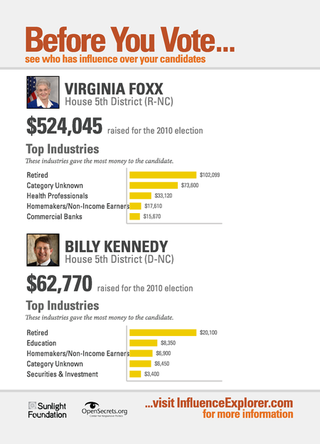
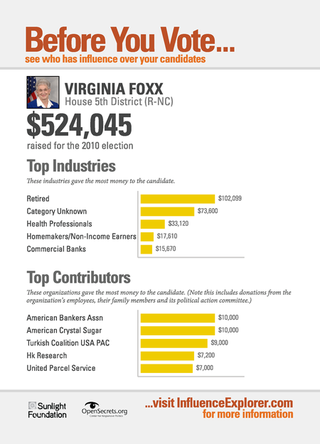
The Sunlight Foundation has an interesting little project up and running that allows you to produce a postcard showing how different candidates' campaigns for Congress have been funded. You can even have the postcard mailed to friends or family before the election. Pictured is the postcard for NC-5 which features Virginia Foxx vs. Billy Kennedy:

NC-05-large

Here's Foxx only:

FoxxPostcard

And here's Kennedy only:

KennedyPostcard

New Local Media Hierarchy

As I last posted the Winston-Salem Journal showed me a little love on Saturday by printing an excerpt from one of my blog posts in their "Bits & Pieces" section of their editorial page on Saturday.  A commenter noted that I should see a spike in traffic to my site, which I assumed as well.  Here's the thing: my traffic went up this last Saturday and Sunday compared to the previous weekend, but only a little and it was still lower than the traffic I had on Friday.  In other words there was a little more traffic, but not enough that I'd say that the Journal's love had a real impact.  

On the other hand when Esbee links to me I see my traffic double, minimum.  I'm not trying to slam the paper here, after all I'd assume that Esbee's readers are more likely to follow a link to another blog than people who read the paper or visit the paper's website are to actively go and find my blog.  Still I think it shows that in the evolving world of online media the media hierarchy is different than in the offline world.  I hope local advertisers and marketers are paying attention.

Oh, and a word of advice to the Journal: there are these little things called hyperlinks that have been used online as long as there's been an online.  You might want to consider using them in your stories seeing as it's considered good manners in the online realm AND the search engines give you credit for it.

Recommendation: Download Google Chrome ASAP

I finally got around to downloading Google Chrome and I'm regretting that I didn't do it sooner.  This thing is very fast and after using it for just a few hours I'm ready to make it my default browser, with Firefox second and IE as "use only if desperate."  I'd put off downloading it until I read an article in an old issue of Wired that was essentially a behind-the-scenes account of how Google got into the browser business. Two things in the article prompted me to act: the fact that they hired a guy specifically to make Chrome faster than the other browsers and that they designed it so that if one tab froze the rest of the tabs would still work.  That's been my biggest frustration with Firefox:  when I overload one tab the rest of the tabs crash with it.  I can't tell you how much online work I've lost due to that.

Another cool feature is that they got rid of the separate search field in the tool bar.  If you go to what we traditionally view as the address field, you know that place where you can type in the address like http://www.google.com and go directly to the site, and type in a search phrase it will provide some web addresses that might make sense if you don't use the search results.  For instance I typed in "google chrome" and it dropped down a menu of links including a link to Google search results and a link directly to the Chrome home page.  When I typed in the name "ed cone" it dropped down a prompt to search for ed cone on Google and it also dropped down some search suggestions for words similar to ed cone and it dropped down a link to Ed's blog.  It's really very convenient.

So, give it a whirl.  Really it's painless because Chrome easily imports all the bookmarks and other settings from your other browser so you'll be up and running in no time and I don't think you'll regret it one bit.  Especially when you see how fast this booger is.

How Much is Netflix Really Costing You?

We've been members of Netflix forever and I've noticed that we use it in fits and starts.  Really it's my fault because I'm generally the one that goes to the website and selects the movies, and I get in trouble when I try to anticipate what everyone will want to watch.  When I do I pick "blah" movies that no one wants to watch, but I think the family is afraid to tell me because they don't want me to feel offended.  On the other hand, I don't want to turn them in because I figure at some point we'll all sit down to watch them.  So there they sit on top of the DVD player, sometimes for weeks on end.

Our heavy usage tends to occur when I find something I really like, say The Wire, and order all of the DVDs and watch them as soon as they come in and return them promptly so that I can watch the next DVD in the series.  Unfortunately that happens about every third month so our droughts are longer than our downpours and I've suspected for a while that we've been paying more than we would renting on an as-needed basis from Blockbuster.

All that's to explain why I immediately tried out FeedFlix when I read about it on Lifehacker.  I just plugged in an RSS feed from our account and within a few seconds I had all the info I could ever want on my family's Netflix usage (see image to the left).  Because our droughts are so long our average hold time for a movie is 7 days and our average cost to rent a movie over the lifetime of our account is a whopping $23.79.  That's nuts!

Now we could pull that down over time by making sure that we recycle our movies very quickly, and now that we can watch Netflix movies online at no additional cost and/or watch them via Tivo once our Tivo is updated then we could really pull that number down quickly.  As it is we're Netflix's dream customer and I hate being that.

So you Netflix customers out there: what are you spending per movie?

Graphic Example of Twitter’s Utility

I've been a fairly casual user of Twitter for a while now and it has been interesting to watch how it has become more commonly used.  I signed up to use it fairly quickly after it's launch, but since no one else I knew was using it I figured it was a kind of geek-fad thing and forgot about it.  Then I noticed more and more of my colleagues using it so I started paying attention to it again, and it's become a pretty easy way for me to track what some of the smartest people I know are doing. 

For the most part, though, most people I know have not a clue what Twitter is or what it does.  The news gods have provided a really memorable example of what it is with this story about a passenger on the plane that slid off the runway in Denver and broke into flames over this past weekend. The article claimed that the passenger, a guy named Mike Wilson, literally got off a Tweet (a message sent via Twitter) before he got out to safety but when I checked his Twitter profile I read a Tweet he'd sent saying that he didn't send the first message until after he was safely off the plane.  He then kept people posted on the post-crash happenings by sending Tweets about how the passengers were being handled.  Note that he was not pleased that the airline wasn't providing them with drinks.

So here's how the passenger did it:

  • At some point he joined Twitter (it's free).
  • He started sending text messages to his Twitter account and the messages are displayed in his Twitter profile.
  • Other people elected to follow him, so whenever he sends a text message they see it in their profile.  To make it easy think of the profile as the equivalent of an email inbox.
  • When the plane crashed and he sent out that text message to his Twitter account all the people who followed him saw the note.  Then of course they could forward it, email about it, tell friends, etc.

Mr. Wilson has received lots of attention for his "tweeting" but when you think about it if he'd simply sent a text to his wife or kids the whole thing would have gone unnoticed.  By sending the text to his Twitter profile where the dozens or hundreds of his followers could read it he did something new and novel and so he ended up being interviewed by the media.  But beyond the novelty there also lies the network effect: by sending the message to a profile that is essentially a mini-blog or mini-webpage he allowed literally anyone to see what was happening, so those people that did follow him could send a link to his profile to whomever they wanted, and those people could forward it, and so on. Next thing you know there are literally thousands of people reading his text dispatches; if he'd sent that same 10-word text to his wife maybe ten people would have seen it. There, in a nutshell, is the powerful effect of Twitter.  (BTW, he has 1,762 followers at 5:22 Eastern on December 22, 2008. I wonder how many he had before the crash.)

So if you have people that are interested in keeping up with you during the day, are regular users of text messaging, and are not averse to mutilations of the English language then you may have the makings for an active Twitter existence.

FYI, if you'd like to follow me on Twitter my profile is jlowder.

Digital Forsyth Group on Flickr

A little over a year ago I read about the Digital Forsyth group in the paper and was pleased to find some really interesting information on the site.  Today I discovered a Flickr group that Digital Forsyth has started that I hope will expand their portfolio of interesting Winston-Salem and Forsyth County images as local Flickr members contribute their own pics to the project.

WTF Six Apart?

I've hosted this blog (and a few others) on Six Apart's Typepad service for four years.  In general I've been very happy with the service, I've received responses to all customer service inquiries, the downtime has been relatively minor and I've been very happy with the fact that it's enabled me to focus on the creative side of blogging without having to learn too much about the technical side. Heck, I even got to meet one of the co-founders, Anil Dash, at ConvergeSouth and I found him to be one of the sharpest, if not the sharpest person there.  So why do I find myself irked with them today?

Because of this announcement that they're giving recently laid off journalists the service for free, and calling it the Journalist Bailout Program.  Now you might think it's cold of me to begrudge someone who's been laid off a helping hand, and maybe it is, but I've been paying for the service for four years and I've helped the folks at Six Apart get where they are.  Why should I be happy that some newcomer is getting appreciation and I'm not?  Really I have no problem with them helping out the journalists, but where's the love for me and my fellow paying TypePad-ers?

This reminds me of a conversation I had with a rep at Register.com a while back.  Before I knew any better I registered my domain names with them and paid some crazy rate like $30 a year, and they sent me renewal notices for that same amount.  I shopped around and got a much better deal at GoDaddy.  Unfortunately I had to call Register.com to finalize the transfer of the domain and that's when the rep offered to best the GoDaddy price.  I told him no thanks and when he asked why I said, "If you really appreciated my business you'd have offered me the better price before I called you.  The fact that you treat me better when I threaten to leave simply tells me that I'm a number, not a valued customer." To put it simply I get irked at any company that offers better deals for new customers than for existing customers.

The reality in this case is that Six Apart is gaining much more than they're giving up.  They're getting the journalists' audiences which means that their ad network will get more views which means more revenue for them.  That's fine for Six Apart, but what kind of appreciation are they showing to me and all the other customers who've been with them as they've grown?

I also find this ironic because a few years ago I tried to contact Six Apart to see if they had a program that would allow someone like me to re-sell their platform.  I knew several small businesses, local politicians and, yes, journalists who would benefit from blogging but needed hand holding.  I had no interest in setting up a platform, finding a host and providing tech support, so I thought if I could re-sell Typepad as the platform and then act as the "rep" who held the clients' hands through the process then it would be a win-win for me and for Six Apart.  I never heard back from them and I moved on to other things.  I guess now I have their answer.