Category Archives: Technology

Dad, Have You Heard of Bitcoin?

My wife and I were driving our son to school on the way to work and in the middle of the trip he asked, “Dad, have you heard of Bitcoin?” I think he was surprised and maybe even a little impressed that I had. I know for a fact that I was VERY impressed that he had. What ensued for the remaining few minutes of the ride was a discussion of bitcoin and a fumbling attempt by both me and my son to describe to my wife what it was. That’s when I realized I only vaguely understood how it might work. How fortuitous, then, that I found this article in today’s Wall Street Journal about Dish Network accepting Bitcoins for payment:

Bitcoin took another step toward mainstream recognition as satellite-TV provider Dish Network Corp. DISH -1.38% will become the largest company yet known to accept payments in the digital currency.

The move shows the resilience of the currency after a string of scandals and regulatory actions raised doubts about bitcoin’s future. The collapse of a major trading exchange helped lead bitcoin to lose two-thirds of its value in four months, but its price has rallied 27% over the past week. Coindesk’s Bitcoin Price Index was quoted at $565.55 at late afternoon in New York…

Dish said it will use Coinbase, a San Francisco-based bitcoin-payment processor, to process the payments, using that firm’s Instant Exchange feature. That means that although its customers will transfer bitcoins through an online facility, Coinbase will absorb the digital currency and remit dollars to Dish.

End of an Era

I’ve been writing this blog for almost ten years and that entire time it’s been hosted on Typepad. I’d been bugged by at least one friend (Dan) to switch over to WordPress for years, but I’d resisted because it seemed like too much of a hassle. About a year ago I tried to convert but the process didn’t work and I didn’t have time to figure out why.

Last week Typepad experienced a hack-attack and their service went down for days. Considering I had over 3,000 posts that I suddenly couldn’t access – I had some backups but they weren’t real current – I was anxious to get back on their system and generate a current backup. A couple of days ago they came back online and I did get a backup downloaded in minutes. At that point I tried one more time to import all of my posts into WordPress and this time it worked, so I quickly went to my registrar and changed my domain name and pointed it to my little navel-gazing project’s new home.

Other motivators for getting off of Typepad and on to WordPress included:

  • I write regularly for a work blog hosted on WordPress and having just one tool for my writing seemed to make more sense.
  • Saving some bucks since I was paying a monthly fee for Typepad and I could get better functionality on WordPress without the monthly fee.
  • There are more developers on WordPress which means a lot more “stuff” to play with in terms of tools, templates, etc.
  • Typepad was really slow to adapt to the changing social media environment and WordPress tools seem superior for posting from a mobile platform. I’m still not sure about that because I haven’t used it much, but that’s my impression.

This isn’t intended to slam Typepad; it’s a great tool that has served me well but it was time to move on and begin a new era of over sharing.

New Etiquette for the Always On Observers

Two recent articles highlight the side effect of "wearable computing" – personal cameras that automatically capture the world around us. First is this piece from a Wired writer describing his year as a Google Glass user:

My Glass experiences have left me a little wary of wearables because I’m never sure where they’re welcome. I’m not wearing my $1,500 face computer on public transit where there’s a good chance it might be yanked from my face. I won’t wear it out to dinner, because it seems as rude as holding a phone in my hand during a meal. I won’t wear it to a bar. I won’t wear it to a movie. I can’t wear it to the playground or my kid’s school because sometimes it scares children.

Next up is a piece in The Wall Street Journal about cameras you can clip to your shirt so they can take pictures automatically throughout the day:

But there's a cost to amassing so much photographic evidence. The tiny cameras made others uncomfortable when they found out they were being recorded. Some friends wouldn't hug me; gossiping colleagues kept asking, "Is that thing on?" These devices upset a fundamental (though arguably flawed) assumption that even in public, you aren't being recorded.

Makes you squirm, doesn't it? One reason I wanted to review these cameras is that this kind of technology isn't going away. "Always on" cameras are becoming popular in home electronics like the Xbox One and a new wave of streaming video security systems. Now you can buy cameras that attach to your wrist, ear, bike helmet and eyeglasses. They're also fast becoming part of the uniforms of cops, soldiers and doctors.

Both articles explore the positive utilities of these devices, but the authors also highlighted the discomfort that these things caused in people around them. It's not surprising when you think about how uncomfortable you'd be if someone were to just start snapping pictures of you with a traditional camera while you're out and about, but it's even more discomfiting when you realize that people can do it without you even knowing it. What this means is that in the very near future we're going to go through a societal learning stage about what will be the appropriate (polite?) way to use these new devices.

What's scary is that we still haven't mastered the etiquette for proper mobile phone usage and those things have been with us for 20 years! Hell, someone was shot and killed in Tampa this month because of dispute over texting in a movie theater, so it's a bit scary to think what we'll be seeing with these always-on cameras. Of course we'll figure it out eventually but there are going to be many uncomfortable moments until we do.

Today’s Teens’ Tepid Take on Transport

My kids, all three of them, have had an extraordinarily luke-warm attitude towards getting their driver's licenses and based on conversations I've had with some of their friends' parents they aren't the only ones. Sure there are still plenty of kids chomping at the bit to get their licenses the day they turn 16, but the percentage of kids who don't seem too excited about it seems much higher these days than when their parents were that age. Why is that? Netscape founder and venture capitalist Marc Andreessen might provide a clue in his answer to the question of why he's so excited about the potential of car-sharing services:

Ask a kid. Take teenagers 20 years ago and ask them would they rather have a car or a computer? And the answer would have been 100% of the time they'd rather have a car, because a car represents freedom, right?

Today, ask kids if they'd rather have a smartphone or a car if they had to pick and 100% would say smartphones. Because smartphones represent freedom. There's a huge social behavior reorientation that's already happening. And you can see it through that. And I'm not saying nobody can own cars. If people want to own cars, they can own cars. But there is a new generation coming where freedom is defined by "I can do anything I want, whenever I want. If I want a ride, I get a ride, but I don't have to worry. I don't have to make car payments. I don't have to worry about insurance. I have complete flexibility." That is freedom too.

While Andreessen is talking about the future of car sharing services (which by the way seem much more likely to succeed in dense urban environments than in small urban/sprawl environments like where my family lives) he's stumbled on an important influence on our kids today – they don't need cars to connect with their friends because they have smartphones, computers and game consoles to connect.  Sure their parents had phones, but with the exception of the lucky few who had their own phone lines in their bedrooms they had to share the phone with the rest of their families and had zero expectation of privacy. Today's kids don't just have private phone conversations they have the ability to have private video chats which their parents could only dream about 30 years ago.

In the case of our youngest, who is well into his 17th year of life and has no desire to get his license, he doesn't even have to leave the living room to play games with his friends. Thanks to Xbox Live he plays games with/against them all the time. His dad had to use that shared family phone to call his friends to coordinate a time to meet at the arcade to watch each other play Galactica. Once that beautiful day in the early 80s rolled around when he got his first Atari system he called his friends over so that could play Atari football head-to-head!

The point is that teens are decreasingly equating a driver's license with freedom. In fact our youngest has flat out said that he's dreading getting his license because he doesn't want the responsibility. On the other hand his dad is pushing him hard to get the damn license so he doesn't have to keep getting out of bed an hour earlier than normal in order to get the kid to school in time to catch the bus to the career center!

But I digress. There truly is a large behavioral shift going on with the younger members of our society. Thanks to the mortgage meltdown many young adults no longer assume that homeownership is all that their parents thought it was cracked up to be, and now that people have mobile networks at their disposal they're no longer socializing in the same way either. Of course kids will still want to get together to party and act like the fools they are, but how often they get together and how they get there is changing very quickly and those habits and patterns will last into their adult years. It'll be interesting to see how it all shakes out.

Well Duh

Sometimes you just have to be slapped upside the head to have some sense driven into you. I was catching up on some reading and came across this piece from Sasha Dichter and these words struck a chord with me:

In today’s world we all are continually experimenting with the lines between connection / productivity / responsiveness and distraction / rudeness.  Two colleagues of mine suggested the following four rules for managing incoming email and handheld devices, which I liked:

  1. Turn off desktop alerts of new emails coming in (the little box that pops up)  (in Outlook: File > Options > Mail > Message Arrival > Uncheck “Display a Desktop Alert”)
  2. No reading email before breakfast
  3. No reading email while in transit
  4. No phone or email in the bedroom

My own scorecard is as follows:

  1. I turned of desktop alerts for new emails about a month ago and I love it.
  2. I almost never read email before breakfast and when I do it’s a sign that I’m under a crazy deadline or stressed for some other reason.
  3. Hmmm.  I made a rule a couple of years ago not to look at my phone while in elevators, and I’ve stuck to that (it had become a reflex), but I spend enough time in transit that I don’t know that I can commit to this one.
  4. I do have my phone in the bedroom but I can honestly say it’s 95% as a time-piece and alarm

In reality these four rules are a really low bar.  Increasingly I think we will all be playing with the limits and rules that work for us, and everyone’s line will be different.  What makes me nervous is when I get reflexive about checking.  That sort of unconscious behavior feels unproductive. (Emphasis mine)

My wife has flat out told me it annoys her how much I check my phone. At the table, when we go to bed, etc. and today when I was checking out at a store I realized I was checking my phone even before the clerk was saying thank you. In other words I'm being exceptionally rude to the people around me, and what bothers me most is I'm certain I'm missing signifcant chunks of conversation with my family. My kids are only a few years from flying the coop permanently – two of them are already in college – so this is just crazy behavior. Do I seriously want to waste the limited days they're still under my roof with my nose stuck in my phone? Obviously not.

For some reason it took reading a stranger's blog to bring me to that "Well, duh" conclusion. I plan on using some of his rules augmented with some of my own to do better.


Tubes

Elon Musk's proposal for whisking people from point A to point B via pneumatic tubes isn't as revolutionary as you'd think. In fact, a New Yorker built a working prototype in 1867 that apparently thousands of people tried. Below is an excerpt from a blog post that looks at the various uses of pneumatic tubes in the 19th century and here's a link to the Bloomberg article about the working prototype:

Interestingly, a pneumatic tube system in London ended up playing a crucial role during the telegraphy era: Undersea signals originating from the US and making it into the UK didn’t have enough oomph left to make it into noisy London, so the telegraphs were printed out on paper and sent into London via the pneumatic tube system. In addition, like with Paris’ extensive system, there were local tube stations in many neighborhoods into which you placed your cylinder. That cylinder could carry messages of course, but it could also carry small physical items as well, including food and even, according to some recorded cases, proposals plus engagement rings. Kind of like a primitive Amazon Prime operating atop of a steampunk Internet system that could deliver physical items!

Uber Teens

Uber is a service that allows you to use an app on your smartphone to book a ride with a car service. Right now the service is available in several large cities around the country so it's not currently relevant here in small-city North Carolina, but the reason it hit my radar is a blog post a mom wrote about why she signed her teenage daughter up for the service. An excerpt:

When I met the Push Girls last year I noted that four of the five women I met were in wheelchairs because of car accidents. The accidents were all excessive speed or alcohol fueled. If a smart phone app can get my child home without risking dangerous driving conditions I’d be a fool to not use it.

Parents of teens: I’m going to ask you to do something we should all do at least once a day. I want you to be still and quiet and try to remember being 14 or even 17. Now put yourself at your friend’s house and their parents have just left. All of a sudden 5 other kids appear and they’re thinking about drinking a beer and smoking some pot. What does the 14 year old you do?

The only answer I have is that I know the 14 year old you doesn’t call Mommy for a ride home.

Now imagine the same scenario. The 14 year old you pulls out a smart phone (it’s probably already out) and texts for a town car. 14 year old you can hop into the back seat of a limo and get home. My credit card information is already stored in the app, no money changes hands and your private driver gets you home.

Boom. Done. Decision made.

That logic is pretty sound to me. In our household we have a similar rule in that any of our kids can call us for a ride and not risk getting in trouble. Sure we'll have a talk about it the next day and we'll push to make sure they avoid getting themselves in similar situations in the future, but I'd rather get a 12:30 a.m. phone call asking for a ride than risk having them hop in a car with an inexperienced driver who may or may not be inebriated. Still, how many kids actually believe their parents won't come down on them like a ton of bricks if they call for a ride in the middle of the night? Not many, which is why I like the idea of a kid having a tool at their disposal that can help them do the right thing.

There's another part of the blog post that was really horrifying to me as a father and it's about teen girls dealing with other dads who play grab-ass:

Then Laurie and I started talking about why every kid should have Uber on their phone and when we got to the part about being a teenager and on occasion not wanting to get into a car with a Dad who plays grab-ass the new Dad looked at us with horror in his eyes. Even though 100% of the adult women at the party sort of nodded and knew what that felt like I was all, “Oh but times have changed. I’m sure it will never be an issue.”

For the record it's my opinion that while having a service like Uber to get my daughter out of harm's way at that moment would be a good thing, it would also be of utmost importance that she inform me of the offending father's actions and allow me to use another tool at my service: a large can of whoop-ass.

Playing Foursquare

Finally I'm seeing a payoff for the ridicule I've endured for continuing to use Foursquare.  I'm not really a hardcore user because I probably forget to check into places I visit about 50% of the time, but when I do check in I get one of two reactions if I'm with someone: if they're an "online" person they say "Are you still using that goofy service?" and if they're a Luddite they say "Is that another one of those stupid social media things you're into?" My reply is usually a shrug or I'll say, "Well sometimes I can get a discount." But all this time what I've really been hoping for is a way to track where I go and the kinds of places I prefer and finally Foursquare has come through with Time Machine.

FourSquareMap
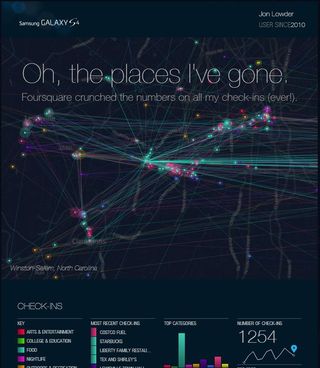
This screenshot below is a map that shows my 1200+ checkins over the last few years and some graphs that show the kind of places I like visit. It won't surprise anyone who knows me that I really like coffee shops.

Here's what's really smart about it though: the time machine then asks if I want to see the future and then takes the opportunity to recommend places to visit based on my history. What I like about this is it highlights parts of Foursquare that I haven't used, didn't really realize I could use, and will now probably utilize. Basically they've helped me understand that this could be much more than just a gimicky, fun, service as Fred Wilson pointed out in his post about Time Machine:

I've been using Foursquare for about four years and have checked in almost 5,000 times. That's an average of 3.4x a day. No wonder Foursquare is so good at making recommendations for me when I am in places I don't know much about.

I plan on testing Foursquare's recommendations on my next trip. As I use the recommendations I'll probably realize that if I were to check in more often I would get even better recommendations, which will lead to more check ins, which will lead to better recommendations, etc.

Importance of Being an Information Omnivore

How much time do you spend at work looking at information that would be classified as outside the realm of your expertise or not part of your core job description? If your answer is "very little" then you could be setting yourself up for eventual failure or at a minimum unnecessarily limiting your ability to succeed. Why? Because you need to understand not just your world, but the universe in which your world exists.

If you need an example you need look no further than what has happened to many people in the newspaper industry. 15 years ago many newspapers were riding high, boasting fat profit margins and enjoying monopolies in their markets. Then they were blindsided by what the internet represented – a distributed network of information sharing that pushed them from the center of the daily information ecosystem. Should the folks working in the newspaper industry have seen it coming? In retrospect it's easy to say yes, but at the time the vast majority of them had not an inkling of what the internet/web was about and so could not conceive how they might be able to utilize it to beat their competition, much less prevent it from decimating their entire business.

But what if some of the senior newspaper execs had spent the late '80s or early '90s looking at the larger universe of information distribution, looking at their circulation operations as one form of information distribution and figuring out how these new forms of distribution could change their business? It's quite likely that some did, and surely there are publishers out there who can point back to efforts at starting fax-based updates, email alerts, etc. But how many truly took the time to understand the underlying shift in information flow, to grasp how the new technology would be adopted by their customers and how they might shift to meet those changing consumption patterns? It's pretty plain by the state of the industry today that not many succeeded if they tried.

Over the last few years the big shift for many industries has been the rapidly expanding adoption of smartphones (over 50% of the US market now uses smartphones), but anyone who's been paying attention has seen it coming and hopefully has been adjusting to address this new reality. But what's next? What's the next big shift in how we do business going to be? It could be something related to Bitcoin, and the why is explained by venture capitalist Fred Wilson in a blog post he wrote to explain his firm's investment in a company called Coinbase:

We believe that Bitcoin represents something fundamental and powerful, an open and distributed Internet peer to peer protocol for transferring purchasing power. It reminds us of SMTP, HTTP, RSS, and BitTorrent in its architecture and openness. Like what happened with those other low level protocols, entrepreneurs and developers are now building technology on top of Bitcoin to make it more useful, more accessible, and more secure.

This has the smell of something important because it could potentially change how companies exchange services for compensation. What's more fundamental to a business than that? More importantly, how much could something like that change your business? Well, how much did the wide adoption of credit cards change business 30+ years ago? But that only offers part of the answer since this feels like something that eases transactions like credit cards did, but expands the market like the web did.  And who could this new development threaten? The banks are a good bet.

So who thinks that bankers truly understand what this could represent? Sure, they see it and they think about it, but how many truly understand the tectonic shift going on beneath the surface. Probably not many, because you can bet there probably aren't many bankers who have stopped counting their money long enough to try and understand this "Bitcoin World" and they could suffer the fate that many newspapers have over the last ten years.

That's where the title of this post comes into play. It is vitally important for all of us to be information omnivores, because you must understand the larger context in which you're working and living. While you don't need to understand all the technology that underlies what we do, just like you don't have to know how an internal combustion engine works to understand the affect of cars, you do need to understand how their application and adoption will affect your business or your life. How do you do this? Simply by being curious. Watch TED talks, read articles in trade magazines from industries that aren't your own, read the blogs of experts in other fields, take a class at a local community college or take a free class from one of the online programs like Coursera. The possibilities are almost endless and even if you never apply the information you glean to your day job you'll know something you wouldn't have otherwise. Worst case scenario you'll probably get better at Trivial Pursuit and you'll be able to wow people at dinner parties with your amazing grasp of (seemingly) worthless knowledge. More likely you'll find that your newfound knowledge will come in handy in ways you never anticipated.