Category Archives: Media

Reading Mrs. Adkins

Anne Adkins has been writing an occasional column for the Winston-Salem Journal for a while now and I must say that, to me, her writing is consistently the best in the paper. From this Sunday's column

George got a job and over the next few months he paid back his loan and appeared to be doing just fine. In those years immediately following World War II, our generation was full of halcyon dreams springing from the conviction that after years of war, we would bring to the world lasting peace. Who would have thought that early one morning on a Virginia mountain road, George’s body would be found face-down in a ditch with a bullet hole in the back.

That was nearly three-quarters of a century ago. As far as I know, no one ever found out who killed George. As the years went by, Al and I, like most of our generation, worked hard, raised our kids, saw more wars come and some of them go, and squeezed the best part out of living. And like every generation before us, we also buried our dead.

Last week a beat-up, yellow truck sped past me on the highway. Suddenly the years peeled away, leaving me with the sharpness of a memory unexpectedly returned. I shut my eyes and there George was, my young lost friend, tossing me one more smile.

I smiled back at the bittersweet thought of a young lost friend who never had the chance to find his way, but for one shining moment in time was King of the Road, gridiron hero of the Golden Wave, the sweetest guy in town.

Embracing the Inevitable

The approach taken by the Rijksmuseum in Amsterdam might very well be the approach some businesses should embrace with their content:

Many museums post their collections online, but the Rijksmuseum here has taken the unusual step of offering downloads of high-resolution images at no cost, encouraging the public to copy and transform its artworks into stationery, T-shirts, tattoos, plates or even toilet paper.

The museum, whose collection includes masterpieces by Rembrandt, Vermeer, Mondrian and van Gogh, has already made images of 125,000 of its works available throughRijksstudio, an interactive section of its Web site. The staff’s goal is to add 40,000 images a year until the entire collection of one million artworks spanning eight centuries is available, said Taco Dibbits, the director of collections at the Rijksmuseum.

Pretty cool huh? If you think about it the museum is kind of doing what companies do with their customers and biggest fans: get them to promote their brand by plastering logoes and other corporate images all over shirts, cups, etc. What's obviously different is that the museum is having them slather their unique "products" on those various and sundry items and some artists or for-profit publishers might not like that. Also, as the museum's director points out, the museum is a different position than a for-profit entity:

“We’re a public institution, and so the art and objects we have are, in a way, everyone’s property,” Mr. Dibbits said in an interview.

But in the next breath he makes a very good argument for why companies might very well embrace the museum's approach even if they own the subject matter:

“‘With the Internet, it’s so difficult to control your copyright or use of images that we decided we’d rather people use a very good high-resolution image of the ‘Milkmaid’ from the Rijksmuseum rather than using a very bad reproduction,” he said, referring to that Vermeer painting from around 1660.

Of course this approach won't work for everyone, but the combination of free publicity and quality control make it a viable consideration for many content creators.

Remembering Sidd Finch

28 years ago in the spring semester of my freshman year of college I read one of the greatest magazine articles ever written. It appeared in the April 1, 1985 issue of Sports Illustrated and with its publication the author, George Plimpton, perpetrated one of the all-time great April Fool's jokes. Titled "The Curious Case of Sidd Finch" it profiled an extraordinary pitcher that the New York Mets were trying to woo into uniform and upon re-reading it almost 30 years later I'm amazed at my recollection of how many people actually believed it. Read it for yourself to see why:

The phenomenon the three young batters faced, and about whom only Reynolds, Stottlemyre and a few members of the Mets' front office know, is a 28-year-old, somewhat eccentric mystic named Hayden (Sidd) Finch. He may well change the course of baseball history. On St. Patrick's Day, to make sure they were not all victims of a crazy hallucination, the Mets brought in a radar gun to measure the speed of Finch's fastball. The model used was a JUGS Supergun II. It looks like a black space gun with a big snout, weighs about five pounds and is usually pointed at the pitcher from behind the catcher. A glass plate in the back of the gun shows the pitch's velocity—accurate, so the manufacturer claims, to within plus or minus 1 mph. The figure at the top of the gauge is 200 mph. The fastest projectile ever measured by the JUGS (which is named after the oldtimer's descriptive—the "jug-handled" curveball) was a Roscoe Tanner serve that registered 153 mph. The highest number that the JUGS had ever turned for a baseball was 103 mph, which it did, curiously, twice on one day, July 11, at the 1978 All-Star game when both Goose Gossage and Nolan Ryan threw the ball at that speed. On March 17, the gun was handled by Stottlemyre. He heard the pop of the ball in Reynolds's mitt and the little squeak of pain from the catcher. Then the astonishing figure 168 appeared on the glass plate. Stottlemyre remembers whistling in amazement, and then he heard Reynolds say, "Don't tell me, Mel, I don't want to know…."

The Met front office is reluctant to talk about Finch. The fact is, they know very little about him. He has had no baseball career. Most of his life has been spent abroad, except for a short period at Harvard University…

Finch's entry into the world of baseball occurred last July in Old Orchard Beach, Maine, where the Mets' AAA farm club, the Tidewater Tides, was in town playing the Guides. After the first game of the series, Bob Schaefer, the Tides' manager, was strolling back to the hotel. He has very distinct memories of his first meeting with Finch: "I was walking by a park when suddenly this guy—nice-looking kid, clean-shaven, blue jeans, big boots—appears alongside. At first, I think maybe he wants an autograph or to chat about the game, but no, he scrabbles around in a kind of knapsack, gets out a scuffed-up baseball and a small, black leather fielder's mitt that looks like it came out of the back of some Little League kid's closet. This guy says to me, 'I have learned the art of the pitch….' Some odd phrase like that, delivered in a singsong voice, like a chant, kind of what you hear in a Chinese restaurant if there are some Chinese in there.

"I am about to hurry on to the hotel when this kid points out a soda bottle on top of a fence post about the same distance home plate is from the pitcher's rubber. He rears way back, comes around and pops the ball at it. Out there on that fence post the soda bottle explodes. It disintegrates like a rifle bullet hit it—just little specks of vaporized glass in a puff. Beyond the post I could see the ball bouncing across the grass of the park until it stopped about as far away as I can hit a three-wood on a good day.

"I said, very calm, 'Son, would you mind showing me that again?'…

"Well, what happens next is that we sit and talk, this kid and I, out there on the grass of the park. He sits with the big boots tucked under his legs, like one of those yoga guys, and he tells me he's not sure he wants to play big league baseball, but he'd like to give it a try. He's never played before, but he knows the rules, even the infield-fly rule, he tells me with a smile, and he knows he can throw a ball with complete accuracy and enormous velocity. He won't tell me how he's done this except that he 'learned it in the mountains, in a place called Po, in Tibet.' That is where he said he had learned to pitch…up in the mountains, flinging rocks and meditating. He told me his name was Hayden Finch, but he wanted to be called Sidd Finch. I said that most of the Sids we had in baseball came from Brooklyn. Or the Bronx. He said his Sidd came from 'Siddhartha,' which means 'Aim Attained' or 'The Perfect Pitch.' That's what he had learned, how to throw the perfect pitch. O.K. by me, I told him, and that's what I put on the scouting report, 'Sidd Finch.' And I mailed it in to the front office."

Believe me, it gets better from there. 
Five Seconds of Fame

Thanks to my job I'm occasionally interviewed by local TV stations. It's cool in the "I never thought I'd be on TV" sense, but on the other hand it's a little like jumping off a cliff because you learn pretty quickly that the TV folks can make you look as good or bad, smart or stupid, as they want.

Last Friday I was fried. We had our annual banquet the night before and my brain was little more than Jell-O as a result. Luckily I had a light schedule so I was cruising through my day until the phone rang at 12:30. It was the local Fox affiliate looking for some background on a story they were working, and also looking for a soundbite if at all possible. Knowing I was in no shape for an interview I claimed a full schedule. Nominally true, but I really just didn't want to do the interview. Eventually the reporter persuaded me to talk and we set a 2:30 appointment. 

The result? A half hour of prep work followed by a total vapor-lock of the brain as soon as the camera was on. Luckily they took mercy on me and only used about five seconds of the interview, thus minimizing my on-camera freeze

Here’s What You Should Know

A good suggestion for news organizations from Jeff Jarvis:

So the opportunity: If I ran a news organization, I would start a regular feature called, Here’s what you should know about what you’re hearing elsewhere.

Last week, that would have included nuggets such as these:

* You may have heard on CNN that an arrest was made. But you should know that no official confirmation has been made so you should doubt that, even if the report is repeated by the likes of the Associated Press.

* You may have heard reports repeated from police scanners about, for example, the remaining suspect vowing not to be taken alive. But you should know that police scanners are just people with microphones; they do not constitute official or confirmed police reports. Indeed, it may be important for those using police radio to repeat rumor or speculation — even from fake Twitter accounts created an hour ago — for they are the ones who need to verify whether these reports are true. Better safe than sorry is their motto…

* You may have heard reports that there were more bombs. But you should know that we cannot track where these reports started and we have no official confirmation so you should not take those reports as credible. We are calling the police to find out whether they are true and we will let you know as soon as we know.


Blogageddon

In the span of 18 hours I learned that my RSS manager of choice, Google Reader, is going dark as of July 1, 2013 and that the Godfather of Blogging in the Triad is shutting down his blog for a while.  I understand Ed's motivation – I long ago morphed into a leisurely poster here because I just didn't have the time or energy to manage an ongoing dialogue like he has for 12 years – but I'm still really bummed to see him pull the plug. It will be interesting to see if anything fills the online void in Greensboro.

A serious hat tip to Ed for providing a valuable online forum for the Greensboro community. I hope he enjoys the peace and quiet.

Reportero

Watching the documentary Reportero it's hard to compare the folks at Zeta with just about any media outlet in the US and not come away believing that the US media outlets are filled with vapid wusses who take for granted their First Amendment protection and that they ply their trade in a place where doing their job rarely leads to physical harm. To be fair it would be hard not to look like a wuss in comparison to the Zeta folks, but many of our outlets give the impression they'd be out of their league in a junior high journalism competition.

For those of you without the patience to watch the video here's the description from the documentary's webpage:  Reportero follows a veteran reporter and his colleagues at Zeta, a Tijuana-based independent newsweekly, as they stubbornly ply their trade in one of the deadliest places in the world for members of the media. In Mexico, more than 50 journalists have been slain or have vanished since December 2006, when President Felipe Calderón came to power and launched a government offensive against the country's powerful drug cartels and organized crime. As the drug war intensifies and the risks to journalists become greater, will the free press be silenced? 

Too bad we can't trade Fox, MSNBC, NYT, WaPo etc. for them. We'd come out way ahead.

Watch Reportero on PBS. See more from POV.


Does the World Need a Dadzine?

Ever noticed the seemingly endless – and often mind-numbing – number of magazines dedicated to mothers? Well, there's a new entry into the relatively unexplored "dad-zine" field:

Kindling Quarterly is an exploration of fatherhood. Through essays, interviews, editorials, art, and photography we highlight creatie individuals whose work and lives are inseparable from their role as a parent. There is no shortage of familiar portrayals of dads in media yet we aim to present a thoughtful dialogue about fatherhood that is missing from our cultural landscape. Men who are active caregivers are not a novelty and we do not depict them as such. While the subjects of our stories are fathers, each issue appeals to anyone interested in art, creativity, and community. Kindling Quarterly playfully assesses and celebrates a multitude of experiences that form contemporary fatherhood.

It's a mistake to judge a magazine by its cover before you even see the cover, but this sounds like it will appeal to roughly .5% of the fathers in America. Another mistake is to engage in gross generalizations, but what's life if nothing but a series of mistakes interrupted by occassional success? So here are some general descriptions of dads that would argue against the vast majority having any interest in a magazine focused on "art, creativity and community":

  • Approximately 99% of dads don't read anything they aren't paid to read. In other words most of them feel that reading is something only a fool would do outside of work requirements.
  • There's a reason those portrayals of dads in the media are so familiar – they're largely accurate and approximately 99% of dads will gladly own up to that fact.
  • If "art" does not include scantily clad women of some variety then 99% of dads would agree it's not really art. (Anyone familiar with what happens to men when their personal lives are assaulted by fatherhood would surely understand this phenomenon).
  • Most dads love their kids, but the last thing they want to do is think about what it means to be a dad. Their wives (or baby-mamas) force them to engage in those "meaning of fatherhood and marriage" discussions ad nauseum so why would they spend their precious free time reading about it?

Hopefully the folks at Kindling will find enough dads who don't fit the mold described above to make their venture a success, but based on the description above there's reason to be concerned for its viability. It appears they're aiming for an elite crowd, which of course precludes this dad from being a suitable target, so perhaps these points are moot. Hopefully so and here's hoping that the folks at Kindling enjoy great success.

Edit!

CascadesStory
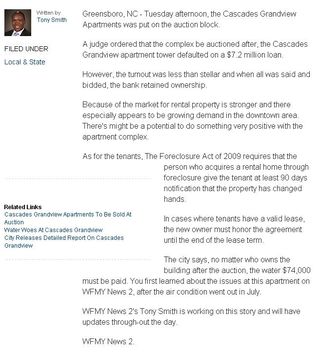
This is an open plea for someone, anyone, to provide a copy editor to certain local news organizations. It's articles like this one that will start grammar teachers spinning on their heads:

A judge ordered that the complex be auctioned after, the Cascades Grandview apartment tower defaulted on a $7.2 million loan…

Because of the market for rental property is stronger and there especially appears to be growing demand in the downtown area. There's might be a potential to do something very positive with the apartment complex…

The city says, no matter who owns the building after the auction, the water $74,000 must be paid. You first learned about the issues at this apartment on WFMY News 2, after the air condition went out in July.

Keep in mind that these are just a couple of the errors found in an eight paragraph piece

An Ink-Stained Wretch Laments

The Carrboro Citizen is shutting down its presses and its publisher, Robert Dickson, wonders aloud what the future holds for newspapers:

The problem is that professional journalism costs money, and that we have all gotten way too comfortable with getting our news for free. Journalists don’t make much money (just ask the Citizen staff), but they’ve still got to eat.

Newspapers have done this to themselves though, and pulling back from the brink is proving to be painful. The siren song of Internet advertising cash has not made up for the lost revenue from print editions. So, what do you know, newspapers across the land are deciding to charge for their online content. Gee, what a concept…

I’ve heard a neighbor tell me how easy it is to defeat the pay wall at The New York Times. The best $3.75 I spend every week is on that newspaper, and I can’t imagine a day without it. What’s our world going to be like when the Grey Lady goes down because readers won’t pay for content? Or The Wall Street Journal or The Washington Post or The News & Observer?

The republic will be on the rocks, that’s what will happen. We can have all the instant information we want, but we have to be able to trust it to make reasonable decisions…

So what does this have to do with the demise of The Carrboro Citizen? My pondering has led me to the belief that one future of hyperlocal news outlets, at least in the style of The Citizen, is as nonprofit entities.

It’s likely too much to ask of small local businesses to provide sufficient advertising revenue to sustain the necessary news coverage for a community like ours. A locally owned and operated nonprofit, however, could supplement ad sales with reader support and maybe a few grants, and come up with a sustainable model for local long-form journalism.

Who knows how we'll get our news in the future? Last night the country suffered through the first of three Presidential debates scheduled for this election season, and many of us tracked it by monitoring Twitter or Facebook. Who could have predicted even fifteen years ago that we'd be getting real-time "news" in 140 characters or less on a smart phone?

But that's news in the most shallow of senses, and does not answer the question of how/where we'll get the lcoal in-depth stories that have traditionally been the province of newspapers. Quite frankly the issue isn't the delivery system – paper vs. digital – but the ability for the people producing the stories to make a living doing it. 

The idea of creating a non-profit to house a local news operation is a good one, and for at least one more reason than Mr. Dickson mentioned: a non-profit is not owned by any one person and answers to a board of directors. Unlike a publicly owned company it isn't driven by the need to meet quarterly profit projections, and unlike a privately owned company it doesn't have to meet an owner's financial expectations or needs. Sure there will be people who exert more control on the organization than others, but there are mechanisms built into a non-profit corporation's structure that help prevent it going off the rails and losing focus on its mission. In fact, maybe its most important aspect is that its core mission moves from creating profit for its owners to serving its community's information needs. 

A non-profit structure wouldn't be a panacea, but if the objective is to create an institution that serves a community's information needs then it's probably a better fit than just about any other at this point in time. There's nothing wrong with for-profit newspapers, but as Mr. Dickson points out their days may be numbered.