Need a way to get your kid to do something unpleasant like, oh, cleaning his pig sty of a room? Daniel Pink has an interesting approach:
Motivating Your Kids – or Clients – by Asking the Right Questions
Leave a reply
Need a way to get your kid to do something unpleasant like, oh, cleaning his pig sty of a room? Daniel Pink has an interesting approach:
Lex has a post about the state of American journalism that ends thus:
Nobody’s coming to save American journalism. Some observers have finally figured that out. And we’ve seen that right here in Greensboro, where billionaire Warren Buffett, the News & Record’s new(-ish) owner who has repeatedly professed his love for newspapers, has made it abundantly clear that he has no use for newspaper people. When the Batten family decided to get their money out of the news bidness and put the N&R and the Landmark chain’s other papers up for sale, Buffett was seen as a savior. Not so much, it has turned out.
At the front lines of journalism, reporters have to report. What’s your best story? Give THAT to your editor, then, and forget the craven or just plain silly assignments that come down from the publisher and the executive editor and the managing editor. Your bosses might have a nose for real news, but my observation of American journalism leads me to think the odds are very much against it anymore. So, you with the laptop, you with the camera, you with the microphone, you with the blog: You’re it. You are all there is. Go get better, go do better. Because it’s you or nobody.
Another way to look at it is that the Fourth Estate is being crowd sourced. Let’s get to it people.
This is just cool.
Let’s set the stage. Two brothers, one conservative and one liberal, are having a lively debate on a C-SPAN show and the show includes a call-in segment. It gets fun when they realize that Joy from Raleigh, NC is their Mom.
http://www.c-span.org/video/?c4519563/joy-woodhouse-calls-c-span-brothers
This weekend my wife and I spent time with some friends and I was (pleasantly) surprised to learn that one of them was a Christmas curmudgeon. For years I’d always felt like I was alone in my sentiment towards the holiday, but lo and behold there was a comrade-in-curmudgeonliness in my own circle of friends.
The life of a Christmas curmudgeon is largely spent faking it. Pretending to enjoy all the trappings, like hanging lights, trimming the tree, hanging stockings, buying gifts, etc. When our kids were little I did truly enjoy watching their excitement build in the week before Christmas, the anticipation of Christmas Eve and their sheer joy on Christmas morning. Outside of that I’ve just never liked the rest of it. The stress of gift buying, of determining where you’re going to spend the holiday, of trying not to offend family or friends if you don’t spend the holiday with them and the accumulation of small annoyances like crappy music played endlessly and people getting their panties in a twist if you say “Happy holidays” instead of “Merry Christmas” all conspire to cause me to view Christmas the way most people view an audit.
So it was kind of refreshing to meet someone who generally feels the same way. When it’s just you it feels like you’re abnormal; everyone else seems to love Christmas so if you don’t you must be broken or emotionally warped. I do think almost everyone gets stressed during the Christmas season, but the vast majority seem to think that the rest of season’s trappings far outweigh the stress.
Not me. I’d love to see us return to the days when it was all about the religious ceremony, the quote-unquote true meaning of Christmas, and not about the trappings of the season. Actually that might be the biggest annoyance of all – the pure hypocrisy of the people who complain about the commercialization of Christmas and then proceed to hang 8 gazillion lights around their house and buy new cars for each other as stocking stuffers.
So let this curmudgeon end on a high note: I do love the lights and I do love seeing family for any reason, so it could be worse.

In an extensive piece that explores whether or not Malcolm Gladwell engaged in plagiarism for several articles he wrote for The New Yorker, Our Bad Media cites a 1970 book on the Greensboro sit ins as one of the sources he allegedly copied without attribution. From the Our Bad Media piece:
In his 2010 New Yorker column “Small Change,” Gladwell took a skeptical look at the use of social media as a tool for activists, discussing the often over-hyped impact of Facebook and Twitter’s effects on protests around the world. He drew parallels throughout the piece to the civil rights movement, mostly by recounting the story of the historic 1960 Greensboro sit-ins, when four black college students began a protest at Woolworth’s over its whites-only lunch counter.
Whereas the previous examples may have been limited in scope, the entirety of Gladwell’s description of the Greensboro sit-ins in his column—including quotes, descriptions of the Woolworth’s, and the sequence of events—are lifted from Miles Wolff’s authoritative but obscure 1970 book, Lunch at the Five and Ten.
We double-checked the print versions of The New Yorker to check if the online edition omitted any attributions or citations. It doesn’t. Gladwell again makes no mention of the author or his book despite building an entire column around it.
Below are the side-by-side comparisons of all Greensboro-related passages from the print edition of Gladwell’s article (in order) and the relevant passages from Wolff’s book.
If you follow the link to the post you’ll find close to a dozen excerpts from Gladwell’s article that match passages from the book. Methinks he might be in some hot water.
For those of you who don’t live in the Winston-Salem area you probably haven’t had the pleasure of eating at Mary’s Gourmet Diner, but you might have heard about the social media kerfluffle that broke out a couple of months ago when someone posted the discount they got for praying, aka showing gratitude. Some people jumped on the story and started screaming discrimination, but once the local press started digging into it what was revealed is that Mary’s had a long-standing policy of letting their servers give on the spot discounts for acts of kindness, “moments of Zen”, etc.
From a business standpoint it was probably a bit risky as a policy because it did open the doors for misunderstandings and perceived bias, but on the other hand it was a positive way for the proprietor, Mary Haglund, to empower her employees to acknowledge positive patrons. (How’s that for a little bit of alliteration?) Anyway, the story got the Daily Show’s attention and it was nice to see they exposed the “perpetual panties in a twist” nature of the shouters.
Video is below, and here’s a link in case it doesn’t load here for some reason. If you aren’t from Winston-Salem and end up visiting our fair city then by all means visit Mary’s – great food and atmosphere.
Fred Wilson writes a blog that is probably one of the easiest places for anyone interested in the future of our online lives to get a peek at what’s coming down the road. He and his venture fund have been early funders of companies like Twitter, Tumblr, Feedburner, FourSquare, SoundCloud, Etsy, MeetUp, Kickstarter and many more. In other words they know their sh**.
That’s what makes this recent post on Wilson’s blog so interesting and exciting:
We made this investment, in a neat company called Veniam that comes out of Porto Portugal, some time earlier this year but they finally got around to announcing it yesterday…
So enough about all of that. What does Veniam do? They make a “stack” of wireless technology that lets moving objects (think buses, garbage trucks, cars, vans, etc) carry a wifi access point/router and mesh with each other and anyone else who wants to join the network. With enough density, buses driving around your city can provision a wireless mesh that anyone can use on their smartphone when they are out and about. It’s a big vision and will take a lot of work (and luck) to realize, but this or something like it is eventually going to work and we are going to have a better way to access the internet on our phones than we have today.
Even if Veniam isn’t the solution, if these guys are backing it then there’s a very good chance that there will be a solution soon. That’s very exciting for those of us who’d like to cut the last-mile cord owned by the telecom/cable axis.
One of the blogs I read on a frequent basis, SwissMiss, has a sponsor called Karma. Karma provides mobile wifi that is not tied to any specific carrier and does not require a contract. In other words it’s like the various wireless carriers’ MiFi devices, but you don’t have to sign a contract and you pay for the data as you go. Their website lists the retail price for the device at $149 – they’re running a special for $99 right now – and the data rates are $14 per GB with discounts available for bulk purchases.
A quick search for comparisons of MiFi plans brought me to this page that compares the providers that require contracts – AT&T, Verizon, Sprint and T-Mobile – and the no-contract providers, Virgin and T-Mobile Monthly 4G. Karma seems to stack up well price-wise against all of them in terms of data plans and since there doesn’t seem to be a time limit on using the data this could be very useful for someone like me who might use a ton of data one month, say while on a business trip, and then not a lot of data for a couple of months at a time.
With the low price of the device itself this seems like a no-brainer. I’ll let you know how it goes if I end up testing it, and would love to hear from anyone else who has given it a try.
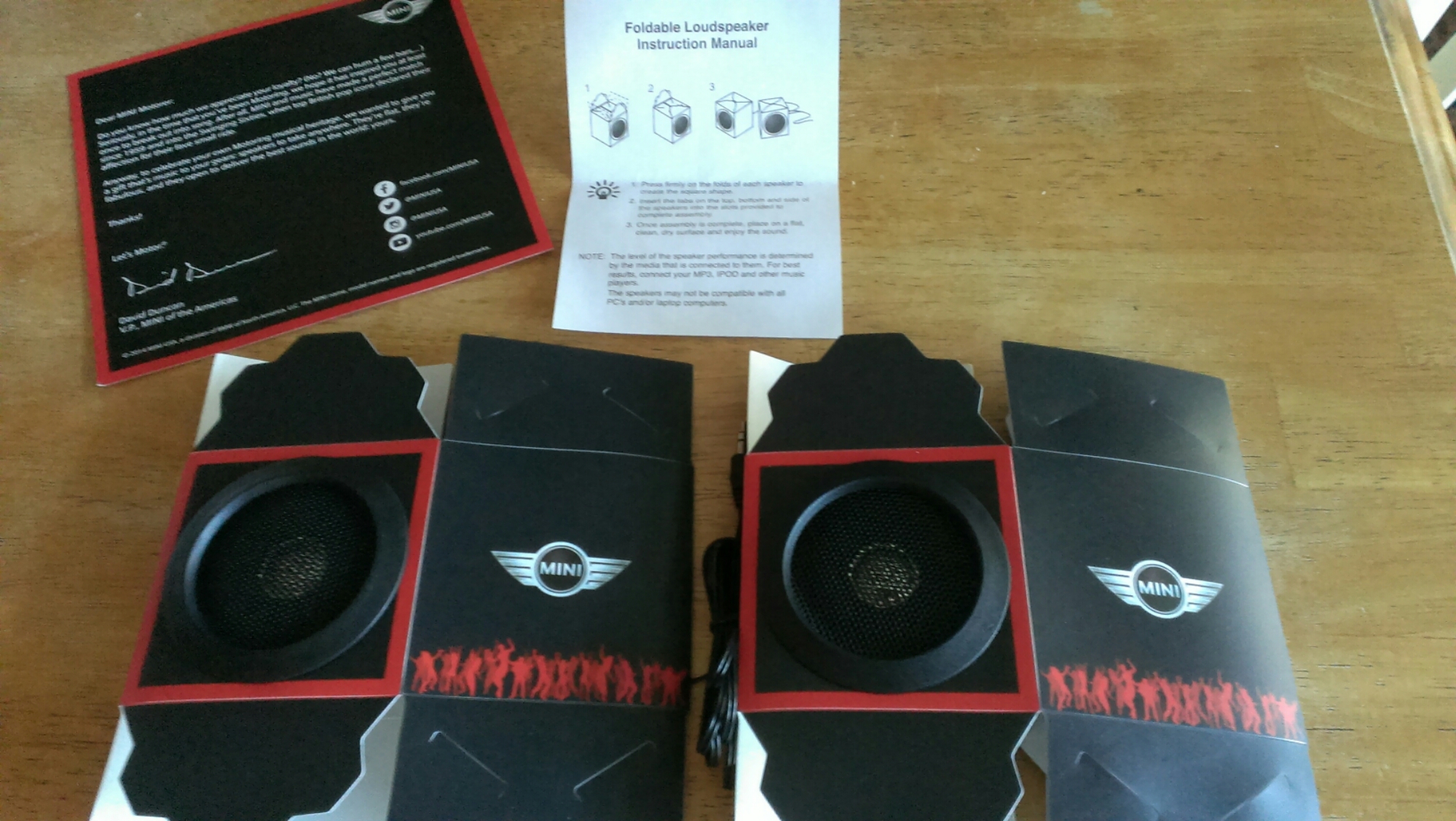
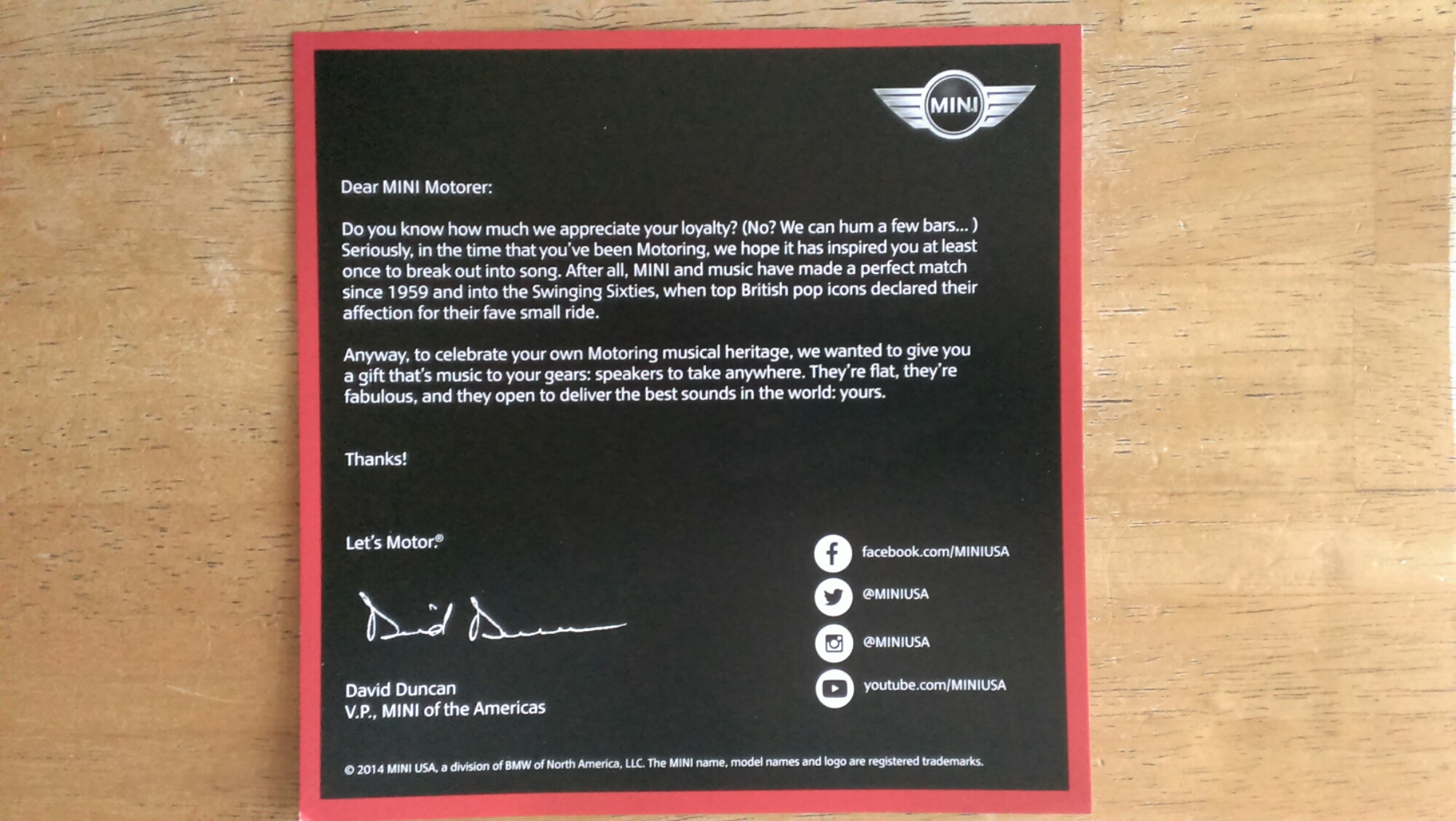
Mini Cooper truly has some smart marketing folks. Yesterday my wife, who’s been driving a Mini for about two years, received a package with what she thought was a free music CD. Instead it was two portable speakers that can be folded flat and are intended to be used to provide “music for your gears” while motoring.
So smart. An unexpected, no strings show of appreciation for their customers.

 Befuddled