Category Archives: Food and Drink

Why My Coffee Habit is a Very Good Thing

Those of you who know me well can probably appreciate how happy this article – The Case for Drinking as Much Coffee as You Like – made me:

"What I tell patients is, if you like coffee, go ahead and drink as much as you want and can," says Dr. Peter Martin, director of the Institute for Coffee Studies at Vanderbilt University. He's even developed a metric for monitoring your dosage: If you are having trouble sleeping, cut back on your last cup of the day. From there, he says, "If you drink that much, it's not going to do you any harm, and it might actually help you. A lot."

Officially, the American Medical Association recommends conservatively that "moderate tea or coffee drinking likely has no negative effect on health, as long as you live an otherwise healthy lifestyle." That is a lackluster endorsement in light of so much recent glowing research. Not only have most of coffee's purported ill effects been disproven – the most recent review fails to link it the development of hypertension — but we have so, so much information about its benefits. We believe they extend from preventing Alzheimer's disease to protecting the liver. What we know goes beyond small-scale studies or limited observations. The past couple of years have seen findings, that, taken together, suggest that we should embrace coffee for reasons beyond the benefits of caffeine, and that we might go so far as to consider it a nutrient.

Reading this was literally like having angels sing in my ear. Oh happy days!

The Diet I Could Love

Diets are horrible, but as an unabashed spud lover this is one I could embrace:

This is the "magic" of potatoes. You can literally live off them, and some people have and do. Of course, you don't want to, nor do I, but it's a useful tool when you understand what's going on, which is one hell of a lot of things as I'm learning…

Yes, as I said, 5 pounds in 3.5 days. It's 1:43pm and I'm still not hungry and have had nothing since the plate I ate last night, recipe to follow. So let's get to the hash browns, just in case you get tired of french fries.

I'm in!

Chicken of the Trees

Apparently squirrel is making it back on the menu in Chicago-of-all-places:

But somewhere along the way, squirrel declined in popularity as a game animal, replaced by bigger quarry, such as deer and turkey, whose numbers had grown in the countryside as the number of humans dwindled. Mainstream views on squirrel eating began to drift toward disdainful—it became something hillbillies and rednecks did. In the late 90s a pair of Kentucky neurologists posited a link between eaters of squirrel brains—a time-honored delicacy among hunters—and the occurrence of a variant of Creutzfeldt-Jakob disease, a theoretical but terrifying new mad squirrel disease. (Peer review later deemed this connection unlikely.) And though noted woodsman and Motor City Madman Ted Nugent devoted a few pages of his wild game cookbook Kill It and Grill It to "Limbrat Etouffee" in 2002—written with a vengeance he typically reserves for sitting Democratic presidents—when the 75th-anniversary edition of Joy of Cooking was published four years later, for the first time in the book's history it didn't include an illustrated how-to for pulling the skin from a squirrel.

Squirrel eating may be making a comeback, however, at least among those with au courant appetites for sustainable, healthy, and locally sourced meats. CNN.com's food blog Eatocracy has encouraged readers to seek out sources of squirrel meat—"more earthy and sumptuous than the darkest turkey." Hunting and foraging authority Hank Shaw has spilled plenty of ink on this "gateway" prey, an abundant animal that hones the hunter's skill for bigger game. It's delicious too, he argues, its pink flesh more dense than a rabbit's, which takes on the nutty flavor of whatever it's been eating.

It's passages like this that might give you pause:

After the heads braised in mirepoix and sherry, a friend demonstrated with a nutcracker the proper technique for extracting a squirrel brain from its cranial cavity, and a half dozen of us popped them into our mouths. They looked like oversize walnuts and tasted slightly creamy, almost like a soft, roasted chestnut. We pulled out the tongues and cheeks, which contained the most concentrated expression of squirreliness. One guest described the meat from the head as "nutty"; others compared it to pork, duck, or lamb. To me this seemed like the very essence of the rodent. If squirrels grew to the size of pigs, you'd really have something.

Yummy. Try getting "tongues and cheeks, which contained the most concentrated expression of squirreliness" out of your head before you eat your next bowl of brunswick stew.

Really you need to go for the article, but stay for the pictures, including the classic photo of a baby sitting in the midst of dead squirrels.

Coffee Addict App

I'm wondering if I can afford the $1 for the Droid version of this app:

Two doctors at Penn State University have developed Caffeine Zone, a free iOS app that tells you the perfect time to take a coffee break to maintain an optimal amount of caffeine in your blood — and, perhaps more importantly, it also tells you when to stop drinking tea and coffee, so that caffeine doesn’t interrupt your sleep.

Red Wine Research

First the bad news:

Remember all that research about resveratrol, the compound in red wine said to help your heart? "Following a three-year investigation, a university review board has concluded that Dipak K. Das, Ph.D., the director of the Cardiovascular Research Center at the university's school of medicine, in Farmington, manipulated research data in at least 145 instances."

Then the good news from one of the commenters on the post:

While scientific misconduct is a serious matter, it is worth understanding that this isn't about "all that research about resveratol" as the summary puts it, but rather just the research on it by a particular researcher in Connecticut, who was neither the first nor most significant researcher in the field.

I'm choosing to believe that red wine is still all it was cooked up to be.

In Praise of a Great Cup of Joe

Anyone who knows me knows I love a good cup of coffee.  Love is an understatement, but appropriate adjectives would likely be unsafe for young/workplace readers so let's just stick with unadulterated love.  That's why I totally get this letter, written by the the third Secretary of the Smithsonian:

Dear Mary,

I hope this will interest you.

Affectionately,

Your Uncle Samuel

The best coffee in Carlsbad is at the Posthof, and is as good as I know of anywhere. I have been looking into the kitchen this morning and seeing it prepared. The statement that figs or anything of the kind are employed is legendary. There is absolutely nothing but coffee, and it owes its superior excellence to the freshness and the pains taken in its making.

1. The coffee in the berry.

There are four kinds of coffee bean employed: the Menado, Ceylon, Java and Preanger. I do not know the English equivalents for the first and last. They are of very different sizes indeed, and this difference in size of the berry must make it difficult to burn them equally.

2. Roasting.

The roasting is done in a rotary wire mesh over a slow fire. The coffee is renewed three times daily. Each time 10 to 20 pounds of coffee is roasted, a girl turning the handle, and the process occupying in each case nearly an hour. In spite of this care, when the beans come out some of them are very dark and these are picked out.

3. Grinding.

The coffee is then ground to a very uniform fineness, something between the head of a small pin and a coarse sand. It is in no ways ground into a snuff-like powder, but is always clearly perceptible as particles between the fingers. The color of the ground coffee is a light chestnut.

4. Mixing with water.

Somewhat over one-quarter of a pound of the ground coffee is measured in a tin and this is emptied into a tin pail holding, I suppose, four to six gallons. Into this is poured, actually boiling soft water, enough to make 10 portions of the coffee. This softness is considered so important, that if the water be at all hard, a little soda is first added to soften it. The coffee and water are then well stirred with a spoon, and the lid put on and allowed to remain two minutes, when it is poured onto a thick straining cloth placed in a tin vessel with large holes at the bottom through which it drains into a white stone pitcher, which is itself set in boiling water. From this pitcher it is poured into the little ones in which it is served on the table.

5. Serving.

The amount of coffee and water just described will, as I have said, make 10 portions, each of which will be, with the addition of the milk, two of the little cups here, or hardly one good breakfast cup as we have it at home. It is served ordinarily with milk which has been boiled, and which has a little whipped cream on top.

6. Comment.

The one criticism I can make is that the coffee with the above proportion of water, is served too diluted for a café au lait. It would be better made half as strong again and diluted with a larger proportion of hot milk.

Now those who know me also no I can't stand anything in my coffee – cream or sugar is a degradation if you ask me – but I totally get how into the coffee he is.  A lousy cup of coffee is more likely to ruin the start of my day than some jackalope cutting me off in traffic, and a great cup of coffee is almost a guarantee for a great day.
Hyperdecanting

For you winos out there (I prefer wino to wine connosieur since being called wino makes me feel less snooty) here's an interesting way to decant wine:

Wine lovers have known for centuries that decanting wine before serving it often improves its flavor. Whatever the dominant process, the traditional decanter is a rather pathetic tool to accomplish it. A few years ago, I found I could get much better results by using an ordinary kitchen blender. I just pour the wine in, frappé away at the highest power setting for 30 to 60 seconds, and then allow the froth to subside (which happens quickly) before serving. I call it “hyperdecanting.”

Wearing Your Food

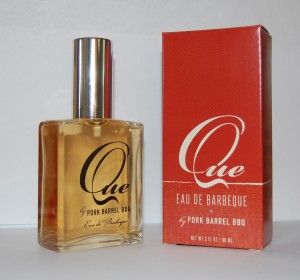
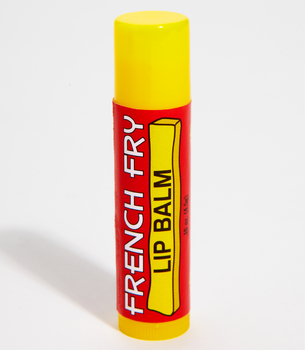
In the past if you said someone was wearing their food you'd almost certainly be implying that they were sloppy eaters. These days that's far from a certainty.  Why?  Well, it seems that wearing your food is the thing to do in 2011. If you don't believe me just check out the following:

FrenchFryLipBalm

French Fry Lip Balm

Spam-chapstick2

Spam Lip Balm

Bbqcologne

BBQ Cologne

And of course Lady Gaga's meat dress.