"A privately owned rocket built in partnership with NASA to haul cargo to the International Space Station blasted off on Sunday for a debut test flight from a new commercial spaceport in Virginia. The 13-story Antares rocket, developed and flown by Orbital Sciences Corp, lifted off at 5 p.m. EDT from a Virginia-owned and operated launch pad at NASA's Wallops Flight Facility on Wallops Island."
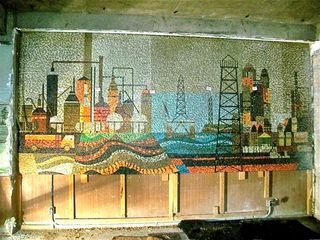
During the clearance sale, a puzzling discovery was made: a fifteen-foot mosaic mural commissioned by The Los Angeles Petroleum Club was found behind some old wood paneling. The Club had at one time maintained a posh member’s suite at the hotel. This is where the intrigue and mosaic sleuthing begins.
Some folks see grafitti and think "Now that's art" and others see it as the defacement of property. Personally I find even grafitti I like to be a defacement of someone's property unless of course the property owner invited the artist to work his magic. That's why in the realm of "unapproved" art I prefer something that's creative, easily removable and inherently temporary. Here's a great example:
Two things about this story are amazing: that something so seemingly simple hasn't been developed before and that something so seemingly simple still took a lot of work to, well, make simple.
British industrial designer Martin Riddiford has created a pineapple-size lamp powered by a 25-pound weight that falls about six feet in a half-hour. That may not sound like much, but it’s enough to drive a silent motor at thousands of rotations per second. The GravityLight, which shines slightly brighter than most kerosene lamps, requires a certain amount of elbow grease: Once the weight reaches bottom, it must be manually lifted to repeat the process.
Riddiford, 57, a co-founder of London-based product design firm Therefore, got the idea four years ago after leaving a meeting with a charity interested in solar tech. “I just sort of had this vision of, well, why can’t you use human power and store it as potential energy rather than in a battery,” he says. The designer, whose Brinlock Abacus calculator was the first with number-shaped buttons, and whose firm has developed products for Toshiba, Samsonite, and Nike (NKE), says he regrets not having done charitable work overseas in his youth and hopes to make up for it with his light. The first prototype, a large-scale contraption involving a bicycle wheel and a windup LED flashlight, was refined over four years into its current cheap yet durable plastic version. “It’s technically quite tricky to get it so it doesn’t jam, but we solved that problem through lots of experimentation,” Riddiford says.
If you want to buy me a book I'd like to recommend it be this one:
Hired by ForbesTraveler.com to review some of the most luxurious accommodations on Earth, and then inspired by a chance encounter in Dubai with the impoverished workers whose backbreaking jobs create such opulence, Bob Harris had an epiphany: He would turn his own good fortune into an effort to make lives like theirs better. Bob found his way to Kiva.org, the leading portal through which individuals make microloans all over the world: for as little as $25-50, businesses are financed and people are uplifted. Astonishingly, the repayment rate was nearly 99%, so he re-loaned the money to others over and over again. After making hundreds of microloans online, Bob wanted to see the results first-hand, and in The International Bank of Bob he travels from Peru and Bosnia to Rwanda and Cambodia, introducing us to some of the most inspiring and enterprising people we've ever met, while illuminating day-to-day life-political and emotional-in much of the world that Americans never see. Told with humor and compassion, The International Bank of Bob brings the world to our doorstep, and makes clear that each of us can, actually, make it better.
Maybe it's the online statistics course I'm taking right now, but for the first time in many moons I find myself fascinated by all things math related. This is way cool:
Here's an article written by a guy who got to test-drive Glass and came away impressed and convinced that it's not a matter of "if" but "when" we'll see Glass in consumers' hands:
But what’s it actually like to have Glass on? To use it when you’re walking around? Well, it’s kind of awesome.
Think of it this way — if you get a text message or have an incoming call when you’re walking down a busy street, there are something like two or three things you have to do before you can deal with that situation. Most of them involve you completely taking your attention off of your task at hand: walking down the street. With Glass, that information just appears to you, in your line of sight, ready for you to take action on. And taking that action is little more than touching the side of Glass or tilting your head up — nothing that would take you away from your main task of not running into people.
It’s a simple concept that feels powerful in practice.
The same is true for navigation. When I get out of trains in New York I am constantly jumping right into Google Maps to figure out where I’m headed. Even after more than a decade in the city, I seem to never be able to figure out which way to turn when I exit a subway station. You still have to grapple with asking for directions with Glass, but removing the barrier of being completely distracted by the device in your hand is significant, and actually receiving directions as you walk and even more significant. In the city, Glass make you feel more powerful, better equipped, and definitely less diverted…
Is it ready for everyone right now? Not really. Does the Glass team still have huge distance to cover in making the experience work just the way it should every time you use it? Definitely.
But I walked away convinced that this wasn’t just one of Google’s weird flights of fancy. The more I used Glass the more it made sense to me; the more I wanted it. If the team had told me I could sign up to have my current glasses augmented with Glass technology, I would have put pen to paper (and money in their hands) right then and there. And it’s that kind of stuff that will make the difference between this being a niche device for geeks and a product that everyone wants to experience.
After a few hours with Glass, I’ve decided that the question is no longer ‘if,’ but ‘when?’

 Befuddled