Monthly Archives: December 2008

Holiday Smile

This really is a rough Christmas for many people so it's great when you see something unexpected that just brings a smile to your face.  My thanks to Brian Leon for pointing to the video below, which features a guy doing what I'll call "The Happy Dance" at places all around the world.  BTW, the last I checked the video had been viewed more than 14 million times. (Update: The folks at College Humor did a spoof on this called Where the Hell is Matt's Girlfriend that's a tad on the raunchy side, but I mention it because one of the locations that the fake Matt is dancing is Winston-Salem. Go figure.)

Merry Christmas! Wanna buy an Ice Cream Shop?

Merry Christmas!  I wish I could give this to you, but I don't have $99,000 lying around so I'm just going to point you in the right direction.  If you've ever dreamed of owning an ice cream shop you can buy a Cold Stone Creamery in Winston-Salem for a low, low, low $99,000.  If you end up buying it please remember me when I show up with one of my kids' teams in tow.  Discounts and gifts are always welcomed:)

Esbee’s Gift to Winston-Salem

Esbee's been running a "Shop Local" series over the last few weeks and she's done us all the favor of compiling the local listings into two pages so you can check them out in two easy clicks.  Considering the traffic that Esbee gets to her site I have to believe that her features were a God-send to the local merchants she highlighted.

Actually the title of this post isn't quite accurate since Esbee is a gift to Winston-Salem; the series is just more of that gift.

How Much is Netflix Really Costing You?

We've been members of Netflix forever and I've noticed that we use it in fits and starts.  Really it's my fault because I'm generally the one that goes to the website and selects the movies, and I get in trouble when I try to anticipate what everyone will want to watch.  When I do I pick "blah" movies that no one wants to watch, but I think the family is afraid to tell me because they don't want me to feel offended.  On the other hand, I don't want to turn them in because I figure at some point we'll all sit down to watch them.  So there they sit on top of the DVD player, sometimes for weeks on end.

Our heavy usage tends to occur when I find something I really like, say The Wire, and order all of the DVDs and watch them as soon as they come in and return them promptly so that I can watch the next DVD in the series.  Unfortunately that happens about every third month so our droughts are longer than our downpours and I've suspected for a while that we've been paying more than we would renting on an as-needed basis from Blockbuster.

All that's to explain why I immediately tried out FeedFlix when I read about it on Lifehacker.  I just plugged in an RSS feed from our account and within a few seconds I had all the info I could ever want on my family's Netflix usage (see image to the left).  Because our droughts are so long our average hold time for a movie is 7 days and our average cost to rent a movie over the lifetime of our account is a whopping $23.79.  That's nuts!

Now we could pull that down over time by making sure that we recycle our movies very quickly, and now that we can watch Netflix movies online at no additional cost and/or watch them via Tivo once our Tivo is updated then we could really pull that number down quickly.  As it is we're Netflix's dream customer and I hate being that.

So you Netflix customers out there: what are you spending per movie?

Reclaiming Futures in Forsyth County (and Elsewhere)

Reclaiming Futures is a project that tries to help young people in trouble with drugs, alcohol and crime.  They have a blog called Reclaiming Futures Every Day and it's there that I found a post about the site visit that Renate Reichs, the Network Coordinator for Cook County, Illinois made as part of her coaching of the Forsyth County and Crossroads (a collaboration of Iredell, Surry and Yadkin counties) networks.  From the post:

The strengths of both sites were readily apparent. Although
Forsyth County is more urban (think Winston-Salem), and Yadkin, Surry,
and Iredell (“R-dale”–?) are more rural (think Mr. Airy and Andy
Griffith), both sites have committed, experienced, and professional
fellows well versed in cooperative planning and collaboration. There is
also a zeal for the tasks involved in Reclaiming Futures that's very
energizing.
 
This is especially noticeable at the Crossroads site, as there are
three counties working together, meeting on a regular basis, and
assembling and smoothing disparate pieces to fit the Reclaiming Futures Model. Specifically, they have regularly-involved people who are not “Fellows
to bring a wider pool of experience, commitment, and knowledge to the
table. For its part, Forsyth County has chosen to expand Reclaiming
Futures from its established drug treatment court, championed by its
Judicial and Justice Fellows, thus starting on a firm foundation.
 
All of that is good news. However, one of the challenges that both
sites face — and it is huge — is a lack of treatment resources.
There's great enthusiasm for implementing better screening and
assessment tools (everybody was off and running with their rapid cycle test for screening), but the “Then what?” question looms large:
  • What if the kids funneled through screening and assessment completely overwhelm treatment capacity?
  • How do we grow treatment—good treatment, administered by professionals?
  • Where do the dollars come from?
  • Is Reclaiming Futures capable of pushing treatment expansion, and exactly how does that happen? 

We'd love to hear from sites that have successfully answered these
questions or are grappling with the same problems. Forsyth, Crossroads
(is that “Ire-dale”?), and I await your wisdom.

This sounds like a worthy program and for the sake of our local at-risk youth I hope they are able to solve their treatment conundrum.

Winston-Salem Journal Full of Itself, or Something

I was out of town over the weekend so I just had a chance to read the Sunday edition of the Winston-Salem Journal.  In their Opinion section the executive editor Carl Crothers announced some changes to their Opinion section, including changing their "Letters to the Editor" to "The readers' forum" and they carry a column written by their letters editor, Mick Scott, explaining how you can get your letter published by the paper. Let's just say I have a small problem with their attitude.

Really the heart of my problem I have with their approach can be summed up by the following paragraph in Mr. Scott's column:

We are selective, but our selectivity isn't to deny participation; it's
to keep the quality high. Our letter writers expend a little more
effort, a little more thought than you'll find on most bulletin boards
or blogs and we want it to be that way.

Surely he's kidding.  I'll grant that a great amount of total crap appears on blogs and bulletin boards, but let's be honest and say that some of the worst stuff that appears locally is in the comments on Journal stories.  If you want to see exactly how infantile and almost illiterate many of your fellow denizens are then make your way to the JournalNow site and read some comments; just be prepared for indecipherable spelling and lots of really unimaginative spewing.

Still, the comments aren't the vaunted "letters" page that Mr. Scott is referring to, that outlet that is necessarily more selective due to limited space.  Let's see some examples of the greater thoughtfulness and effort that they've carried on the "letters" page of the Journal in just the last couple of weeks:

December 4, 2008: Was Doonesbury any good last Sunday? The print was too small for me to read it. – JEFF SPARKS, Clemmons
December 9, 2008: Thank God and Greyhound that Forsyth County Commissioner Dave Plyler
has taken the chair from Commissioner Gloria Whisenhunt. It's time for
a change. -JIM HATCHER, Winston-Salem
December 10, 2008: While I read the article "DNA Secrets" (Dec. 4) with interest, was
it really key to the story to include a photo of decades-old feces? I
would submit that sometimes an accurately written description is worth
a thousand photos. – PAIGE DEAL, Winston-Salem
December 15, 2008: Congratulations to all who participated in the Dec. 7 performance of Handel's Messiah
, by the Mozart Club. To the local church choir singers who were not on stage — you missed a thrilling experience. Do join next year's performance. I hope that the same conductor, Peter Perret, and the same soloists will be there, too. – ANN W. CHARLES, Winston-Salem

Riveting stuff, eh? I have nothing against the letter writers, but if the space is so limited and special don't you think the paper could have found something more interesting or compelling to print?  Honestly I think my kids put more thought into their Facebook status line than those authors put into their letters.

On another note, something that kind of nagged at me when I read Crothers' column was the question of  why "Editor" is capitalized in "Letters to the Editor", yet "readers'" isn't in "The readers' forum."  To me it reads that the paper feels that editors are somehow special, while readers are the great unwashed masses.  It seems pompous.

Don't get me wrong. I like that the paper is trying to engage the readers, but I think they're hamstrung by their institutional tradition of pontificating rather than conversing.  For their sakes I hope their efforts help save the franchise, but it's not happening until they start to think of their readers with a capital "r".

Graphic Example of Twitter’s Utility

I've been a fairly casual user of Twitter for a while now and it has been interesting to watch how it has become more commonly used.  I signed up to use it fairly quickly after it's launch, but since no one else I knew was using it I figured it was a kind of geek-fad thing and forgot about it.  Then I noticed more and more of my colleagues using it so I started paying attention to it again, and it's become a pretty easy way for me to track what some of the smartest people I know are doing. 

For the most part, though, most people I know have not a clue what Twitter is or what it does.  The news gods have provided a really memorable example of what it is with this story about a passenger on the plane that slid off the runway in Denver and broke into flames over this past weekend. The article claimed that the passenger, a guy named Mike Wilson, literally got off a Tweet (a message sent via Twitter) before he got out to safety but when I checked his Twitter profile I read a Tweet he'd sent saying that he didn't send the first message until after he was safely off the plane.  He then kept people posted on the post-crash happenings by sending Tweets about how the passengers were being handled.  Note that he was not pleased that the airline wasn't providing them with drinks.

So here's how the passenger did it:

  • At some point he joined Twitter (it's free).
  • He started sending text messages to his Twitter account and the messages are displayed in his Twitter profile.
  • Other people elected to follow him, so whenever he sends a text message they see it in their profile.  To make it easy think of the profile as the equivalent of an email inbox.
  • When the plane crashed and he sent out that text message to his Twitter account all the people who followed him saw the note.  Then of course they could forward it, email about it, tell friends, etc.

Mr. Wilson has received lots of attention for his "tweeting" but when you think about it if he'd simply sent a text to his wife or kids the whole thing would have gone unnoticed.  By sending the text to his Twitter profile where the dozens or hundreds of his followers could read it he did something new and novel and so he ended up being interviewed by the media.  But beyond the novelty there also lies the network effect: by sending the message to a profile that is essentially a mini-blog or mini-webpage he allowed literally anyone to see what was happening, so those people that did follow him could send a link to his profile to whomever they wanted, and those people could forward it, and so on. Next thing you know there are literally thousands of people reading his text dispatches; if he'd sent that same 10-word text to his wife maybe ten people would have seen it. There, in a nutshell, is the powerful effect of Twitter.  (BTW, he has 1,762 followers at 5:22 Eastern on December 22, 2008. I wonder how many he had before the crash.)

So if you have people that are interested in keeping up with you during the day, are regular users of text messaging, and are not averse to mutilations of the English language then you may have the makings for an active Twitter existence.

FYI, if you'd like to follow me on Twitter my profile is jlowder.

Lest You Think all Sheriffs are Old, Fat or Both

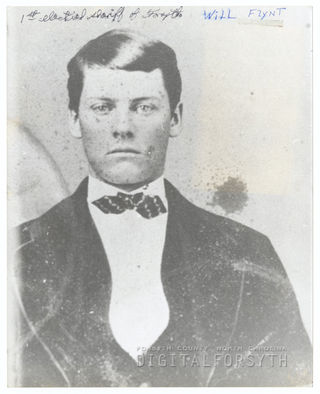
Sheriff will flynt Who's that strapping young fellow pictured to the left?  Why that's Forsyth County's first duly elected sheriff, one Will Flynt who served as sheriff from 1850-1854.  Is it just me or does he look like he's 12 in that picture?  More photos like that can be found at Digital Forsyth. (Picture courtesy of the Forsyth County Public Library Photograph Collection)

Digital Forsyth Group on Flickr

A little over a year ago I read about the Digital Forsyth group in the paper and was pleased to find some really interesting information on the site.  Today I discovered a Flickr group that Digital Forsyth has started that I hope will expand their portfolio of interesting Winston-Salem and Forsyth County images as local Flickr members contribute their own pics to the project.

Executive Compensation in Winston-Salem: Reynolds American

Today's episode of "Executive Compensation in Winston-Salem" focuses on the company that at one time employed both my parents when they were students at Wake Forest.  It's the company that pops to mind when people think of business in Winston-Salem.  Why yes, it's Reynolds American Inc., and I have to tell you that what the execs at Reynolds are paid makes the folks I've already profiled at WFUBMC and Novant look like they're in the minor leagues.

My source for this information is the most recent proxy statement posted on Reynolds' website.  If you've never looked at one of these you should check it out: they spend page after page explaining their rationale for executive compensation.  It's really kind of overwhelming.  The numbers listed for each executive are for 2007.

Susan Ivey, Chairman of the Board, CEO and President of Reynolds American Inc..  She was paid a salary of $1,190,350, granted stock awards of $3,114,421, received non-equity incentive plan compensation of $4,243,000, pension value and non-qualified deferred compensation earnings of $688,848 and all other compensation of $231,241.  Total: $9,467,860

Dianne Neal, Executive VP and CFO of Reynolds American Inc.  She was
paid a salary of $553,250, granted stock awards of $926,711,
received non-equity incentive plan compensation of $1,340,325, pension
value and non-qualified deferred compensation earnings of $120,231 and
all other compensation of $341,593.  Total: $3,282,110

Daniel Delen, President and CEO of RJR Tobacco.  He was
paid a salary of $760,000 and a bonus of  $125,000, granted stock awards of $1,743,949,
received non-equity incentive plan compensation of $658,000 and
all other compensation of $212,532.  Total: $3,499,481

Jeffrey Eckmann, RAI Group President.  He was
paid a salary of $629,250, granted stock awards of $985,602,
received non-equity incentive plan compensation of $1,401,325, pension
value and non-qualified deferred compensation earnings of $887,663 and
all other compensation of $269,821.  Total: $4,173,661

Tommy Payne, Executive VP – Public Affairs of Reynolds American Inc.  He was
paid a salary of $383,725, granted stock awards of $493,984,
received non-equity incentive plan compensation of $730,064, pension
value and non-qualified deferred compensation earnings of $43,139 and
all other compensation of $227,425.  Total: $1,878,337